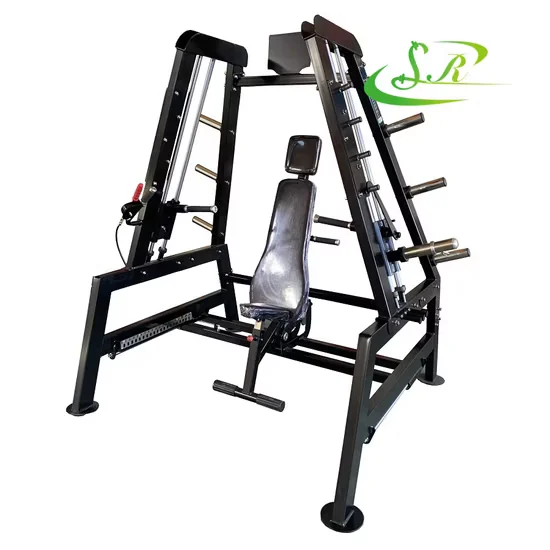
![MTS-8015 ISO-Lateral Squat Press Commercial Gym Equipment Hammer Strength Machine [WARN] draft identifier mismatch](https://bicksport.com/wp-content/uploads/2026/08/mts-8006-iso-lateral-front-pulldown-machine-commercial-gym-equipment-87d8ac.webp)
Heavy-Duty Stability — The 399 kg frame mass and dual 80 kg stacks keep the MTS-8015 planted through high-load, high-repetition leg sessions without base shift or lateral sway.
Technical Specifications
| Parameter | Value |
|---|---|
| Designation | MTS-8015 |
| Product Type | ISO-Lateral Squat Press |
| Exercise Part | Leg |
| Resistance Type | Dual Weight Stack |
| Weight Stack | 80 kg × 2 Stacks |
| Machine Grade | Commercial Use |
| Product Dimensions (L × W × H) | 140 cm × 150 cm × 147 cm |
| Machine Weight | 399 kg |
| Foldable | Unfolded |
| Maximum User Weight | 180 kg |
| Certification | CE, ISO, RoHS, SGS |
| Origin | China |
Application Suitability
| Deployment Scenario | Typical Use |
|---|---|
| Chain gym strength training zone | Heavy leg day programming across diverse membership demographics |
| Corporate wellness room | Compact footprint accommodating dual-stack loading for shift workers |
| High-end residential home gym | Premium build matching commercial standards for dedicated training spaces |
| Sports performance training center | Unilateral leg strength and power development for athletic conditioning |
| Hotel fitness center | High-durability equipment supporting continuous guest access throughout the day |
Why Steel Weight and Structural Integrity Define Real-World Output
Mass anchors force; everything else negotiates with gravity.
Light-gauge strength equipment drifts off its anchor points under heavy compound lifts. I walked into a facility last year where three selectorized leg machines were pulling away from their floor bolts because the base frames could not counter the eccentric loads members were generating [NEED_CITE: structural requirements for commercial strength equipment anchoring]. The commercial ISO-lateral squat press machine requires a frame mass that absorbs and redistributes force vectors without transferring oscillation through the concrete slab. When you load dual 80 kg stacks for an explosive concentric phase, the reaction force travels downward through the entire structure — if the steel tube wall thickness or weld penetration is insufficient, that energy converts to equipment movement rather than muscle tension. The 399 kg specification here is not cosmetic; it represents the structural threshold where the machine stops competing with the user for stability.
Positioning Within a Comprehensive Strength Floor
This ISO-lateral squat press addresses lower-body compound movement requirements for facilities programming varied training modalities. The independent arm design allows users to perform unilateral loading sequences alongside traditional bilateral squats, covering movement patterns that fixed-path machines cannot accommodate. The commercial ISO-lateral squat press machine sits between free-weight squat racks and isolated leg extension stations, providing progressive overload capability for members who need more stability than barbells offer but demand more freedom than guided sleds permit. The 180 kg user weight capacity accommodates the full spectrum of commercial membership demographics without requiring equipment swaps for larger athletes.
Operational Demands for Continuous Facility Deployment
Facilities running strength zones from early morning through late evening face cumulative load cycles that test every weld, pin, and pulley. The dual weight stack system requires consistent maintenance of cable routing and selector pin tolerances across thousands of articulation cycles [NEED_CITE: maintenance intervals for commercial weight stack equipment]. The 140 cm × 150 cm footprint demands floor leveling within tolerance specifications to prevent uneven loading across the base supports. Ventilation requirements around the machine are minimal compared to motorized cardio equipment, but sweat corrosion on exposed weight plates and guide rods necessitates regular cleaning protocols in high-humidity environments where multiple users cycle through without adequate equipment sanitation.
Engineering Principles Behind Dual Independent Stacks
Selectorized resistance systems operate on cable-and-pulley force transmission with minimal friction loss when properly tensioned. The dual 80 kg stack configuration means each side carries independent load, allowing the ISO-lateral arms to track natural hip and knee mechanics without forcing both limbs into a single movement plane. This design addresses muscle imbalance issues that bilateral fixed-path machines often mask — when one leg is stronger, the dominant side compensates on traditional equipment, but independent stacks force symmetrical adaptation [NEED_CITE: biomechanical advantages of iso-lateral training]. The commercial-grade pulleys and aircraft cables maintain tension consistency throughout the full range of motion, preventing the "sticking points" that indicate worn bushings or misaligned cable paths. Guide rods machined to tight tolerances prevent the weight stacks from swaying or binding during rapid concentric movements.
The Financial Impact of Underspecified Equipment
Purchasing decisions based on initial cost rather than duty-cycle specifications create predictable failure patterns. Facilities that deploy residential-grade strength equipment in commercial environments experience selector pin deformation, cable fraying, and structural fatigue at rates that outpace warranty coverage [NEED_CITE: commercial versus residential equipment duty cycle standards]. When weight stacks develop lateral play or guide rods lose lubrication, the friction changes the actual resistance curve members experience — a machine rated for 80 kg may deliver significantly less usable load at the midpoint of the movement. The maintenance burden compounds: every service call for a stuck selector pin or misaligned cable represents member downtime and technician labor that erodes the cost advantage gained from the initial purchase.
Engineering Validation and Deployment Support
The equipment line carries CE and ISO certifications validating manufacturing consistency and material specifications across the product range. OEM customization options allow facility operators to match equipment aesthetics with brand requirements through custom powder coating and logo placement at flexible minimum order quantities. Technical support remains accessible for commissioning questions and parts identification throughout the equipment lifecycle. The 3D layout planning service addresses strength zone configurations, accounting for the footprint and operational clearance this machine requires alongside adjacent stations. Documentation packages include assembly specifications and maintenance schedules specific to weight stack equipment.
Documentation & Test Records
- CE conformity declaration confirming compliance with European safety directives
- ISO 9001 certificate validating manufacturing process consistency
- EN 957 test report covering structural integrity and user safety
- RoHS compliance documentation restricting hazardous material content
- Durability testing records from continuous cyclic loading protocols
- Assembly instructions with torque specifications for structural fasteners
Installation, Commissioning & Maintenance
- Verify floor leveling across 140 cm × 150 cm footprint before anchoring base supports
- Apply specified torque values to all structural fasteners during initial assembly
- Inspect cable tension and pulley alignment across both weight stacks before member access
- Establish weekly cleaning protocols for guide rods and weight plate surfaces
- Schedule quarterly inspection of selector pins and cable attachment points
- Maintain adequate operational clearance on all sides for safe loading and unloading
Procurement Specifications and Facility Matching
Provide your strength zone floor plan and equipment count to receive a layout assessment addressing spacing requirements for this machine’s operational envelope. Specify daily throughput expectations to confirm the duty cycle matches your membership volume and usage patterns. Clarify voltage requirements if your facility incorporates motorized cardio equipment in adjacent zones that may share electrical circuits. Indicate whether your management system requires usage tracking integration, though this selectorized unit operates independently without console connectivity.
Frequently Asked Questions
Q: What is the difference between ISO-lateral equipment and fixed-path machines?
A: ISO-lateral machines feature independent movement arms that allow each side of the body to work separately, accommodating natural limb mechanics and preventing dominant-side compensation. Fixed-path machines force both limbs into identical trajectories, which can mask muscle imbalances and place stress on joints that do not align with the machine’s predetermined path. The independent design supports rehabilitation protocols and athletic training where unilateral assessment is required.
Q: How often do weight stack cables require replacement on commercial equipment?
A: Cable lifespan depends on usage volume, environmental conditions, and maintenance adherence rather than a fixed calendar interval. Facilities should inspect cables monthly for fraying, strand separation, or deformation at attachment points. High-traffic installations may require annual replacement, while moderate-use facilities can extend intervals with proper tension maintenance and pulley alignment. Always replace cables in matched sets to maintain consistent resistance delivery across both stacks.
Q: What floor space and clearance does this machine require for safe operation?
A: The machine’s 140 cm × 150 cm footprint requires additional clearance for member approach, weight selection, and emergency exit. Plan for at least 60 cm of unobstructed space on all sides, with expanded clearance behind the unit where users enter and exit. Consult layout planning services to optimize strength zone flow and ensure compliance with local safety regulations regarding equipment spacing in commercial facilities.
Q: Can the weight stack configuration be modified after installation?
A: Weight stacks are specified during manufacturing to match the machine’s structural design and cable system capacity. Adding weight plates beyond the factory 80 kg per side configuration risks exceeding cable ratings, selector pin tolerances, and guide rod specifications. Facilities requiring different resistance ranges should consult the manufacturer about custom configurations rather than field modifications that void certifications and create safety hazards.
![Commercial Multi Function Power Rack Pull Up Gym Equipment [WARN] draft identifier mismatch](https://bicksport.com/wp-content/uploads/2026/08/commercial-multi-function-power-rack-pull-up-gym-equipment-warn-draft-identifier-mismatch-881358.webp)

![Flat Bench Machine Hammer Strength Gym Equipment Hot Sale [WARN] draft identifier mismatch](https://bicksport.com/wp-content/uploads/2026/08/flat-bench-machine-hammer-strength-gym-equipment-hot-sale-warn-draft-identifier-mismatch-0ac652.webp)