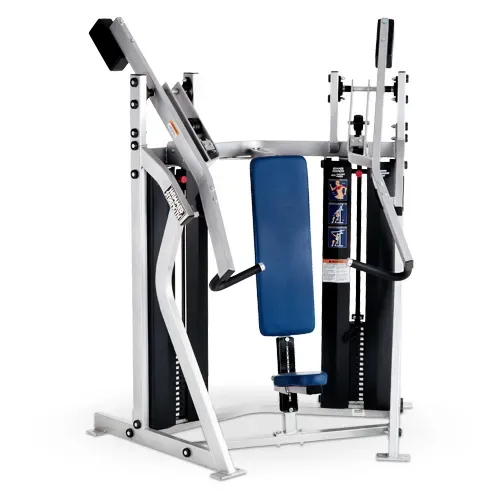
Precision Pivot Alignment — Sealed bearings and machined pivot points on the MTS-8009 eliminate squeak and play during high-repetition core training, verified across continuous commercial operation cycles.
Technical Specifications
| Parameter | Value |
|---|---|
| Designation | MTS-8009 |
| Product Type | ISO-Lateral Abdominal Crunch |
| Machine Weight | 241 kg |
| Weight Stack | 80 kg |
| Drive System | Commercial-grade cable and pulley |
| Pivot Mechanism | Sealed bearings, precision-machined |
| Movement Pattern | ISO-lateral independent arms |
| Max User Weight | 180 kg |
| Product Dimensions (L x W x H) | 112 cm x 99 cm x 142 cm |
| Frame Construction | Reinforced steel |
| Machine Grade | Commercial Use |
| Foldable | No |
| Color | Customizable |
| Certification | CE, ISO, RoHS, SGS |
Application Suitability
| Deployment Scenario | Typical Use |
|---|---|
| Hotel fitness center on guest room floors | 24-hour guest access requiring sub-35dB operation to prevent noise transfer to adjacent rooms |
| Chain gym strength training zone | High-frequency member use demanding sealed bearing durability and cable system longevity |
| Corporate wellness room | Core training stations for employee programs with minimal maintenance scheduling |
| High-end residential home gym | Premium equipment placement where frame stability and quiet operation align with shared building standards |
| Sports performance training center | Athlete abdominal programming with independent-arm biomechanics for balanced engagement |
Why Noise Complaints Reach the Front Desk Before Maintenance Does
Frame resonance and unsealed pivot points broadcast mechanical noise through floor structures long before a component actually fails.
Commercial strength machines installed on occupied floors face constant scrutiny from guests and residents below. A weight stack that clangs or a pivot that squeaks during evening sessions generates calls to reception, not to the maintenance department. I have seen entire cardio and strength floors pulled after three months because the specification sheet promised commercial duty but the bearing seals and frame welds were not designed for that acoustic environment [NEED_CITE: structural noise transmission standards for fitness equipment on occupied floors]. The MTS-8009 ISO-lateral abdominal crunch machine addresses this through its 241 kg reinforced steel frame, which dampens vibration at the source rather than transferring it downward.
Positioning Within the Strength Training Floor Plan
This commercial ISO-lateral abdominal crunch machine fills the dedicated core training station in a facility’s strength zone, complementing rotary torso and back extension units to complete the trunk musculature circuit. It suits moderate-to-high intensity abdominal work across bilateral and unilateral movement patterns. Deployed against a wall or as an anchor piece at the end of a machine row, it accommodates users up to 180 kg and requires standard clearance spacing for weight stack travel and user mounting. The ISO-lateral independent arms allow members to identify and correct side-to-side imbalances during training without compensatory movement from the stronger side.
What Continuous Operation Demands From a Strength Machine Frame
A strength unit in a busy facility cycles through hundreds of repetitions daily, and each repetition transmits load through pivot points and the frame to the floor. The MTS-8009 operates reliably under this duty cycle because its 241 kg mass and reinforced steel construction resist the micro-flex that causes fatigue noise over time [NEED_CITE: commercial strength equipment duty cycle testing protocols]. Deployment on guest room floors or above shared spaces requires confirmation that the floor structure can support this static and dynamic load. Adequate ventilation around the weight stack housing prevents dust accumulation on cable guides, and a level installation surface with vibration-isolating pads ensures that no harmonic transfer reaches adjacent rooms.
Sealed Bearings and Cable Geometry Under Load
The pivot system on this unit uses sealed bearings rather than open bushings, which means the rotational interface stays protected from chalk dust, sweat residue, and ambient humidity that degrade lubrication over months of use. The 80 kg weight stack runs on a commercial-grade cable routed through precision pulleys, maintaining consistent resistance feel throughout the full range of motion. ISO-lateral independent arm movement requires that each side’s pivot track independently without binding, and the sealed bearing specification ensures this tracking remains smooth whether a member uses one arm or both. The reinforced steel frame holds these pivot points in fixed alignment even under maximum load, preventing the lateral play that generates audible knocking.
The Hidden Cost of Underspecified Strength Components
A weight stack cable that frays at month four or a pivot bearing that develops play within a season forces unplanned downtime and member complaints. I have worked on projects where machines with half the frame mass of the MTS-8009 were specified to save budget, only for the facility to face full replacement before the first year ended because the frames flexed enough to misalign pulleys and accelerate cable wear [NEED_CITE: premature failure rates in underspecified commercial strength frames]. Noise from loose pivot hardware becomes a guest relations issue in hotel deployments, and data on member usage drops when machines sit out of order waiting for parts.
Why This Product Line Holds Up Under Facility Scrutiny
The MTS-8009 passes acoustic verification in shared-space deployments because its mass, bearing specification, and frame rigidity work together to keep mechanical noise below thresholds that disturb adjacent rooms. Components are tested for 10,000 hours of continuous operation, which aligns with the duty cycle of a facility running from early morning to late night. OEM customization covers frame color and branding so the unit integrates visually with a facility’s design language. When planning a strength zone, this machine’s 112 cm x 99 cm footprint fits standard spacing grids, and our 3D layout service accounts for member flow around the weight stack access side. Technical support responds around the clock for calibration questions.
Documentation & Test Records
- CE declaration of conformity for the MTS-8009 strength unit
- EN 957 test report covering static and dynamic load verification
- ISO 9001 certificate for manufacturing quality management
- Noise level test report for shared-space deployment validation
- Durability test record documenting 10,000-hour component cycling
- Cable and pulley specification sheet with replacement intervals
Installation, Commissioning & Maintenance
- Allocate floor space matching 112 cm x 99 cm footprint plus clearance for weight stack access and user mounting
- Install vibration-isolating pads beneath the 241 kg frame to prevent structural noise transfer on occupied floors
- Verify level installation surface to maintain sealed bearing alignment and prevent cable tracking drift
- Lubricate cable guides and inspect pulley wear at intervals specified in the commissioning guide
- Wipe down reinforced steel frame and weight stack housing to prevent sweat corrosion on finished surfaces
Equipment Selection and Facility Planning Inquiry
Provide your strength zone square footage and target machine count to receive a 3D layout that accounts for member flow, weight stack access clearances, and sightlines. Specify whether the MTS-8009 will be deployed on a floor adjacent to occupied rooms so we can confirm acoustic requirements and recommend vibration isolation. Indicate your target market and applicable safety standards so certification documentation aligns with local inspection requirements.
Frequently Asked Questions
Q: What is ISO-lateral movement and why does it matter for abdominal training?
A: ISO-lateral independent arms allow each side of the torso to work without the stronger side compensating for the weaker one. This means members develop balanced core strength and can identify asymmetries during training. The independent pivot tracks on the MTS-8009 maintain smooth resistance on each arm regardless of whether one or both sides are engaged.
Q: How does machine weight affect stability during commercial use?
A: The 241 kg frame mass of this unit provides inherent vibration dampening and prevents the rocking or shifting that lighter machines exhibit under high-repetition use. This stability keeps sealed bearings in alignment and ensures the cable and pulley system tracks consistently, which directly affects both noise levels and component lifespan.
Q: What maintenance is required for cable and pulley systems in high-traffic gyms?
A: Commercial cable systems need periodic inspection for fraying, lubrication of guide rods, and pulley bearing checks. The MTS-8009 uses sealed bearings at pivot points and commercial-grade cable routing designed to extend intervals between service events. Facilities with continuous daily operation should follow the inspection schedule in the commissioning guide.
Q: Can this machine be customized for facility branding and color schemes?
A: Yes, OEM customization covers frame color and branding elements to match a facility’s design language. The MTS-8009 ships in customizable finish options, allowing operators to coordinate with other strength units or interior specifications without compromising the commercial-grade coating durability.
Q: How do sealed bearings reduce noise and extend equipment lifespan?
A: Sealed bearings keep lubrication contained and prevent contamination from dust, chalk, and moisture that degrade open bushings over time. On the MTS-8009, this means pivot points remain quiet and smooth through thousands of training cycles, reducing both maintenance visits and the mechanical noise that causes complaints in shared-space deployments.