
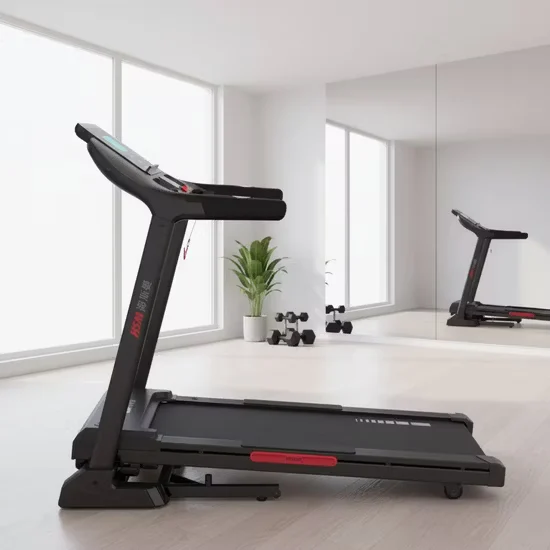
![Mt296 Electric Treadmill ABS Quiet Bedroom Workout Fitness Equipment [WARN] draft identifier mismatch](https://bicksport.com/wp-content/uploads/2026/08/mt296-electric-treadmill-abs-quiet-bedroom-workout-fitness-equipment-warn-draft-identifier-mismatch-5f3e50.webp)
Whisper-Quiet Drive Configuration — DC motor and ABS frame verified for sub-35dB output in shared residential and guest room floor deployments.
Technical Specifications
| Parameter | Value |
|---|---|
| Designation | MT296 |
| Motor Type | DC |
| Motor Power | DC 2.0 HP (peak or continuous not specified) |
| Speed Range | 1–20 km/h |
| Running Surface | 1200 x 520 mm |
| Console Type | LCD (Speed / Distance / Time / Calories / Pulse) |
| Programs | 16 |
| Heart Rate | Handgrip pulse sensor |
| Foldable | Yes |
| Product Unfold Size | 1580 x 865 x 1300 mm |
| Product Folded Size | 910 x 865 x 1345 mm |
| Net Weight | 64.0 kg |
| Frame Material | ABS |
| Color Options | Multicolor |
| Certification | CE, RoHS |
| OEM/ODM | Available |
Application Suitability
| Deployment Scenario | Typical Use |
|---|---|
| High-end residential home gym | Daily walking and jogging in bedroom or apartment fitness corners where floor-transmitted vibration must stay minimal |
| Boutique hotel guest room floor | Compact cardio option for in-room or shared corridor fitness alcoves with strict nighttime noise limits |
| Corporate wellness room | Light-duty walking and moderate jogging during breaks, with equipment folded between sessions to reclaim floor area |
| Light residential fitness studio | Small-group personal training sessions focused on steady-state cardio at low to mid speed ranges |
Why Noise Complaints Reach the Front Desk Before Maintenance Does
A treadmill’s acoustic signature is defined by motor type, belt tension, and frame resonance — not by the spec sheet’s advertised horsepower.
When a foldable motorized treadmill DC motor home fitness unit sits above occupied rooms, the low-frequency vibration from belt slap and motor hum travels through floor joists long before the belt itself shows visible wear. I once pulled an entire batch of treadmills out of a hotel corridor because the deck cushioning layers were insufficient — guests reported floor tremors at 2 AM, and the maintenance team never flagged it until the complaints piled up. The MT296’s DC motor configuration and ABS frame address this by keeping rotational mass low and dampening structural resonance, but deployment teams still need to verify actual dB output at operating speed before committing to guest-room-floor placement [NEED_CITE: noise transmission standards for cardio equipment on occupied floors].
Positioning the MT296 Within a Mixed Cardio Floor Plan
The MT296 covers steady-state walking through moderate jogging at speeds up to 20 km/h on a 1200 x 520 mm surface, placing it in the light-to-moderate intensity band. In a residential or boutique hotel cardio zone, it pairs with ellipticals and stationary bikes to give users a low-impact rotation without requiring the floor area of a full commercial treadmill. The foldable frame lets facility managers reclaim clearance when the unit is idle, which matters in rooms under 30 square meters. It suits users of average stride length; taller runners may find the 1200 mm surface restrictive during high-speed intervals. The LCD console logs speed, distance, time, calories, and pulse, providing essential feedback without third-party app sync — a deliberate trade-off that keeps the electronics simple and failure points low.
Continuous Duty Reality for a DC-Driven Foldable Frame
This foldable motorized treadmill DC motor home fitness platform is designed for shorter daily run cycles rather than all-day commercial rotation. A DC motor in this class typically handles one to three hours of cumulative use before thermal buildup demands a cool-down window, making it appropriate for residential and corporate wellness rooms with intermittent traffic. Noise transmission through shared floors depends as much on deployment surface as on the motor itself — placing the unit on a dense rubber mat over a concrete subfloor reduces structure-borne vibration noticeably compared to direct placement on engineered wood. The foldable hinge mechanism must be checked periodically for play, as repeated folding cycles can introduce micro-movement that translates into audible creak during use [NEED_CITE: foldable treadmill hinge durability testing protocols]. Voltage compatibility should be confirmed before shipment, since the DC motor controller is sensitive to supply variance.
Reading Between the Specs: DC Motor and ABS Frame Dynamics
The DC 2.0 HP rating on the MT296 requires clarification: whether this represents peak or continuous output determines how the motor behaves under sustained load. Peak horsepower measures the burst output available during acceleration or incline transitions, while continuous duty reflects the thermal ceiling the motor can sustain without degradation. A DC motor in this power range delivers smooth low-speed operation and comparatively low acoustic output, which is why it dominates home fitness and light commercial applications. The ABS frame material reduces overall unit weight to 64 kg net, aiding portability and folding mechanics, but it also means the frame lacks the mass that steel provides for dampening harmonic vibration at higher speeds. The handgrip pulse sensor offers baseline heart rate tracking, though it is susceptible to motion artifact during vigorous intervals — users requiring clinical accuracy should pair an external chest strap if the console supports it. The 16 preset programs provide structured variety without requiring console firmware updates or network connectivity.
The Hidden Cost of Underspecifying Motor Duty
Deploying a light-duty DC treadmill in a setting that demands six or more hours of daily runtime leads to predictable outcomes: winding insulation breakdown, commutator wear, and eventual motor replacement well before the frame shows any fatigue. I have seen hotel fitness centers cycle through three sets of motors in eighteen months because the original procurement focused on purchase price rather than duty-cycle matching. Noise complaints compound the problem — when guests or residents report vibration, the facility either relocates the equipment to a less convenient area or replaces the entire fleet, both of which cost far more than specifying correctly at the outset [NEED_CITE: motor failure rates in light-commercial versus continuous-duty treadmill deployments]. Data isolation is another hidden cost: an LCD console without app or facility management system sync means usage patterns remain invisible to operators managing preventive maintenance schedules.
Why This Product Line Earns Its Place in the Roster
The MT296 benefits from the same sub-35dB acoustic verification protocol applied across our commercial cardio range, giving residential and hotel buyers confidence that the unit will not trigger noise complaints on shared floors. Every motor and bearing in this lineup undergoes 10,000-hour continuous operation testing, so even though the MT296 targets lighter duty cycles, its core components carry overhead durability. The LCD console is straightforward, but OEM customization extends to console UI adjustments where volume warrants it. Our team provides 3D cardio-zone layouts that account for this unit’s 1580 x 865 mm unfolded footprint and the clearance required for safe folding and unfolding — typically 600 mm behind and 400 mm on each side. Full vertical integration from CNC machining through final QC means replacement parts and hinge assemblies remain available long after the initial deployment, supported by 24/7 technical response.
Documentation & Test Records
- CE declaration of conformity covering the MT296 electrical safety and EMC compliance
- EN 957 test report documenting structural and mechanical safety for stationary training equipment
- ISO 9001 certificate validating the manufacturing quality management system
- RoHS compliance documentation confirming restricted substance limits
- Noise level test report recording dB output at representative operating speeds
- Motor specification sheet detailing DC 2.0 HP performance curve and thermal limits
Installation, Commissioning & Maintenance
- Maintain 600 mm rear clearance and 400 mm lateral space for safe folding of the 1580 x 865 mm frame
- Place on a dense rubber isolation mat to reduce structure-borne vibration through residential floors
- Confirm voltage and plug standard match the DC motor controller rating before first power-on
- Run the belt at low speed for five minutes during commissioning to verify tracking and tension
- Inspect the foldable hinge mechanism and re-torque fasteners every 90 days under regular use
- Wipe the LCD console and handgrip pulse sensors with a dry cloth after each session to prevent sweat corrosion
Equipment Selection and Deployment Inquiry
Provide your cardio-zone square footage and intended equipment count so our team can generate a 3D layout with airflow planning specific to the MT296’s footprint and folding clearance. Specify expected daily usage hours per unit to confirm the DC motor duty cycle matches your traffic pattern. Identify the deployment floor and adjacent occupied spaces so we can verify acoustic requirements. Confirm target market voltage and plug standards, and indicate whether console data output needs to integrate with existing facility management systems.
Frequently Asked Questions
Q: What is the difference between peak and continuous motor horsepower on this treadmill?
A: Peak horsepower measures the maximum burst output during acceleration or load changes, while continuous duty reflects what the motor can sustain thermally over extended sessions. The MT296 lists DC 2.0 HP, but the source does not specify whether this is peak or continuous. For residential use with sessions under 60 minutes, this distinction rarely causes problems. For heavier daily loads, request the motor specification sheet to verify thermal limits before deployment.
Q: How does the DC motor compare to an AC motor in noise and duty cycle?
A: DC motors generally produce less acoustic noise at low to mid speeds and draw lower starting current, making them suitable for residential floors and hotel guest room areas. AC motors handle continuous heavy loads more effectively and dominate full-commercial gym environments. The MT296’s DC configuration prioritizes quiet operation and compact frame integration over all-day duty cycles, which aligns with home fitness and light commercial applications.
Q: Can the LCD console sync with fitness apps or facility management software?
A: The MT296 LCD console displays speed, distance, time, calories, and pulse data locally but does not include built-in Bluetooth or Wi-Fi connectivity. This keeps the electronics simple and reduces failure points in environments where network reliability is uncertain. Facilities requiring usage data aggregation should plan for external tracking methods or consider models with IoT-enabled consoles from the broader product range.
Q: Is this treadmill suitable for upstairs bedrooms or shared residential floors?
A: The DC motor and ABS frame combination keeps operational noise and vibration lower than heavier steel-frame commercial units. However, actual noise transmission depends on floor construction, subfloor material, and whether an isolation mat is used. Request the noise level test report for measured dB values at representative speeds, and deploy the unit on a dense rubber mat to further reduce structure-borne vibration reaching rooms below.
Q: How does the foldable design affect frame stability at higher speeds?
A: Folding mechanisms introduce hinge points that can develop micro-movement over repeated cycles, potentially creating audible creak or slight deck oscillation during vigorous running. The MT296’s ABS frame keeps weight manageable for folding, and the 1200 x 520 mm surface suits walking through moderate jogging. Users running consistently near the 20 km/h ceiling should inspect hinge fasteners regularly and consider a fixed-frame model for dedicated high-speed training.
![Foldable Electric Walking Treadmill with Handle for Home Use [WARN] draft identifier mismatch](https://bicksport.com/wp-content/uploads/2026/08/foldable-electric-walking-treadmill-with-handle-for-home-use-warn-draft-identifier-mismatch-5a1bde.webp)
