
![Mt296 Electric Running Machine Treadmill for Home Use Commercial [WARN] draft identifier mismatch](https://bicksport.com/wp-content/uploads/2026/08/mt296-electric-running-machine-treadmill-for-home-use-commercial-warn-draft-identifier-mismatch-9cd95c.webp)
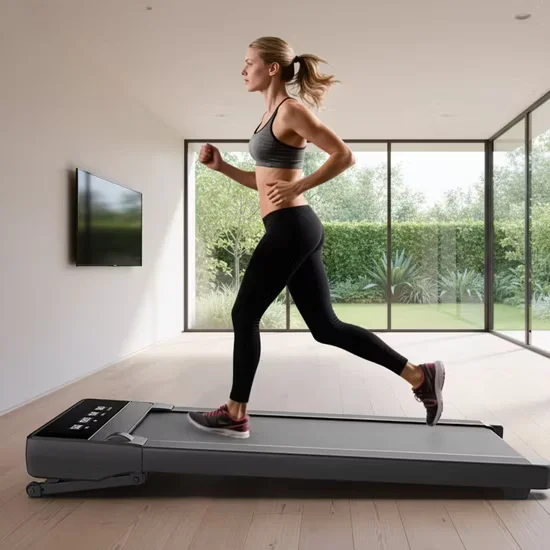
Space-Efficient Drive — The MT296 foldable treadmill pairs a DC 2.0HP motor with a compact folding frame for residential fitness corners and light-duty training areas.
Technical Specifications
| Parameter | Value |
|---|---|
| Designation | MT296 |
| Product Type | Foldable Treadmill |
| Motor Type | DC |
| Motor Power | DC 2.0HP ¹ |
| Speed Range | 1–20 km/h |
| Running Surface | 1200 x 520 mm |
| Console Type | LCD (Speed / Distance / Time / Calories / Pulse) |
| Programs | 16 preset programs |
| Heart Rate | Pulse sensors |
| Foldable | Yes |
| Product Unfold Size | 1580 x 865 x 1300 mm |
| Product Folded Size | 910 x 865 x 1345 mm |
| Net Weight | 64.0 kg |
| Material | ABS |
| Certification | CE, RoHS |
¹ Peak or continuous duty rating not specified in source documentation — confirm with manufacturer before procurement.
Application Suitability
| Deployment Scenario | Typical Use |
|---|---|
| High-end residential home gym | Daily walking and jogging in private apartments with foldaway storage between sessions |
| Private apartment fitness corner | Space-constrained environments where the unit folds vertically when not in use |
| Light-duty personal training area | Short-duration supervised sessions with limited daily run-time demands |
| Corporate wellness room | Employee fitness spaces with moderate traffic and standard operating hours |
What Peak Horsepower Hides About Continuous Duty in a Foldable Motorized Treadmill DC Motor Home Use Setup
A 2.0HP DC motor rating means nothing until you know whether it sustains that output continuously or only in short bursts.
When residential fitness equipment gets pushed beyond its intended daily session window, the motor thermal profile shifts faster than most buyers anticipate. I once watched a batch of home-grade treadmills fail within three months inside a hotel corridor because nobody asked whether the horsepower rating was peak or continuous [NEED_CITE: motor duty cycle classification for continuous commercial operation]. The DC motor inside the MT296 is sized for shorter, intermittent sessions typical of apartment gyms and private training corners — not eight-hour daily throughput. Understanding this boundary before deployment prevents the kind of thermal cutoff failures that generate noise complaints and equipment returns.
Where the MT296 Fits in a Residential Cardio Layout
This foldable treadmill covers steady-state walking through moderate-intensity jogging at speeds up to 20 km/h, occupying the endurance-training slot in a home fitness setup. It complements strength stations and free-weight areas by providing a dedicated cardiovascular option that folds away when floor space is needed for other activities. The 1200 x 520 mm running surface accommodates average stride lengths comfortably, though taller users with extended gaits should verify comfort during longer sessions. The LCD console tracks speed, distance, time, calories, and pulse — delivering the essential feedback loop for self-directed foldable motorized treadmill DC motor home use sessions without app-dependent complexity.
Thermal Envelope and Deployment Environment for DC Motor Platforms
The DC motor in this unit generates heat proportional to session duration and user load, making daily run-time expectations a critical procurement variable. In residential settings above or beside occupied rooms, motor noise and vibration transmission through floor structures become practical concerns that spec sheets rarely quantify in context [NEED_CITE: acoustic transmission standards for residential fitness equipment placement]. Adequate ventilation around the motor housing — particularly when the unit is positioned against walls in tight apartment corners — prevents thermal buildup during repeated sessions. Standard household voltage supplies this treadmill, but confirming local plug type and circuit capacity before shipment avoids commissioning delays. A level floor surface with an anti-vibration mat underneath the unit reduces both transmitted noise and frame stress on the folding hinge mechanism over time.
Reading the Drive Train and Console Specifications
The distinction between peak and continuous horsepower defines how long a DC motor can sustain output before thermal protection engages — peak ratings reflect momentary capacity, while continuous ratings reflect sustainable thermal equilibrium under load. The MT296’s DC 2.0HP rating requires verification on which standard applies, because a peak-rated motor deployed for extended sessions will cycle through thermal cutoffs prematurely. The LCD console outputs speed, distance, time, calorie estimates, and pulse readings through handlebar sensors, which provide adequate trending data for general fitness tracking but are inherently less stable than chest-strap telemetry during high-movement running. The 16 preset programs allow users to vary intensity without manual speed adjustments, though these programs operate independently without connectivity to third-party fitness apps or facility management platforms. The 1200 x 520 mm running surface width provides lateral stability for walking and jogging, while the ABS deck material and frame construction determine how effectively impact forces are absorbed before reaching the user’s joints — a factor that becomes more noticeable as session duration increases. The foldable hinge mechanism introduces a structural joint that must maintain rigidity through thousands of articulation cycles without developing play or audible creaking during use.
The Hidden Cost of Underspecifying Motor Duty Cycles
Deploying peak-rated DC motors in environments where users exceed light daily usage leads to thermal fatigue and premature winding degradation — failures that surface as intermittent shutdowns before total motor burnout. Noise output from an undersized motor under strain transmits through residential floor structures, generating complaints from adjacent rooms that escalate into equipment removal demands. Insufficient deck cushioning on a rigid ABS platform causes joint discomfort during sessions exceeding thirty minutes, contributing to user avoidance and underutilized equipment [NEED_CITE: deck cushioning material fatigue under repetitive loading cycles]. When LCD consoles lack connectivity options, usage data remains trapped on the device with no pathway to track member engagement or schedule preventive maintenance based on actual run-time accumulation.
Why the HSM Cardio Line Addresses These Failure Points
Sub-35dB operational noise verified across hotel deployments means the acoustic engineering principles applied to our commercial range inform how we approach motor selection and frame damping even in foldable platforms. Every unit in our cardio family undergoes 10,000-hour durability testing on motors, frames, and bearings — data available for review before procurement decisions. The MT296’s compact folded footprint of 910 x 865 x 1345 mm integrates into 3D cardio-zone layouts that account for clearance, sightlines, and airflow around each station. Full OEM and ODM customization covers console UI, color, and specification adjustments to match deployment requirements. Our engineering team provides free layout planning that factors in the MT296’s specific unfolding clearance and adjacent equipment spacing to prevent congestion. Technical support remains available around the clock for commissioning questions and spare parts sourcing long after installation.
Documentation & Test Records
- CE declaration of conformity covering electrical safety and EMC requirements for this treadmill model
- EN 957 test report validating structural and mechanical safety under rated load conditions
- ISO 9001 certificate demonstrating quality management across the manufacturing process
- RoHS compliance documentation confirming restriction of hazardous substances in all components
- Motor specification sheet detailing thermal characteristics and duty-cycle parameters
- Console technical documentation with LCD display parameters and preset program descriptions
Installation, Commissioning & Maintenance
- Allow minimum clearance around the MT296’s 1580 x 865 x 1300 mm unfolded footprint for safe user entry and exit
- Place anti-vibration pads beneath the frame to reduce transmitted noise through residential floor structures
- Confirm dedicated circuit capacity matches the DC 2.0HP motor draw before first power-on
- Verify folding hinge tension and locking mechanism engagement after initial assembly and periodically thereafter
- Inspect running belt alignment and tension on the 1200 x 520 mm surface at quarterly intervals
- Wipe LCD console and pulse sensor grips after each use to prevent sweat corrosion on contact surfaces
Planning Your Cardio Equipment Inquiry
Provide the available floor area and intended equipment count so our team can generate a 3D layout incorporating the MT296’s folding clearance and operational spacing. Specify expected daily session duration and user volume to confirm whether the DC motor duty cycle aligns with your deployment intensity. Indicate the floor level and adjacent room occupancy to assess acoustic requirements for the installation site. State your target market voltage and plug standard to ensure correct electrical configuration before shipment.
Frequently Asked Questions
Q: What is the difference between continuous duty and peak horsepower in DC treadmill motors?
A: Peak horsepower reflects the maximum output a motor can produce momentarily, such as during startup or sudden load spikes. Continuous duty horsepower represents the sustained output the motor can maintain without thermal shutdown. For residential treadmills, understanding which rating applies determines whether the unit handles your expected daily session length without overheating or premature component degradation.
Q: How does a foldable treadmill frame affect long-term structural rigidity?
A: The folding hinge introduces a mechanical joint that must withstand repeated articulation and running loads without developing looseness. Over time, hinge wear can manifest as frame vibration or audible creaking during use. Verifying hinge durability testing records and load-bearing specifications helps predict long-term stability, particularly when multiple users deploy and fold the unit daily.
Q: Can the LCD console on this model sync with third-party fitness apps?
A: The MT296 LCD console displays speed, distance, time, calories, and pulse readings locally without Bluetooth or wireless connectivity options. This design suits users who prefer standalone tracking without app dependency. If data export or facility management integration is required, confirm available console upgrades or alternative models with connectivity features before finalizing your equipment selection.
Q: What running surface dimensions suit users with longer stride lengths?
A: The MT296 provides a 1200 x 520 mm running surface, which accommodates walking and moderate jogging for average-height users comfortably. Taller individuals with longer natural strides may find the length restrictive during faster running speeds. Testing the surface at intended training intensities before bulk procurement helps confirm whether the dimensions match your user population’s biomechanical requirements.
Q: How does DC motor noise compare to AC motors in shared residential spaces?
A: DC motors typically produce less audible noise at lower speeds compared to AC counterparts, making them suitable for apartment environments and upstairs rooms. However, noise output increases significantly when a DC motor operates near or beyond its thermal design limit. Matching motor capacity to expected session duration prevents the strain-induced noise that triggers complaints from neighboring spaces [NEED_CITE: comparative acoustic profiles of DC versus AC motors in residential treadmill applications].
![Wear-Resistant Mt296 ABS Electric Treadmill for Warm-up and Gym Use [WARN] draft identifier mismatch](https://bicksport.com/wp-content/uploads/2026/08/wear-resistant-mt296-abs-electric-treadmill-for-warm-up-and-gym-use-warn-draft-identifier-mismatch-7e7732.webp)

![HSM MT166 Home Use Motorized Treadmill with Hydraulic Cylinder for Home Gym [WARN] draft identifier mismatch](https://bicksport.com/wp-content/uploads/2026/08/hsm-mt166-home-use-motorized-treadmill-with-hydraulic-cylinder-for-home-gym-warn-draft-identifier-mismatch-a9ca5a.webp)