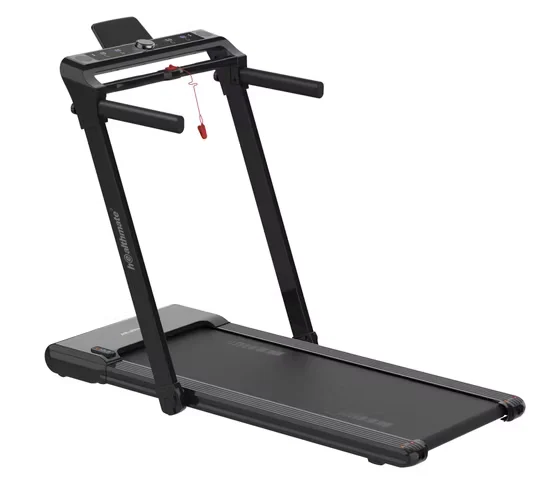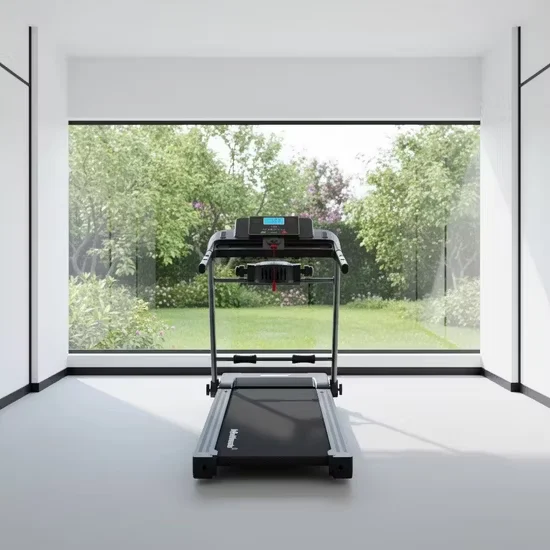
Acoustic-Optimized Home Deployment — DC motor platform engineered for shared-wall residential spaces where noise transfer and floor footprint dictate equipment selection.
Technical Specifications
| Parameter | Value |
|---|---|
| Designation | MT026M |
| Product Type | Foldable Treadmill |
| Motor Type | DC |
| Motor Power | 1.5HP* |
| Speed Range | 1–12 km/h |
| Running Surface | 1200 x 460 mm |
| Console Type | LCD (Speed / Distance / Time / Calories / Pulse) |
| Programs | 12 preset programs |
| Heart Rate | Handgrip pulse sensors |
| Foldable | Yes |
| Product Unfold Size | 1465 x 750 x 1150 mm |
| Product Folded Size | 1465 x 750 x 390 mm |
| Net Weight | 46.0 kg |
| Material | ABS |
| Certification | CE, RoHS |
| OEM/ODM Custom | Yes |
* Peak or continuous duty rating not specified in source — verify against manufacturer motor specification sheet before deployment planning.
Application Suitability
| Deployment Scenario | Typical Use |
|---|---|
| High-end residential home gym | Daily walking and jogging in apartments where foldability and low noise are primary constraints |
| Corporate wellness room | Compact cardio station for employee use during breaks, stowed when room serves other functions |
| Community fitness center with limited floor area | Light-duty cardio option in multi-use spaces requiring stowable equipment between sessions |
| Boutique studio recovery zone | Low-intensity warm-up or cool-down station positioned beside treatment or stretching areas |
What Peak Horsepower Hides About Continuous Duty in a foldable home treadmill motorized 1.5HP
Motor labels tell you the peak, not what the unit actually sustains hour after hour.
When a residential operator or apartment dweller selects a treadmill based solely on advertised horsepower, the continuous duty rating often remains buried in the motor specification sheet — or missing entirely. A DC motor rated at peak output can handle short bursts, but daily sessions pushing past thirty minutes generate heat accumulation that light-duty windings cannot dissipate. I have walked into community fitness rooms where under-rated motors failed within months because the equipment was asked to run far beyond its intended duty cycle [NEED_CITE: motor duty cycle classification for continuous residential operation]. The foldable home treadmill motorized 1.5HP platform on the MT026M requires buyers to confirm whether that rating reflects sustained output before committing to deployment in any setting where multiple users share the unit across a single day.
Where the MT026M Fits Within a Compact Cardio Zone
This unit covers walking through moderate jogging intensities, filling the steady-state cardio slot in a home or small wellness room where floor space is contested. The 1200 x 460 mm running surface accommodates users who walk or jog at controlled paces, while the foldable frame lets the room serve other functions between sessions. In a mixed cardio layout, it pairs with a stationary bike or compact elliptical to offer upper-and-lower-body variety without demanding a dedicated room. The LCD console and handgrip pulse sensors serve individual users tracking basic session metrics, and the foldable home treadmill motorized 1.5HP profile suits residential spaces where ceiling height and wall clearance limit standing equipment placement.
Daily Run-Time, Noise Transfer, and Electrical Alignment
Deployment above occupied rooms or beside shared walls demands attention to how vibration and motor noise propagate through floor slabs and partition framing. The DC motor in this unit operates at lower acoustic output than comparable AC platforms, but actual decibel levels at running speed must be confirmed through a noise level test report before installing on upper residential floors [NEED_CITE: noise propagation standards for cardio equipment in multi-story residential buildings]. Heat dissipation in a folded-against-wall position differs from freestanding placement, so ventilation clearance behind the unit matters when it is stored. Voltage and plug standards vary across export markets, and discovering a mismatch after the container arrives causes weeks of downtime — confirm the target market electrical specification during the order scoping phase. Floor leveling and a vibration-damping mat beneath the running deck reduce structure-borne noise transfer to rooms below.
Reading the Drive and Control Specifications
The DC motor platform delivers smoother low-speed operation than an AC equivalent, which matters for users who begin sessions at walking pace before progressing to a jog. Continuous versus peak horsepower remains the critical distinction: peak rating indicates the maximum output the motor can produce momentarily, while continuous duty reflects what it sustains under thermal equilibrium during extended operation. The LCD console displays speed, distance, time, calories, and pulse data through handgrip sensors — a reliable baseline for individual tracking, though handgrip readings can drift when palm moisture or grip pressure varies during the session. The 12 preset programs introduce interval and tempo variation without requiring manual speed adjustments mid-run. ABS deck components form the running surface structure, and verifying the cushioning layer specification determines whether joint loading remains acceptable for repeat daily users [NEED_CITE: deck cushioning material standards for impact attenuation on residential treadmills]. The foldable hinge mechanism concentrates stress at the pivot point, so frame rigidity under repeated folding cycles warrants review in the durability test record.
The Cost of Overlooking Specification Gaps
Residential operators who skip the motor specification sheet often discover the gap between peak and continuous output only after the thermal cutoff trips mid-session or the winding insulation degrades from repeated overheating. Noise complaints in apartment buildings escalate quickly when treadmill vibration transfers through floor joists to the unit below, sometimes forcing a complete equipment swap rather than a simple repositioning. A running surface that lacks adequate cushioning generates joint discomfort that discourages repeat use, turning a capital investment into a clothesline. Console data that cannot export to external apps leaves usage patterns invisible, preventing operators from understanding whether the equipment justifies its floor space. Voltage mismatches discovered at the destination port delay deployment by weeks and incur re-certification costs that erode the original purchase margin [NEED_CITE: electrical compliance rework costs for imported fitness equipment].
Why This Product Line Addresses Those Gaps
The MT026M enters a product family where sub-35dB whisper-quiet operation has been verified across hotel deployments, establishing an acoustic benchmark that informs how this foldable unit is positioned for noise-sensitive residential spaces. Motors across the range undergo 10,000-hour durability testing, and requesting the test record for this specific model confirms whether the DC platform meets the same continuous-use standard. The six-series cardio family means a facility sourcing this treadmill can add a bike or elliptical from the same production line, simplifying spare parts and maintenance training. OEM customization extends to console UI and color, allowing residential integrators to match interior finishes. The 3D cardio-zone layout service covers square footage, sightlines, and member flow — for a single-unit home deployment, this translates to confirming wall clearance and folded storage footprint against the actual room dimensions. Technical support responds around the clock, which matters when a residential user encounters a console error on a Sunday morning.
Documentation & Test Records
- CE declaration of conformity covering the MT026M electrical and mechanical safety requirements
- EN 957 test report validating structural and performance standards for this treadmill class
- ISO 9001 certificate confirming quality management across the manufacturing process
- RoHS compliance documentation for restricted substance limits in electronic components
- Motor specification sheet detailing continuous versus peak duty rating for the DC platform
- Noise level test record at operating speeds relevant to residential deployment scenarios
Installation, Commissioning & Maintenance
- Maintain minimum clearance behind and beside the 1465 x 750 mm footprint for ventilation and fold-down access
- Place a vibration-damping mat beneath the deck to reduce structure-borne noise transfer on upper floors
- Confirm voltage and plug type match the target market circuit before connecting the DC motor to power
- Run the belt at low speed for initial alignment check and verify LCD console sensor response across all 12 programs
- Inspect belt tension and deck lubrication at intervals specified in the commissioning guide for ABS deck surfaces
- Wipe handgrip pulse sensors after each session to prevent sweat residue from degrading heart rate reading accuracy
Planning Your Equipment Selection
Provide the room dimensions and intended equipment count so the 3D layout confirms whether the MT026M fits the allocated zone with adequate clearance for folding and user circulation. Specify expected daily run-time per unit to validate the motor duty cycle against actual usage patterns. Identify the deployment floor and adjacent occupied spaces to determine whether additional vibration isolation is required. Confirm the destination market voltage and plug standard during the inquiry stage. Indicate whether console data needs to interface with any external fitness tracking platform.
Frequently Asked Questions
Q: What is the difference between continuous duty and peak horsepower, and why does it matter for daily treadmill use?
A: Peak horsepower measures the maximum output a motor can produce for a brief moment, while continuous duty reflects what it sustains under thermal equilibrium during extended sessions. A motor rated only at peak may overheat when asked to run thirty minutes or longer at steady load. Requesting the motor specification sheet clarifies whether the rating supports your expected daily usage pattern without premature winding degradation or thermal cutoff events.
Q: How does a DC motor compare to an AC motor in terms of noise and suitable duty cycles?
A: DC motors generally deliver quieter low-speed operation and smoother acceleration, making them common in residential and light-commercial treadmills. AC motors sustain higher continuous loads and suit heavy-use commercial environments where the unit runs many hours daily. The choice depends on expected session length and daily user count — a setting with multiple users per day may need an AC platform rated for higher duty cycles.
Q: Can the LCD console data sync with external fitness apps or facility management software?
A: The LCD console on this model displays speed, distance, time, calories, and pulse data locally through handgrip sensors. Review the console technical documentation to determine whether data export or app sync capability is available. If integration with external platforms is required for your deployment, specify this during the inquiry phase so the appropriate console configuration can be scoped.
Q: What noise level should I expect, and is this model suitable for deployment above occupied rooms?
A: Actual decibel output varies with running speed, user weight, and floor construction. Obtain the noise level test report to verify performance at the speeds your users will operate most frequently. For upper-floor residential installations, pairing the unit with a vibration-damping mat and confirming structural floor composition helps determine whether noise transfer to rooms below remains within acceptable limits.
Q: How does the foldable mechanism affect frame rigidity and long-term durability under repeated use?
A: A folding hinge introduces a stress concentration point that a fixed frame does not carry. Repeated fold-and-unfold cycles can loosen fasteners and shift alignment if the pivot hardware is not engineered for the expected cycle count. Review the durability test record for fold-cycle data and inspect hinge hardware during routine maintenance intervals to catch wear before it affects running belt tracking or structural stability.
![Motorized Treadmill Healthmate Durable Commercial for Hotel Fitness [WARN] draft identifier mismatch](https://bicksport.com/wp-content/uploads/2026/08/motorized-treadmill-healthmate-durable-commercial-for-hotel-fitness-warn-draft-identifier-mismatch-1bf133.webp)
![W08 Electric Folding Treadmill for Cardiopulmonary Training Home Use [WARN] draft identifier mismatch](https://bicksport.com/wp-content/uploads/2026/08/w08-electric-folding-treadmill-for-cardiopulmonary-training-home-use-warn-draft-identifier-mismatch-cfef96.webp)