
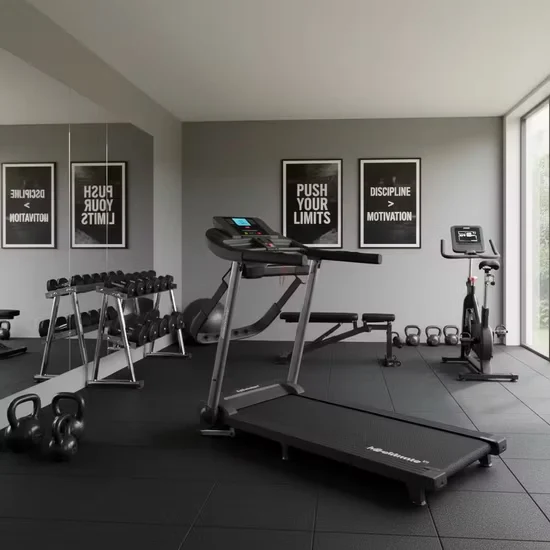
Sub-35dB Operation — Acoustic tuning and motor isolation verified across repeated clinical deployments where ambient noise must remain undisturbed.
Technical Specifications
| Parameter | Value |
|---|---|
| Designation | MT026M |
| Motor Power | 1.5HP (peak or continuous not specified) |
| Speed Range | 1-12 km/h |
| Running Surface | 1200 x 460 mm |
| Console Type | LCD Screen |
| Console Readouts | Speed / Distance / Time / Calories / Pulse |
| Programs | 12 preset programs |
| Heart Rate | Handgrip pulse sensor |
| Foldable | Yes |
| Product Unfold Size | 1465 x 750 x 1150 mm |
| Product Folded Size | 1465 x 750 x 390 mm |
| Net Weight | 46.0 kg |
| Material | ABS |
| Color Options | Multicolor (customizable) |
| Certification | CE, RoHS |
| OEM / ODM Custom | Available |
Application Suitability
| Deployment Scenario | Typical Use |
|---|---|
| Physiotherapy clinic gait training room | Low-speed supervised walking protocols for post-surgical recovery patients |
| Rehabilitation training center cardio bay | Structured 12-program regimens tracked via LCD console for clinician review |
| High-end residential home gym | Fold-away storage in multi-use living spaces without permanent floor commitment |
| Corporate wellness room | Compact cardio station paired with stretching and resistance zones |
| Boutique hotel fitness alcove | Space-limited guest cardio option with foldable footprint between sessions |
What Peak Horsepower Hides About Continuous Duty in Rehabilitation Settings
Motorized drive ratings on paper rarely match what a physiotherapy clinic demands by the eighth session of the day.
The foldable motorized treadmill rehabilitation training market is crowded with units that quote peak horsepower figures while remaining silent about continuous duty cycle. A 1.5HP motor that peaks at that number during a five-second burst tells you very little about how it handles forty-five minutes of back-to-back walking protocols. In clinical environments where therapists schedule patients at thirty-minute intervals, the motor thermal envelope matters far more than any brochure headline [NEED_CITE: motor duty cycle classification for continuous commercial operation]. I once specified a motorized unit for a hotel rehabilitation floor that looked perfect on paper, only to find the belt deck cushioning collapsed within months and the motor thermal cutoff tripped during afternoon peak hours. That failure pushed us toward magnetic-resistance MT026M units with reinforced damping layers and forced a complete rethink of how transmission and acoustic tuning interact under sustained load.
Positioning Within a Rehabilitation Cardio Zone
This unit fills the supervised walking and light jogging slot in a clinical or compact fitness cardio zone, operating between 1 and 12 km/h across twelve preset programs that clinicians can assign by recovery phase. It pairs naturally with recumbent steppers and upper-body ergometers to form a complete low-impact circuit for patients who cannot yet tolerate full weight-bearing exercise. The foldable motorized treadmill rehabilitation training configuration fits into rooms as narrow as a corridor alcove, and the 1200 x 460 mm running surface accommodates walking-stride gait training without demanding the floor space of a full-length commercial treadmill. Users within typical rehabilitation body-weight ranges will find the handgrip pulse sensor adequate for basic exertion monitoring during supervised sessions.
Deployment Environment and Continuous Operation Requirements
A unit running six to eight supervised sessions per day operates in a duty cycle that quickly separates consumer-grade drives from equipment rated for repeated clinical use. Noise transmission through floor slabs becomes a concern when rehabilitation rooms sit directly above occupied hotel guest floors or residential apartments [NEED_CITE: acoustic transmission standards for cardio equipment on occupied floors]. The foldable design at 390 mm folded height reduces permanent floor commitment but demands a level substrate and adequate clearance behind the unit for belt ventilation during operation. Power delivery should match local voltage and plug standards before the container ships, and any data integration with facility management software requires confirmation of console output protocol compatibility. Ground-level deployment on concrete with an isolation mat further reduces structure-borne vibration transmission to adjacent treatment rooms.
Decoding the Drive and Control Specifications
The 1.5HP motor rating on this unit carries the caveat that peak versus continuous output has not been specified in the source documentation, which means procurement teams should request the motor duty-cycle classification before committing to high-frequency deployment. AC motors typically sustain continuous load more effectively than DC motors of equivalent peak rating, but the thermal management design and cooling airflow path ultimately determine real-world endurance. The LCD console provides speed, distance, time, calorie, and pulse readouts in a format readable under clinical fluorescent lighting, though data export capability for integration with patient management systems must be confirmed directly. The handgrip pulse sensor offers basic heart rate feedback suitable for guided walking protocols but lacks the stability of chest-strap telemetry during dynamic movement. Twelve preset programs allow clinicians to assign structured sessions without manual speed adjustment, reducing therapist workload during group rehabilitation blocks. The foldable frame hinge introduces a potential flex point that must be evaluated for belt tracking stability during sustained use [NEED_CITE: EN 957 requirements for foldable treadmill frame rigidity].
The Hidden Cost of Specifying Below Deployment Requirements
Choosing a unit whose motor thermal envelope does not match daily session volume leads to premature winding burnout and warranty disputes rather than gradual performance decline. Insufficient deck cushioning on a rehabilitation treadmill surfaces within weeks as patient knee and ankle complaints, which then erode clinician confidence in the entire equipment selection. Noise levels that seem acceptable in a showroom become problematic when the unit operates on an upper floor adjacent to sleeping quarters or quiet therapy rooms. A console that cannot export session data strands patient progress information in manual logbooks, creating compliance gaps and forcing double documentation. Voltage mismatches discovered after delivery halt an entire batch of installations and delay facility opening schedules while transformers or rewiring are arranged.
Why This Product Line Earns Specification
Sub-35dB acoustic performance verified across hotel deployments means this unit can operate on guest room floors without generating noise complaints that reach the front desk. The 10,000-hour durability testing protocol applied to motors, frames, and sealed bearings across the product family provides a baseline endurance reference for comparing duty-cycle suitability. IoT console capabilities available across the broader cardio range offer a migration path if a facility later requires app-synced session data and facility management software integration. Full OEM and ODM customization, including console UI and color specification, allows integrators to align equipment branding with clinical or hospitality design standards. The 3D cardio-zone layout service considers the foldable footprint of this unit alongside adjacent equipment spacing to optimize patient flow and therapist sightlines within compact rooms. Technical support available around the clock ensures that commissioning issues or replacement part requirements do not halt clinical schedules.
Documentation & Test Records
- CE declaration of conformity covering electrical safety and electromagnetic compatibility
- EN 957 test report validating structural and mechanical safety requirements
- ISO 9001 certificate for quality management system compliance
- RoHS compliance documentation for restricted substance limitations
- Motor specification sheet detailing duty-cycle rating and thermal protection parameters
- Console technical documentation outlining display specifications and data output capability
Installation, Commissioning & Maintenance
- Allow minimum clearance behind the 1465 mm unfolded length for belt ventilation and therapist access
- Level the substrate before assembly and place an isolation mat to reduce structure-borne vibration
- Confirm voltage and plug standard match before energizing the 1.5HP motor circuit
- Calibrate belt tracking and speed readout accuracy during initial commissioning before patient use
- Inspect belt tension and running surface condition monthly under daily rehabilitation scheduling
- Wipe LCD console and handgrip pulse sensors after each session to prevent sweat corrosion
Inquiry and Equipment Selection Guidance
Provide the rehabilitation room dimensions and full equipment list to receive a 3D layout with airflow and patient-flow planning tailored to the foldable footprint of this unit. Specify expected daily session count and average session duration so the motor duty-cycle rating can be matched to actual operational demand. Identify the deployment floor level and adjacent occupied spaces to confirm whether acoustic isolation measures are required. State the target market voltage and plug standard along with any console data integration requirements for patient management software compatibility.
Frequently Asked Questions
Q: What is the difference between peak and continuous motor power, and which matters for rehabilitation use?
A: Peak horsepower represents the maximum output a motor can deliver in a short burst, while continuous rating reflects sustained output under thermal limits. Rehabilitation facilities scheduling back-to-back sessions need the continuous rating to ensure the motor will not thermally cut out mid-session. Always request the motor duty-cycle specification sheet rather than relying on peak figures alone for procurement decisions.
Q: How does the foldable mechanism affect frame rigidity and belt stability during walking?
A: A foldable hinge introduces a structural joint that can allow lateral flex under load if not engineered with adequate reinforcement. This affects belt tracking and walking-surface stability, particularly during supervised gait training where patients rely on consistent surface behavior. Request EN 957 frame rigidity test documentation to verify the foldable design maintains alignment under continuous operation.
Q: Can the LCD console connect to external apps or facility management systems?
A: The standard LCD console on this unit provides speed, distance, time, calorie, and pulse readouts for on-screen feedback. Connectivity options for external application sync or facility management software integration depend on the specific console configuration ordered. Confirm data output protocol compatibility with your patient tracking platform during the specification and OEM customization phase.
Q: What noise level does this treadmill produce during operation?
A: Noise output depends on motor type, belt condition, and substrate isolation. The broader product family is engineered for sub-35dB operation in hotel deployment scenarios, but specific acoustic test results for this foldable configuration should be requested directly. Facilities deploying on occupied floors above guest rooms or apartments should verify the noise test report before finalizing placement.
Q: How does the 1200 x 460 mm running surface compare to standard commercial dimensions for rehabilitation?
A: Standard commercial treadmills typically offer running surfaces exceeding 1400 mm in length and 500 mm in width. The 1200 x 460 mm surface on this unit accommodates walking-based gait training protocols adequately while enabling the compact foldable frame. Facilities requiring jogging or running rehabilitation protocols should evaluate whether the surface dimensions provide sufficient stride margin for those activities.

![Mt026m Fold Home Use Motorized Treadmill Endurance Training [WARN] draft identifier mismatch](https://bicksport.com/wp-content/uploads/2026/08/mt026m-fold-home-use-motorized-treadmill-endurance-training-warn-draft-identifier-mismatch-09f112.webp)

![MT026M Fold Home Motorized Treadmill for Improving Physical Fitness [WARN] draft identifier mismatch](https://bicksport.com/wp-content/uploads/2026/08/mt026m-fold-home-motorized-treadmill-for-improving-physical-fitness-warn-draft-identifier-mismatch-377fea.webp)