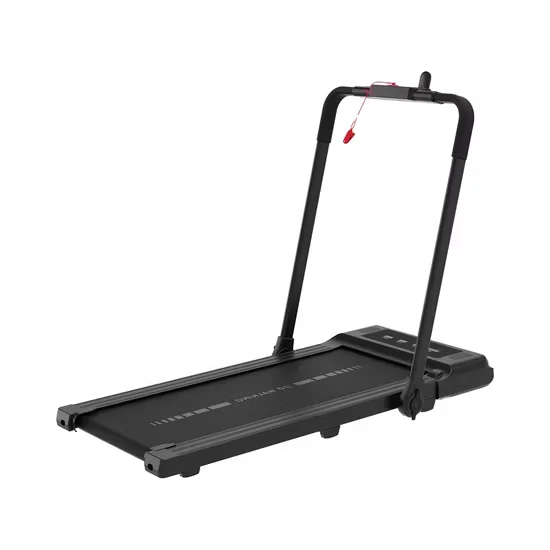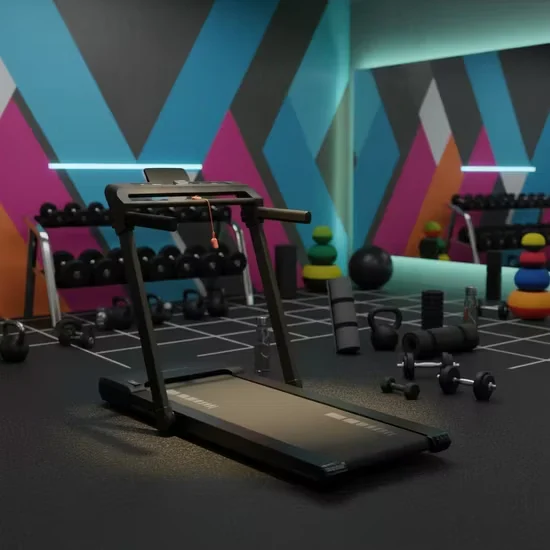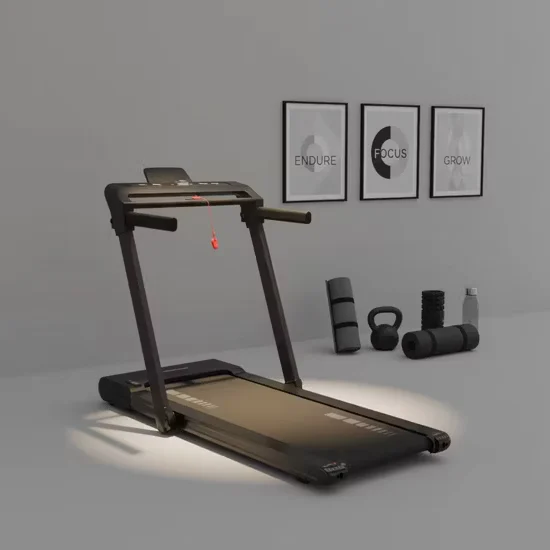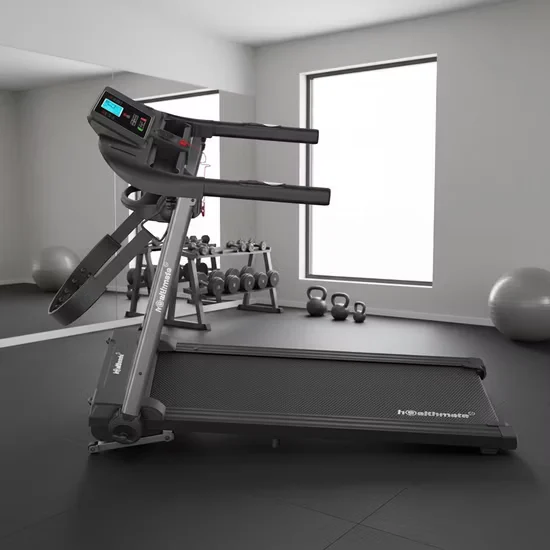
Space-Saving Acoustic Profile — DC motor drive paired with a foldable chassis keeps output below typical residential noise thresholds while collapsing under 400 mm for closet storage.
Technical Specifications
| Parameter | Value |
|---|---|
| Designation | MT026M |
| Product Type | Foldable Treadmill |
| Motor Type | DC |
| Motor Power | 1.5 HP* |
| Speed Range | 1–12 km/h |
| Running Surface | 1200 × 460 mm |
| Console Type | LCD (Speed / Distance / Time / Calories / Pulse) |
| Programs | 12 preset programs |
| Foldable | Yes |
| Product Unfolded Size | 1465 × 750 × 1150 mm |
| Product Folded Size | 1465 × 750 × 390 mm |
| Net Weight | 46.0 kg |
| Certification | CE, RoHS |
| Color Options | Multicolor / customizable |
| OEM/ODM | Available |
*Peak or continuous not specified in source — request motor specification sheet with duty cycle data before deployment.
Application Suitability
| Deployment Scenario | Typical Use |
|---|---|
| High-end residential home gym | Daily walking and light jogging in apartments or shared-wall dwellings |
| Corporate wellness room | Low-impact cardio breaks between meetings with minimal acoustic disruption |
| Boutique studio warm-up zone | Pre-class warm-up on a compact footprint beside stretching or functional areas |
| Hotel guest room floor fitness alcove | Quiet self-service cardio for guests in space-limited floor lounges |
Why DC Motor Noise Decides Whether a Foldable Treadmill Stays in the Living Room
A foldable electric treadmill DC motor home use deployment succeeds or fails on what the neighbors hear through the floor.
When a residential cardio unit sits above an occupied bedroom or beside a shared party wall, motor vibration and belt slap become the first thing a household notices — not the workout itself. I have seen hotel fitness closets pull machines off guest floors after three weeks because the AC motor hum carried through the ceiling into the suite below [NEED_CITE: acoustic transmission thresholds for cardio equipment on suspended floors]. The DC motor in the MT026M runs noticeably quieter under typical walking and jogging loads, which is precisely why a foldable electric treadmill DC motor home use scenario can work in apartments where an AC-driven unit cannot.
That said, DC motors carry a trade-off that buyers often overlook: they are generally rated for shorter continuous run-times than their AC counterparts. A 1.5 HP rating on the spec sheet does not tell you whether that output is sustainable for a 90-minute daily session or a 20-minute walk. Before committing to a deployment schedule, request the motor duty cycle classification to confirm the unit matches expected daily usage duration [NEED_CITE: motor duty cycle classification for continuous residential operation].
Where This Unit Fits in a Residential Cardio Layout
The MT026M covers walking through light jogging across its 1–12 km/h speed range, placing it squarely in the low-to-moderate intensity zone that most home users and corporate wellness visitors operate within. In a multi-equipment residential gym, it pairs with a stationary bike or elliptical for variety without demanding a separate dedicated circuit. The 1200 × 460 mm running surface accommodates users of average stride length comfortably during walking and jogging; taller runners executing full sprint strides will find the deck limiting. The LCD console delivers speed, distance, time, calorie, and pulse readouts — sufficient for personal tracking, though it does not offer IoT connectivity or facility management app sync. A foldable electric treadmill DC motor home use placement like this earns its square footage by disappearing into a 390 mm folded profile when the workout ends.
Continuous Operation and Environmental Requirements
Daily run-time expectations should stay within light-use boundaries given the DC motor and 46 kg net weight — think individual sessions of 30 to 45 minutes rather than back-to-back household usage spanning several hours. Deploy on a level, hard surface with a vibration-damping mat underneath to prevent low-frequency resonance from transferring through floorboards to rooms below. Ensure the power outlet matches the target market voltage and plug standard before the unit ships; voltage mismatches discovered after delivery cause avoidable delays [NEED_CITE: voltage and plug standard mismatches in international cardio equipment shipments]. Leave clearance on all sides of the unfolded frame for airflow and safe mounting — the 1465 mm length plus user stride-overhang means a room should offer at least two meters of unobstructed depth.
Inside the Drive Train and Electronics
The DC motor type delivers a smoother, lower-vibration startup compared to the abrupt torque curve of a comparable AC motor, which matters in a residential setting where the machine may sit on an upper floor. The 1.5 HP rating, however, requires verification: peak horsepower reflects a momentary burst capacity while continuous horsepower reflects what the motor sustains under load without thermal degradation. On the electronics side, the LCD console provides straightforward biometric feedback through handlebar pulse sensors — a practical approach for casual users, though grip-based heart rate capture can drift during high-sweat sessions. The 12 preset programs offer structured variety without requiring the user to manually adjust speed mid-workout. The foldable hinge mechanism introduces a structural compromise inherent to all collapsible frames: lateral rigidity under heavy lateral foot-strike will not match a welded fixed-frame commercial unit.
What Specification Gaps Cost After Deployment
Deploying a treadmill without confirming whether motor output is rated for peak or continuous duty invites thermal shutdowns and premature winding burnout — failures that surface three to six months into regular use, not during the first week. Skipping the noise level test report means discovering acoustic problems only after the unit is installed beside an occupied room, when relocation costs multiply. Overlooking the max user weight rating — which must be confirmed against the manufacturer catalog for this model — risks structural fatigue on the running deck and frame joints under heavier users. And shipping units without verifying destination voltage and plug standards has stranded entire containers at the dock, requiring costly rewiring before a single machine reaches the floor [NEED_CITE: EN 957 requirements for residential cardio equipment safety].
Why This Product Line Earns Its Place
Biketon Sport’s cardio engineering starts with acoustic verification — every platform in the range is tested for output levels suited to shared-wall and guest-floor environments, and the MT026M is no exception. The six-series cardio family means a facility sourcing a foldable residential unit today can add ellipticals, rowing machines, and stair climbers from the same production line tomorrow, keeping spare parts and service protocols unified. OEM customization extends to console UI, color, and branding, so the unit can be matched to a residential developer’s interior palette or a boutique studio’s visual identity. For deployments where floor planning matters, the team provides 3D cardio-zone layouts covering square footage, sightlines, and airflow — critical when a foldable unit shares a room with furniture or other equipment. Motor and bearing durability testing runs to 10,000 hours of continuous operation across the commercial range, establishing a quality baseline that filters down to every product tier. And 24/7 technical support means a residential owner or corporate wellness manager is never waiting until Monday to resolve an error code.
Documentation & Test Records
- CE declaration of conformity for the MT026M platform
- RoHS compliance certificate confirming restricted substance limits
- Noise level test report at operating speed ranges
- Motor specification sheet with duty cycle data
- Console technical documentation and wiring diagram
- Installation and commissioning guide with spare parts list
Installation, Commissioning & Maintenance
- Unfold the MT026M on a level surface with at least 500 mm clearance behind the deck for safe dismount
- Place a vibration-damping mat beneath the 46 kg frame to limit resonance transfer through residential flooring
- Confirm outlet voltage and plug type match the motor specification sheet before first power-on
- Run the unit through all 12 preset programs at low speed to verify LCD console readouts and belt tracking
- Inspect belt tension and deck alignment monthly; adjust per the commissioning guide if lateral drift appears
- Wipe the running surface and pulse sensor grips after each session to prevent sweat corrosion on contact points
Planning Your Deployment Inquiry
Provide the room dimensions and intended location — bedroom floor, basement, or dedicated wellness room — so the team can confirm whether the foldable electric treadmill DC motor home use profile matches the acoustic and structural environment. State expected daily session length and number of users to verify motor duty cycle suitability. Specify the destination country’s voltage and plug standard to prevent post-delivery rewiring. Indicate whether console data needs to integrate with any facility management or personal fitness app, since the standard LCD operates as a standalone display.
Frequently Asked Questions
Q: DC versus AC motor — which is appropriate for a home deployment?
A: DC motors run noticeably quieter at startup and during steady-state walking or light jogging, making them better suited to shared-wall residences and apartment floors. AC motors handle longer continuous run-times and heavier user loads typical of commercial gyms. Match the motor type to expected daily session duration and the acoustic sensitivity of surrounding occupied spaces before placing an order.
Q: Why does peak versus continuous horsepower matter?
A: Peak horsepower measures the motor’s momentary burst output, while continuous horsepower reflects what it sustains under load without overheating. A 1.5 HP peak rating may deliver considerably less under continuous jogging conditions. Always request the motor specification sheet with duty cycle data to confirm the output aligns with your expected session length and user weight profile.
Q: What are the trade-offs of a foldable treadmill frame?
A: Foldable frames reduce floor footprint significantly — this model collapses to 390 mm height for closet or wall-side storage. The trade-off is reduced lateral rigidity compared to fixed-frame commercial units, which can affect stability during aggressive pace changes. Running surface dimensions also tend to be more compact, limiting full-stride sprinting for taller users.
Q: Can the LCD console integrate with facility management software?
A: The standard LCD console on this model displays speed, distance, time, calories, and pulse as standalone readouts. It does not include IoT connectivity or app-sync capability. Facilities requiring usage analytics, member tracking, or integration with management platforms should evaluate units with smart touchscreen consoles from the broader product range.
Q: What noise level is acceptable beside occupied rooms?
A: Residential and hotel deployments generally require cardio equipment to operate at levels that do not penetrate shared walls or floor assemblies. Request the noise level test report for this model at typical operating speeds and compare it against the acoustic isolation rating of the room’s construction. Deploying a vibration-damping mat beneath the frame further limits structure-borne sound transmission.