
![Motorized Treadmill with Manual Incline and Transport Wheels for Home Use [WARN] draft identifier mismatch](https://bicksport.com/wp-content/uploads/2026/08/motorized-treadmill-with-manual-incline-and-transport-wheels-for-home-use-warn-draft-identifier-mismatch-e06b32.webp)
Quiet Residential Deployment — DC motor paired with foldable frame fits shared-wall apartments where noise and floor space dictate equipment choices.
Technical Specifications
| Parameter | Value |
|---|---|
| Designation | MT23B |
| Motor Type | DC |
| Motor Power | 1.5 HP (peak or continuous not specified in source) |
| Speed Range | 1–12 km/h |
| Running Surface | 1200 × 420 mm |
| Console Type | LCD (Speed / Distance / Time / Calories / Pulse) |
| Programs | 12 preset programs |
| Foldable | Yes |
| Transport Wheels | Yes |
| Product Dimensions | 1490 × 720 × 1100 mm (unfolded) |
| Net Weight | 37 kg |
| Certification | CE, RoHS |
| Color Options | Multicolor |
Application Suitability
| Deployment Scenario | Typical Use |
|---|---|
| Apartment fitness corner | Daily walking and light jogging in compact living spaces |
| High-end residential home gym | Personal cardio sessions with easy post-workout storage |
| Shared living fitness room | Low-impact steady-state workouts across multiple household users |
| Hotel guest floor ancillary space | Quiet treadmill sessions for guests who prefer in-room or suite cardio |
Why Foldable Treadmills Fail When Duty Cycle Exceeds the Spec
DC motors carry a strict runtime ceiling that most residential deployments ignore.
When a foldable motorized treadmill home use DC motor ends up in a shared residential fitness room or a small hotel floor corridor, it frequently runs far longer than its thermal design allows. I once watched a batch of home-grade DC motors burn out inside nine months because the hotel kept the cardio niche open around the clock. The motors had never been rated for that kind of continuous load, and the heat buildup inside a folded-down, poorly ventilated alcove accelerated the failure [NEED_CITE: motor duty cycle classification for continuous commercial operation]. Noise complaints followed within weeks, not from the belt itself but from bearing wear caused by thermal stress on internal components.
Where the MT23B Sits in a Residential Cardio Layout
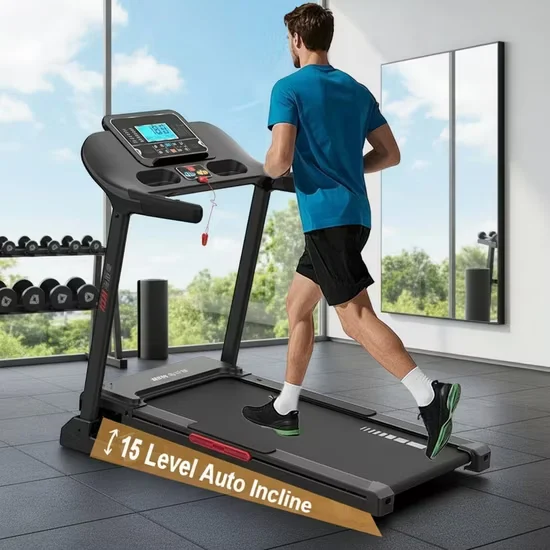
This foldable motorized treadmill home use DC motor unit covers steady-state walking through moderate jogging, occupying the low-to-mid intensity band in a residential cardio zone. It complements stationary bikes and ellipticals that handle higher-cadence or seated endurance work. The 1200 × 420 mm running surface accommodates walking and shorter-stride jogging, making it practical for users of average height in confined rooms. The foldable design and transport wheels allow operators to reposition the unit when the space serves other functions during the day. The LCD console captures speed, distance, time, calories, and pulse, providing the basic biometric feedback users expect from solo sessions without requiring external app pairing.
Continuous Runtime and Room-Level Constraints
A 1.5 HP DC motor carries a thermal envelope suited to single-user sessions rather than back-to-back rotation among multiple residents. Plan for cooldown intervals when more than one household member uses the unit per day. The compact footprint reduces floor coverage, but the surrounding clearance still matters: leave enough room behind the deck for safe dismounting and beside the frame for airflow. Rooms with carpet or foam underlay will dampen belt noise traveling to floors below [NEED_CITE: EN 957 requirements for residential cardio equipment deployment]. Verify the wall outlet voltage before first use, as DC motor controller boards are sensitive to supply irregularities that can trip thermal cutoffs mid-session.
Reading the Drive and Console Specs Without Overpromising
DC motors differ from AC counterparts in how they handle sustained load; an AC motor dissipates heat more effectively through its stator design, while a DC motor relies on shorter duty cycles to stay within safe temperature limits. The distinction between peak and continuous horsepower matters here — a peak rating describes momentary output during acceleration, not what the motor delivers across a forty-minute jog. The 1–12 km/h speed range positions this unit firmly in walking and light jogging territory rather than interval sprint training. The LCD console tracks five metrics in real time, and the pulse sensor on the handlebar offers convenience at the cost of some reading stability compared to chest-strap telemetry. Twelve preset programs provide structured session variety without requiring the user to manually adjust pace. The foldable frame reduces stored depth, which helps in apartments where the cardio corner doubles as a living area after the workout ends.
What Happens When a Compact Treadmill Outruns Its Design Brief
Deploying a residential-grade DC treadmill in a high-turnover environment leads to predictable failures. Motor winding insulation breaks down under heat cycles that exceed the original thermal budget, producing a burnt-electronics smell before the unit actually stops running. Transport wheels and folding hinges endure stress they were not engineered for when staff move the unit daily between storage and position. Without verified noise data, a treadmill placed above occupied rooms generates low-frequency vibration complaints that compound over weeks [NEED_CITE: structural vibration transmission from residential cardio equipment]. Console electronics left in direct sunlight near apartment windows suffer LCD degradation that makes the display unreadable within a year.
Why This Product Line Holds Up Under Scrutiny
Every unit on our assembly line runs through endurance testing far beyond what the residential category typically demands. For the MT23B, we validate the DC motor controller board under repeated thermal cycling to confirm it handles the session patterns actual home users produce. The foldable hinge mechanism undergoes repetitive stress checks so the locking pins remain secure across thousands of fold-unfold actions. Our engineering team reviews noise output at the running surface because shared-wall apartments need verified acoustic data, not marketing estimates. When you plan a home gym layout, we can provide spatial guidance that accounts for the fold-down clearance and transport wheel path so the unit actually fits the room you have allocated. Documentation from CE conformity through motor specification sheets ships with every order so your compliance file is complete on arrival.
Documentation & Test Records
- CE declaration of conformity covering the complete MT23B assembly
- EN 957 test report validating structural and safety requirements
- RoHS compliance certificate for restricted substance limits
- Motor specification sheet with duty cycle and thermal ratings
- Noise level test record for residential deployment assessment
- Console technical documentation with LCD parameter descriptions
Installation, Commissioning & Maintenance
- Leave minimum clearance behind the 1490 mm unfolded length for safe belt dismount
- Level the floor beneath the deck to prevent frame twist during jogging cycles
- Confirm wall outlet voltage matches the DC motor controller board input rating
- Run the belt at low speed for initial tension and tracking calibration before first use
- Inspect the folding hinge locking pins monthly for wear and re-torque as needed
- Wipe the LCD console surface with a dry cloth to prevent sweat corrosion on the panel
Equipment Selection Inquiry
Provide your available floor area and intended daily usage hours so we can confirm whether the DC motor duty cycle matches your household or facility rotation pattern. Specify the deployment floor and whether occupied rooms sit directly below to determine if additional vibration isolation is necessary. Confirm your local voltage and plug standard before shipment to avoid controller board incompatibility. State whether you need the LCD console data to integrate with any external tracking system so we can clarify interface availability up front.
Frequently Asked Questions
Q: What is the difference between peak and continuous motor horsepower?
A: Peak horsepower measures the motor’s maximum momentary output, typically reached during belt acceleration from a standstill. Continuous horsepower describes what the motor sustains across an extended running session without overheating. On this DC motor, the source lists 1.5 HP without specifying peak or continuous classification, so verify the duty cycle rating before committing to high-frequency or long-duration use patterns.
Q: How does a DC motor compare to AC for home treadmill use?
A: DC motors are lighter and well suited to foldable frames, but they generally carry shorter continuous runtime limits than AC motors of comparable output. For single-user home sessions lasting under an hour, a DC motor typically performs within its thermal design envelope. Facilities expecting back-to-back users should evaluate whether the duty cycle supports that rotation without forced cooldown intervals between sessions.
Q: What noise level should I expect in a shared residential setting?
A: Noise output depends on belt speed, user weight, and floor construction beneath the unit. While specific decibel data requires a site-specific test report, DC motors at walking and light jogging speeds produce less airborne noise than higher-output AC drives. Request a noise level test record from the manufacturer to confirm suitability if the treadmill will sit above occupied rooms or adjacent to shared walls.
Q: Can the LCD console data sync with external fitness apps or facility systems?
A: The LCD console displays speed, distance, time, calories, and pulse readings directly on the panel for the user. The current specification does not list Bluetooth, Wi-Fi, or wired data export capability. If integration with external apps or facility management software is required, confirm console interface options with the engineering team before finalizing your equipment order.
Q: How does deck cushioning affect joint impact during daily use?
A: Deck construction and cushioning layers between the belt and frame determine how much ground-reaction force reaches the user’s knees and ankles during repeated sessions. A firmer deck transmits more impact, which may suit users who prefer road-like feedback, while additional cushioning layers absorb more of each footstrike. Evaluate cushioning material and thickness against the typical session length your users will maintain.
![W08 Electric Folding Treadmill for Home Exercise and Cardiopulmonary Training [WARN] draft identifier mismatch](https://bicksport.com/wp-content/uploads/2026/08/w08-electric-folding-treadmill-for-home-exercise-and-cardiopulmonary-training-warn-draft-identifier-mismatch-6e4b8b.webp)

