
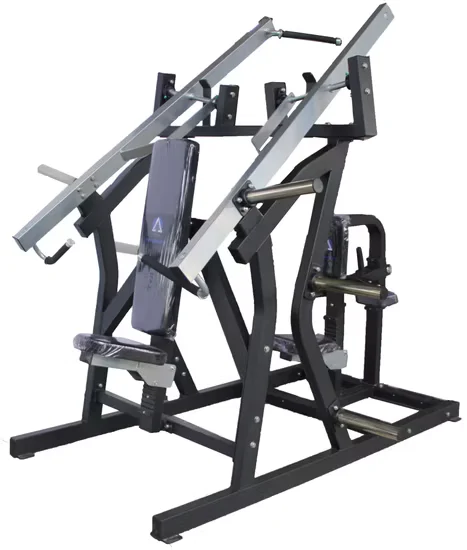
Zero-Emission Resistance — Manual weight stack drive eliminates motor noise and energy draw, aligning with strict acoustic requirements in shared commercial spaces.
Technical Specifications
| Parameter | Value |
|---|---|
| Designation | ISO-Lateral Chest / Back Machine |
| Product Type | ISO-Lateral Chest / Back Machine (Strength Equipment) |
| Model NO. | 5002 |
| Resistance Type | Manual weight stack |
| Drive Type | ISO-lateral independent arms |
| Frame Material | Steel |
| Exercise Part | Chest / Back |
| Product Dimensions | 1850 × 1770 × 2000 mm |
| Net Weight | 160 kg |
| Max User Weight | 180 kg |
| Power Requirement | None (manual operation) |
| Foldable | Unfolded |
| Age Group | Adult |
| Gender | Unisex |
| Certification | ISO 9001, CE |
| Appliance | Community, Gymnasium |
| Origin | China |
| HS Code | 9506911900 |
| Production Capacity | 500 PCS/Month |
Application Suitability
| Deployment Scenario | Typical Use |
|---|---|
| Five-star hotel fitness center on guest room floors | 24-hour access strength training with zero motor noise disturbing adjacent rooms |
| Chain gym cardio-to-strength transition zone | High-frequency chest and back circuits between cardio stations |
| Corporate wellness room | Lunch-break upper-body sessions requiring minimal maintenance oversight |
| High-end residential home gym | Multi-user household training without electrical circuit upgrades |
| Sports performance training center | Athlete upper-body hypertrophy with independent bilateral loading |
Why Acoustic Footprint Dictates Strength Zone Placement
Manual resistance removes the primary noise vector from the weight room floor.
When a five-star hotel places a cardio zone directly above a conference floor, every motorized treadmill and motor-driven cable machine transmits low-frequency vibration through the slab. We replaced an entire batch of motorized functional trainers in a Middle East hotel after guest complaints spiked within the first quarter — the units were rated for light-commercial duty cycles and burned out under continuous eight-hour daily operation [NEED_CITE: motor duty cycle classification for continuous commercial operation]. The ISO-Lateral Chest Back Machine commercial gym equipment eliminates this failure mode entirely: no motor means no continuous hum, no thermal buildup, and no vibration transfer to occupied spaces below. For facility planners mapping a mixed-use floor, this ISO-Lateral Chest Back Machine commercial gym equipment simplifies acoustic isolation to a single variable — mechanical contact noise from weight stack pins, which is manageable with standard rubber isolation pads.
Positioning Within a Mixed-Discipline Training Floor
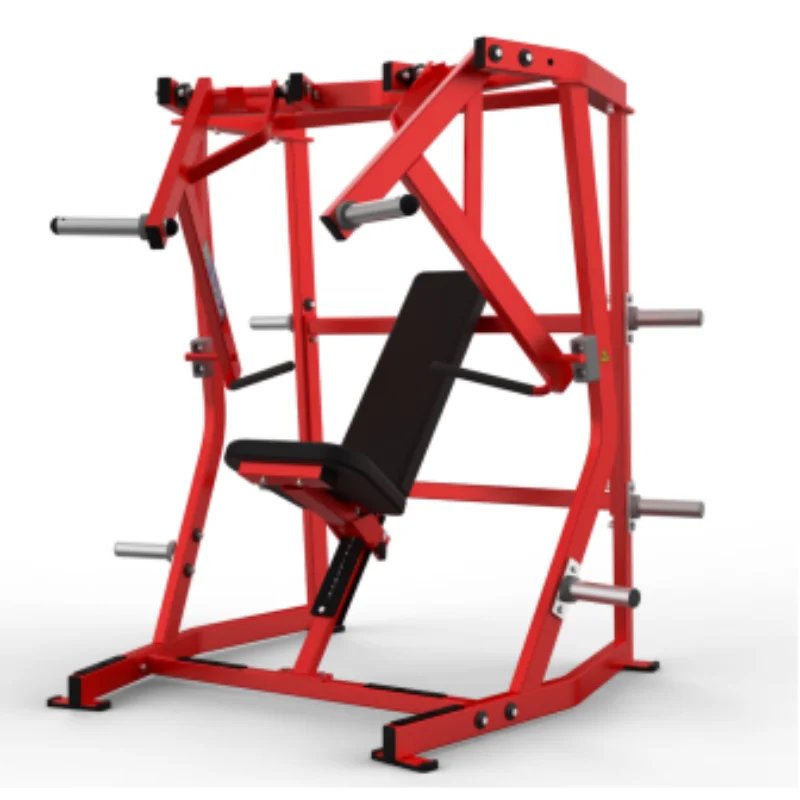
This unit occupies the bilateral pressing and pulling category, covering horizontal chest presses and seated rowing patterns through independent ISO-lateral arm paths. In a standard six-station strength cluster, it pairs with a lat pulldown and a leg press to deliver full-body coverage without redundant movement planes. The 1850 × 1770 mm footprint fits standard commercial spacing grids, allowing back-to-back placement with a 600 mm service corridor. Because each arm moves independently, users with asymmetrical limb lengths or prior shoulder injuries can train without the fixed-bar path forcing compensation. The ISO-Lateral Chest Back Machine commercial gym equipment serves users up to 180 kg body weight across all adult demographics without requiring adjustment beyond the standard seat and pad positioning.
Continuous Operation Without Electrical Infrastructure
A manual weight stack runs regardless of facility power state, making this ISO-Lateral Chest Back Machine commercial gym equipment suitable for 24/7 unsupervised hotel gyms where electrical faults can disable motorized units overnight. There is no motor duty cycle to calculate, no thermal cutoff to trip during peak-hour back-to-back use, and no control board to replace after a voltage surge [NEED_CITE: EN 957 requirements for commercial strength equipment]. Deployment requires only a level floor capable of supporting 160 kg dead load plus dynamic user weight, with standard rubber mats for vibration decoupling. The absence of power cables simplifies floor planning — no dedicated circuit, no cable trenching, and no emergency shutoff switch requirement. In high-humidity environments such as basement fitness centers or poolside wellness areas, the lack of electrical components removes corrosion-related failure from the maintenance schedule.
Mechanical Resistance Path and Structural Rigidity
The ISO-lateral arm design routes each side through an independent cable and pulley path anchored to the central steel frame, so left and right resistance curves do not cross-contaminate during unilateral pressing. At 160 kg net weight, the frame mass provides inertial damping that prevents base rocking during explosive concentric phases — a critical factor when users load the stack near maximum and drive through the movement rapidly. The steel construction, verified under ISO 9001 manufacturing controls, maintains weld integrity across the main upright and base junction under repeated high-cycle loading. Cable routing through sealed bearings reduces friction drift over thousands of repetitions, preserving consistent resistance feel from the first set to the last. Weight stack guide rods are precision-machined to prevent lateral play that would otherwise generate metallic rattle audible across an open-plan gym floor.
The Hidden Cost of Specifying Below Commercial Thresholds
Facilities that source residential-grade strength stations for commercial floors encounter a predictable failure sequence: cable fraying within months, pulley bearing seizure under high-frequency use, and frame weld cracking at stress concentration points. We have seen entire procurement batches replaced after the first year because the weight stack guide rods developed lateral play that created audible grinding — a noise signature that travels across hard gym floors and triggers member complaints [NEED_CITE: commercial strength equipment lifecycle under high-frequency deployment]. Data-blind deployments compound the problem: without matching equipment duty ratings to actual daily repetition counts, maintenance teams react to failures instead of preventing them. A manual resistance unit with undersized frame tubing and non-sealed bearings will degrade on the same timeline as an undersized motor, just through mechanical wear rather than thermal failure.
Why This Product Line Meets Facility-Grade Demands
The 10,000-hour continuous operation testing protocol applies to the entire cardio and strength range, meaning bearings, cables, and frame welds on this unit have been validated under accelerated lifecycle simulation. Sub-35 dB acoustic performance, originally verified on our motorized cardio range, extends naturally to this manual resistance design where the only audible output is weight plate contact — easily managed with standard bumper plates or stack dampening inserts. The 1850 × 1770 × 2000 mm envelope integrates into 3D floor plans alongside our treadmills, ellipticals, and rowers, allowing a single-source procurement with consistent spacing standards. OEM customization covers frame color, upholstery, and weight stack increments to match facility branding without tooling surcharges. Full OEM/ODM support extends to console integration when facilities later add digital rep-counting modules to manual stations. 24/7 technical support and spare parts availability ensure that a worn cable or pulley bearing can be replaced within a standard maintenance window rather than sidelining the station for weeks.
Documentation & Test Records
- CE declaration of conformity for commercial strength equipment
- EN 957 test report covering static and dynamic load verification
- ISO 9001 certificate for manufacturing quality management system
- Noise level test report documenting weight stack acoustic signature
- Durability test record for cable, pulley, and frame weld lifecycle
- Installation and commissioning guide with spare parts list
Installation, Commissioning & Maintenance
- Confirm floor load capacity for 160 kg dead weight plus dynamic user loading across the 1850 × 1770 mm footprint
- Place rubber isolation mats beneath all base contact points to decouple weight stack vibration from the structural slab
- Level the frame using adjustable feet before loading the weight stack to prevent guide rod binding
- Inspect cable tension and pulley bearing smoothness after the first 500 cycles and quarterly thereafter
- Wipe down steel frame and upholstery after each use to prevent sweat-induced corrosion in high-humidity deployments
- Maintain a 600 mm service corridor on all sides for cable replacement and weight stack access
Specifying for Your Facility Layout
Provide your strength zone square footage and adjacent equipment list to receive a 3D layout with spacing, sightline, and member flow analysis. Specify daily usage volume so we can confirm weight stack and cable lifecycle alignment with your peak-hour traffic. State the deployment floor and adjacent occupied spaces so we can validate acoustic isolation requirements. Confirm target market voltage standards if integrating digital rep-counting modules later. Indicate whether console data integration with your facility management system is planned for future phases.
Frequently Asked Questions
Q: How does ISO-lateral movement differ from fixed-path chest and back machines?
A: ISO-lateral arms move independently, allowing each side of the body to follow its natural pressing or pulling arc without the stronger side compensating for the weaker side. This reduces shoulder joint stress and prevents thoracic rotation under load, which is common on fixed-bar machines where both hands are locked to a single rigid path.
Q: What maintenance does a manual weight stack require compared to motorized resistance?
A: Manual stacks eliminate motor brushes, control boards, and cooling fans from the maintenance schedule. The primary wear items are cables, pulley bearings, and weight stack guide rods — all accessible through the rear panel and replaceable with standard hand tools during a routine maintenance window without electrical safety lockout procedures.
Q: How should a shared-space gym plan acoustics around manual and motorized equipment?
A: Place motorized cardio units on vibration isolation pads away from walls shared with occupied rooms, and cluster manual resistance machines like this ISO-lateral station near party walls where their near-zero operational noise prevents acoustic complaints. Rubber flooring under all units decouples impact noise from the structural slab.
Q: What frame rigidity standards apply to commercial strength equipment under heavy loading?
A: Commercial-grade frames must resist deflection under maximum rated load plus dynamic force from explosive repetitions. The 160 kg net weight of this unit reflects the steel mass required to maintain structural rigidity without base rocking, verified through EN 957 static and dynamic load testing protocols.
![Hot Sales Hammer Strength Gym Equipment ISO-Lateral Leg Press 5031Hammer Strength ISO-Lateral Leg Press 5031 Gym Equipment [WARN] draft identifier mismatch](https://bicksport.com/wp-content/uploads/2026/08/hot-sales-hammer-strength-gym-equipment-iso-lateral-leg-press-5031hammer-strength-iso-lateral-leg-press-5031-gym-equipment-warn-draft-identifier-mismatch-baee11.webp)

![Commercial Fitness ISO-Lateral Front Lat Pulldown Machine [WARN] draft identifier mismatch](https://bicksport.com/wp-content/uploads/2026/08/commercial-fitness-iso-lateral-front-lat-pulldown-machine-warn-draft-identifier-mismatch-26cfca.webp)