![HSM MT026M Foldable Motorized Treadmill for Home Use [WARN] draft identifier mismatch](https://bicksport.com/wp-content/uploads/2026/08/hsm-mt026m-foldable-motorized-treadmill-for-home-use-warn-draft-identifier-mismatch-a7b1cb.webp)
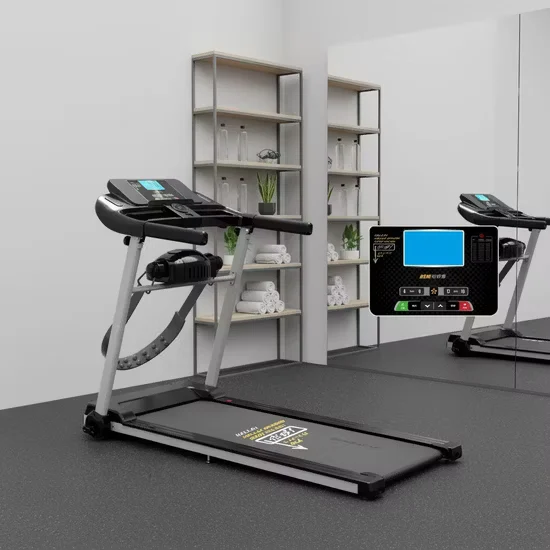
Space-saving DC platform — the MT026M reduces stored footprint to 1465 × 750 × 390 mm while maintaining a 1200 × 460 mm running surface for residential deployments.
Technical Specifications
| Parameter | Value |
|---|---|
| Designation | MT026M |
| Product Type | Foldable Treadmill |
| Motor Type | DC |
| Motor Power | 1.5HP* |
| Speed Range | 1–12 km/h |
| Running Surface | 1200 × 460 mm |
| Console Type | LCD (Speed / Distance / Time / Calories / Pulse) |
| Programs | 12 preset programs |
| Heart Rate | Handgrip pulse sensors |
| Product Unfold Size | 1465 × 750 × 1150 mm |
| Product Folded Size | 1465 × 750 × 390 mm |
| Net Weight | 46.0 kg |
| Material | ABS |
| Foldable | Yes |
| Certification | CE, RoHS |
| OEM / ODM | Available |
* 1.5HP listed; peak or continuous duty classification to be confirmed against manufacturer test sheet.
Application Suitability
| Deployment Scenario | Typical Use |
|---|---|
| High-end residential home gym | Daily walking and light jogging in private or shared living spaces |
| Apartment and multi-use room fitness | Fold-and-store cardio for rooms that serve dual purposes throughout the day |
| Corporate wellness compact cardio zone | Low-density employee fitness rooms with limited floor area |
| Boutique hotel guest floor fitness alcove | Light-access cardio points outside the main gym, where noise transfer to adjacent rooms matters |
Why Noise Complaints Reach the Front Desk Before Maintenance Does
Motor vibration and belt slap transmit through floor slabs faster than any maintenance ticket travels through a work-order system.
I have seen hotel operators place entry-level treadmills directly above occupied guest rooms, then face a wave of noise complaints within the first week of operation. The DC motor in a foldable motorized treadmill home use DC motor platform like this one draws lower continuous current than a commercial AC unit, which helps limit vibration at the source — but only if the deck cushioning and frame isolation are engineered to stop structure-borne sound from reaching the slab. When they are not, the front desk hears about it long before the engineering team does [NEED_CITE: structure-borne noise transmission paths in multi-story hospitality cardio installations].
Where the MT026M Fits Inside a Residential or Light-Use Cardio Zone
This unit covers steady-state walking through moderate jogging at speeds up to 12 km/h, which suits the majority of home users who train in 30- to 60-minute sessions. The 1200 × 460 mm running surface accommodates walking and light jogging gaits for most adult users, while the foldable frame lets the same room serve as a yoga space or home office once training is complete. In a compact cardio zone it sits naturally alongside a stationary bike or a resistance-training station without dominating the floor plan. The foldable motorized treadmill home use DC motor format works for users up to the platform’s rated capacity who prioritize space flexibility over high-speed sprint intervals. Data collection is limited to speed, distance, time, calories and pulse through the LCD console and handgrip sensors — enough for session tracking without the overhead of a connected ecosystem.
Continuous-Run Limits and the Environment It Can Tolerate
A 1.5HP DC motor is sized for intermittent residential duty cycles, meaning sessions in the range of 30 to 60 minutes with cooldown gaps between users. Running it continuously for multiple hours in a shared facility pushes the motor’s thermal envelope beyond what the housing and ventilation were designed to handle [NEED_CITE: DC motor thermal limits under continuous residential treadmill duty cycles]. Deployment on an upper floor requires a solid, level substrate and, ideally, a vibration-dampening mat between the feet and the slab to intercept structure-borne sound before it reaches rooms below. The unit needs a standard single-phase household outlet matching the target market’s voltage and plug standard — a detail that must be confirmed before production, because a mismatch discovered after the carton is opened turns inventory into dead stock. Adequate airflow around the motor housing, at minimum on the rear and one side, prevents heat buildup during consecutive sessions in an enclosed apartment or wellness room.
How the Drive, Deck and Console Specifications Translate to Real Behavior
The DC motor delivers lower continuous power draw than an AC motor of equivalent peak rating, which is appropriate for daily home sessions rather than all-day commercial throughput. Peak and continuous horsepower are not interchangeable — a motor rated at a given peak figure may sustain considerably less under continuous load, so the actual usable output during a 45-minute jog must be confirmed on the manufacturer’s test sheet. The LCD console displays speed, distance, time, calories and pulse, with pulse captured through handgrip sensors rather than a chest strap or optical module; handgrip sensors are convenient but can drift when the user’s grip loosens during faster intervals. Twelve preset programs provide structured variety without requiring the user to design sessions manually. The foldable frame collapses from a 1465 × 1150 mm profile to a 390 mm depth, cutting the floor footprint by roughly two-thirds when stored — a meaningful gain in apartments where the same room serves multiple functions. ABS construction on the shrouds keeps weight at 46.0 kg, which aids relocation but means the frame relies on geometry and cross-bracing rather than mass for stability during use [NEED_CITE: frame rigidity requirements for foldable treadmill platforms under dynamic loading].
The Hidden Cost of Specification Shortcuts
When a light-duty DC motor is pushed into a commercial gym running eight or more hours daily, winding insulation fails within months and the unit is pulled from the floor — generating replacement cost, member complaints and a reputation hit that lingers longer than the repair. In residential settings, the equivalent failure mode is a motor that overheats during longer sessions and trips its thermal cutoff, leaving the user stranded mid-workout and unwilling to trust the machine again. Noise is the other quiet killer: a treadmill that transmits belt slap through an apartment slab will generate neighbor complaints that no amount of post-sale goodwill can erase. And when the voltage or plug standard specified at order time does not match the destination market, every unit in the shipment becomes a rework project — rewiring, re-certifying and re-packaging at a cost that erases the margin the order was supposed to deliver [NEED_CITE: rework costs from voltage and plug mismatches in exported fitness equipment].
Why This Line Exists Alongside the Broader Cardio Portfolio
The MT026M addresses the residential end of the deployment spectrum where floor space, noise transfer and power draw are the constraints rather than continuous commercial throughput. It draws from the same engineering discipline that produces our sub-35dB commercial platforms — the same insistence on motor isolation, deck cushioning and structural rigidity — scaled to a duty cycle measured in daily hours rather than daily shifts. Every unit in our six-series cardio family, including this foldable treadmill, is backed by 10,000-hour durability testing on motors and bearings, and OEM customization extends to console UI, colorway and logo application. For operators planning a mixed-use residential fitness room, we provide a free 3D cardio-zone layout that accounts for this unit’s 1465 × 750 mm footprint, fold-clearance requirements and airflow gaps so the final installation works both acoustically and operationally. Technical support runs 24/7 from the point of commissioning onward.
Documentation & Test Records
- CE declaration of conformity covering the MT026M platform
- EN 957 test report for treadmill safety and structural performance
- RoHS compliance certificate for restricted substance limits
- Motor specification sheet detailing duty cycle and thermal ratings
- Noise level test report at representative operating speeds
- LCD console technical documentation with wiring and program maps
- Spare parts list and installation commissioning guide
Installation, Commissioning & Maintenance
- Maintain front, rear and lateral clearance around the 1465 × 750 mm unfolded footprint for safe mounting and fold operation
- Level the running surface before first use; place a vibration-dampening mat beneath the feet to reduce structure-borne sound on upper floors
- Confirm single-phase voltage and plug match the destination market before connecting to a dedicated circuit
- Run a brief calibration cycle after assembly to verify speed readout and LCD console sensor accuracy
- Inspect belt tension and alignment after the first 20 hours of use, then at regular intervals per the commissioning guide
- Wipe the ABS shrouds and handgrip pulse sensors after each session to prevent sweat corrosion
Equipment Selection and Inquiry Guidance
Provide the room dimensions and intended equipment list so we can return a 3D layout showing the MT026M’s placement, fold-clearance zone and recommended airflow gaps. Specify the expected daily session volume so the DC motor’s duty cycle can be matched to actual use rather than assumed. Confirm the deployment floor level and whether occupied rooms sit directly below, so noise isolation requirements are defined before the order is placed. State the target market voltage and plug standard, and indicate whether LCD console data output needs to interface with any existing building management or member-tracking system.
Frequently Asked Questions
Q: What is the difference between continuous duty and peak horsepower on a home treadmill?
A: Peak horsepower is the maximum output the motor can produce for a brief burst, while continuous duty rating reflects what it can sustain over an extended session. A motor may list an impressive peak figure but deliver considerably less under continuous load. For home users running 30- to 60-minute sessions, the continuous rating determines whether the motor can maintain speed on longer jogs without thermal shutdown.
Q: How does a DC motor compare to AC for residential treadmill use?
A: DC motors draw lower continuous current and generate less heat during intermittent home sessions, making them a practical fit for daily 30- to 60-minute use. AC motors are built for continuous commercial duty cycles running many hours per day. For a residential foldable treadmill, DC keeps energy draw and thermal output within the limits of a household circuit and a compact motor housing.
Q: Does the foldable mechanism affect frame rigidity during running?
A: A well-engineered fold mechanism locks the frame into a rigid triangle when deployed, so the running experience approaches that of a fixed-frame unit. The critical factor is the latch and hinge construction — they must resist flex under dynamic loading. The MT026M’s fold mechanism is tested through repeated deployment cycles to confirm that structural integrity holds over the platform’s service life.
Q: What noise level should be expected on upper-floor residential installations?
A: Noise output depends on motor vibration, belt-deck contact and structure-borne sound transmitted through the floor slab. A DC motor at residential duty produces lower vibration than a commercial AC unit, but the floor substrate and presence of a dampening mat also matter. Request the unit’s noise level test report and pair it with a vibration mat on upper-floor installations to minimize transfer to rooms below.