

Sub-35dB Whisper-Quiet Operation — Verified across hotel deployments where cardio equipment sits directly above occupied guest rooms without triggering noise complaints.
Technical Specifications
| Parameter | Value |
|---|---|
| Designation | W04H1 |
| Product Type | Foldable Treadmill |
| Motor Type | DC motor |
| Speed Range | 1–6 km/h (maximum up to 15 km/h) |
| Running Surface | 1000 × 400 mm |
| Console Type | LED screen displaying speed, distance, time, and calories |
| Programs | 6 preset programs |
| Product Dimensions | 1250 × 520 × 125 mm |
| Foldable | Yes (unfolded design) |
| Transport Wheels | Yes |
| Function | Multifunctional, Single |
| Age Group | Adult |
| Color Options | Multicolor |
| Certification | CE, RoHS |
Application Suitability
| Deployment Scenario | Typical Use |
|---|---|
| High-end residential home gym | Daily walking and light jogging in compact living spaces where transport wheels allow quick repositioning |
| Corporate wellness room | Low-impact cardio sessions for employees during breaks, folded and stored when not in use |
| Small studio or apartment fitness zone | Space-efficient treadmill deployment with easy relocation via integrated wheels |
| Light commercial use in boutique studios | Warm-up walking stations supporting group training circuits with moderate daily runtimes |
Why the Wrong Foldable Treadmill Fails in Residential Deployments
Structural rigidity and motor thermal management separate residential-grade units from machines that survive daily use.
Home fitness environments demand quiet operation and spatial flexibility, yet many foldable treadmill household transport wheels solutions on the market sacrifice durability to achieve compact footprints. I have watched lightweight frames develop resonance at sustained speeds, turning a quiet morning walk into a floor-shaking disturbance that travels through shared residential structures. The motor in a poorly specified unit also operates outside its continuous duty envelope when users exceed casual walking speeds, leading to thermal shutdowns and premature winding failure [NEED_CITE: motor duty cycle classification for continuous residential and light commercial operation]. When the running surface is too narrow or too short, adult users unconsciously alter their gait, creating joint strain that drives equipment abandonment within months.
Where This Treadmill Fits in a Mixed Cardio Layout
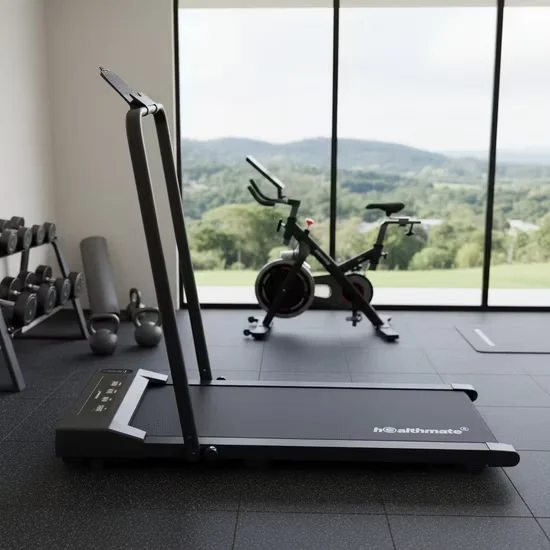
The W04H1 serves walking and light jogging intensities, occupying the low-to-moderate effort band in a cardio zone. It complements higher-intensity equipment such as spin bikes and stair climbers by providing an accessible entry point for users who prefer steady-state movement. The 1000 × 400 mm running surface accommodates adult walkers and shorter-stride joggers comfortably, while the foldable design and transport wheels allow operators to clear the floor for group sessions or multi-use events. This foldable treadmill household transport wheels configuration works well in residential fitness corners and corporate wellness rooms where floor area is contested and equipment must be repositioned frequently.
Continuous Runtime and Deployment Environment Requirements
For residential and light commercial scenarios, this unit is designed for moderate daily runtimes rather than all-day continuous operation found in large gym cardio rows. The DC motor requires adequate ventilation around its housing, so placing the treadmill flush against a wall restricts airflow and accelerates thermal buildup. Floor leveling matters: an uneven surface forces the frame to twist under load, producing noise and uneven belt wear that compounds over weeks. Deploying on upper floors of apartment buildings or hotels requires attention to vibration transmission through structural slabs, and a quality anti-vibration mat noticeably reduces low-frequency hum reaching the room below [NEED_CITE: EN 957 requirements for vibration and noise in residential cardio equipment deployment]. Voltage and plug standards must match the destination market before the unit is unboxed, as mismatches discovered post-installation force costly adapter chains or returns.
Motor Output, Running Surface, and Console Logic Explained
The speed range of 1–6 km/h with a maximum ceiling of 15 km/h reflects a motor tuned for walking and light jogging rather than sustained running, which keeps thermal load manageable during typical residential sessions. A running surface of 1000 × 400 mm provides adequate length for walking strides but requires users taller than average to monitor foot placement during faster intervals. The LED console tracks speed, distance, time, and calorie estimates across six preset programs, giving users structured progression without touchscreen complexity. Calorie readings on LED consoles of this class use algorithmic estimation based on speed and duration rather than biometric feedback, so values serve as relative session-to-session comparisons rather than clinical measurements. Transport wheels integrated into the frame base let one person tilt and roll the unit to a storage position, eliminating the need to drag or carry a machine that weighs significantly more than portable fitness accessories.
What Happens When Specifications Are Compromised
Choosing a treadmill based solely on folded dimensions often means accepting a running belt that is too short for safe adult use at any speed above a slow walk. Undersized motors operating near their thermal ceiling during routine sessions fail within months in light commercial environments, generating warranty claims and member dissatisfaction simultaneously. Frames that flex under load produce rhythmic noise that travels through floor assemblies in multi-unit residential buildings, resulting in noise complaints that are difficult to resolve without relocating the equipment entirely [NEED_CITE: structural vibration transmission in multi-story residential fitness deployments]. Console electronics that lack basic program variety push users toward external devices for workout structure, leaving usage data unrecorded and maintenance intervals untracked.
Why This Product Line Holds Up Under Scrutiny
The W04H1 benefits from the same engineering discipline applied across our full commercial cardio range, where sub-35dB acoustic verification and 10,000-hour component testing are standard protocols. The foldable mechanism on this unit is validated for repeated deployment cycles rather than treated as a one-time convenience feature. Our six-series cardio family means this treadmill can be specified alongside matching ellipticals, bikes, and rowers so a single facility sources consistent build quality and console logic across disciplines. OEM customization extends to color, branding, and console UI adjustments at flexible minimum order quantities. Free 3D cardio zone layout planning accounts for the W04H1’s footprint, transport wheel clearance, and user spacing to ensure the deployment actually functions in the allocated square footage. Technical support runs 24/7 for commissioning questions and spare parts coordination.
Documentation & Test Records
- CE declaration of conformity covering electrical safety and EMC compliance
- RoHS compliance report for restricted substance limits in electronic assemblies
- Noise level test record documenting operational acoustics under load
- Motor specification sheet detailing thermal class and continuous duty rating
- LED console technical documentation with program logic and wiring diagrams
- EN 957 test report validating structural and safety requirements
Installation, Commissioning & Maintenance
- Allow minimum clearance behind the 1250 mm frame length for safe mounting and dismounting during use
- Place on a leveled surface with an anti-vibration mat to protect floor finishes and reduce transmitted noise
- Confirm voltage and plug type match local supply before connecting the DC motor circuit
- Run the belt at low speed for initial alignment check and tension verification before user handover
- Wipe the running surface and LED console after each session to prevent sweat corrosion on electrical contacts
- Inspect transport wheel axles periodically for debris accumulation that impedes smooth repositioning
Equipment Selection and Inquiry Guidance
Provide the available floor area and intended equipment count so we can generate a 3D layout with airflow and user circulation planning for your space. Specify expected daily usage duration to confirm the motor duty cycle matches your deployment intensity. Identify the installation floor and adjacent occupied rooms so acoustic requirements can be confirmed before shipment. State your target market voltage and plug standard to ensure the unit ships with the correct electrical configuration. Indicate whether console data output needs to interface with any existing facility management or member tracking systems.
Frequently Asked Questions
Q: How does a foldable treadmill compare to a fixed-frame unit in terms of space utilization?
A: A foldable treadmill reduces its floor footprint significantly when stored vertically, freeing space for other activities or equipment. Fixed-frame units occupy a permanent rectangular area but generally offer wider running surfaces and heavier frames that absorb more vibration. The choice depends on whether the deployment location requires the floor to serve multiple functions throughout the day or remains dedicated to fitness use exclusively.
Q: What is the difference between peak and continuous motor output on a household treadmill?
A: Peak output describes the maximum power the motor can deliver in short bursts, such as during acceleration from a standstill. Continuous output is the sustainable power level the motor can maintain without overheating over extended sessions. Marketing materials sometimes highlight peak values because they appear larger, but continuous output determines whether the treadmill can support a full workout without thermal shutdowns or speed fluctuations.
Q: How do transport wheels affect daily usability of a home treadmill?
A: Transport wheels let a single person tilt the treadmill onto its front or rear axle and roll it to a storage position without lifting the full unit weight. This capability matters in apartments and multi-purpose rooms where the treadmill must be moved after each session. Without wheels, relocating even a compact treadmill requires two people or risks damaging floor surfaces through dragging.
Q: What data does the LED console actually track and how reliable is it?
A: The LED console on this unit displays speed, distance, time, and estimated calorie expenditure across six preset programs. Speed and distance readings are derived from belt rotation and are generally consistent session to session. Calorie estimates use speed and duration algorithms rather than individual biometric input, so they are best used for comparing relative effort between workouts rather than as precise metabolic measurements.
Q: How does treadmill deck cushioning relate to joint comfort during walking and jogging?
A: Deck cushioning absorbs a portion of the impact force generated when the foot strikes the running surface, reducing the load transmitted through ankles, knees, and hips. A rigid deck transfers more force directly to joints, which becomes noticeable during sessions longer than twenty minutes. Effective cushioning systems maintain their absorption properties over months of use rather than compressing permanently under repeated loading.
![Healthmate Electric Walking Treadmill for Home Gym Use [WARN] draft identifier mismatch](https://bicksport.com/wp-content/uploads/2026/08/healthmate-electric-walking-treadmill-for-home-gym-use-warn-draft-identifier-mismatch-ef17bb.webp)
![Healthmate Remote Controller Compact Walking Treadmill with Foldable Design for Home Gym Use [WARN] draft identifier mismatch](https://bicksport.com/wp-content/uploads/2026/08/healthmate-remote-controller-compact-walking-treadmill-with-foldable-design-for-home-gym-use-warn-draft-identifier-mismatch-624049.webp)
![Commercial Gym Cardio Treadmill Factory OEM Walking Machine [WARN] draft identifier mismatch](https://bicksport.com/wp-content/uploads/2026/08/commercial-gym-cardio-treadmill-factory-oem-walking-machine-warn-draft-identifier-mismatch-cc852c.webp)