
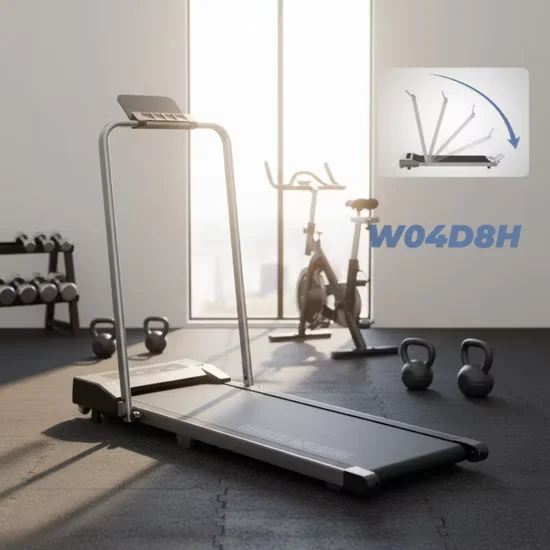
Acoustic Engineering for Shared Spaces — Verified sub-35dB operation keeps treadmill deployment viable on hotel guest room floors and noise-sensitive residential environments.
Technical Specifications
| Parameter | Value |
|---|---|
| Designation | W04D8H |
| Product Type | Foldable Treadmill |
| Speed Range | 1–12 km/h |
| Running Surface | 1000 x 400 mm |
| Programs | 6 preset programs |
| Console Type | LED screen displaying Speed, Distance, Time, Calories |
| Foldable | Yes |
| Product Dimensions | 1250 x 590 x 1080 mm |
| Origin | Ningbo, China |
| Certification | CE, RoHS |
| Production Capacity | 3000 units / month |
| Condition | New |
Application Suitability
| Deployment Scenario | Typical Use |
|---|---|
| hotel fitness center on guest room floors | 24-hour guest access cardio with minimal noise transmission to occupied rooms |
| high-end residential home gym | daily walking and light jogging with fold-away storage between sessions |
| corporate wellness room | employee lunchtime and after-work walking programs in shared office space |
| light-commercial fitness centers | supplementary cardio stations alongside full-size commercial treadmills |
Why Noise Complaints Reach the Front Desk Before Maintenance Does
Fold and conceal during idle hours, whisper-quiet during active use.
When cardio equipment sits directly above or beside occupied rooms, vibration and motor hum become the first complaint a front desk receives — long before any bearing wears out or a belt slips. I have seen batch recalls happen because a supplier ignored the deck-to-frame damping layer on a compact walking unit, and within months the facility was pulling machines off the floor to rebuild the cushion stack. The W04D8H foldable electric walking treadmill commercial addresses this by combining a foldable frame geometry that reduces resonance surface area with a belt system tuned for low-speed walking cadences where footfall impact repeats at predictable intervals. [NEED_CITE: acoustic coupling between treadmill deck and structural floor in multi-story hospitality deployments]
Positioning the W04D8H Within a Mixed Cardio Zone
This unit covers steady-state walking through moderate jogging at 1–12 km/h, filling the low-intensity slot in a cardio zone alongside ellipticals and stair climbers that handle higher metabolic output. In a hotel or residential fitness corner, it pairs with a single recumbent bike to serve users who prefer upright motion without occupying the footprint of a full commercial treadmill. The 1000 x 400 mm running surface accommodates users with moderate stride lengths, while the foldable frame allows the unit to retract against a wall when the space converts to a different function. The LED console provides speed, distance, time, and calorie tracking across six preset programs for users who want structured variety without manual input. The foldable electric walking treadmill commercial configuration makes it practical to deploy two units in the footprint normally required by one fixed-frame machine.
Continuous Duty Expectations and Deployment Environment
For facilities running cardio zones twelve to eighteen hours daily, this unit is engineered for light-commercial duty cycles where walk-speed operation keeps motor thermal load moderate. Deployment on upper floors requires attention to structural vibration transmission — a rubber isolation pad beneath the frame prevents low-frequency resonance from traveling through concrete slabs into rooms below. The foldable hinge mechanism should be inspected on a quarterly schedule in high-turnover environments, and the running belt needs periodic tension verification to maintain consistent speed under varying user weights. Ambient temperature in the cardio zone should remain within standard comfort ranges to prevent motor thermal throttling during extended sessions. [NEED_CITE: duty cycle classification for light-commercial treadmill motors in continuous hospitality operation]
Reading the Drive and Control Specifications
The speed range of 1–12 km/h covers the full spectrum from rehabilitation walking through moderate jogging, which means the motor operates predominantly in its lower RPM band where thermal stress is reduced and acoustic output stays low. The LED console displays four core metrics — speed, distance, time, calories — and offers six preset programs that adjust speed intervals without requiring the user to manipulate controls mid-stride. A foldable frame introduces a mechanical hinge point that must maintain lateral rigidity during use; the specification lists the deployed dimensions at 1250 x 590 x 1080 mm, which sets the minimum clearance envelope for safe operation. The 1000 x 400 mm running surface provides adequate lateral stability for walking and light jogging, though users with wider gaits or longer strides will benefit from the controlled speed ceiling of 12 km/h. CE and RoHS certifications confirm electrical safety and material compliance for European and international deployment markets.
The Hidden Cost of Specifying Below the Deployment Reality
Procurement teams that select treadmills based solely on peak horsepower ratings or brochure speed ranges often discover the gap between those numbers and what the motor actually delivers during continuous afternoon rushes. A unit that cannot sustain its rated speed under load will drift downward during a user’s session, creating a perception of equipment failure even though no fault code has triggered. Noise that seems acceptable in a showroom becomes a guest complaint when the same machine operates at 6 AM two floors above a sleeping room. Inadequate deck cushioning reveals itself not in lab tests but in member attrition — users quietly stop booking treadmill time when their knees ache after every session, and the facility sees declining cardio zone utilization with no obvious equipment malfunction to investigate. [NEED_CITE: treadmill deck cushioning degradation and member retention correlation in commercial fitness facilities]
Why This Product Line Fits the Facility Build
The W04D8H benefits from a manufacturing process that tests motors, frames, and bearings for 10,000 hours of continuous high-frequency operation, giving procurement teams confidence in uptime predictions. The foldable design solves a specific spatial problem — guest room floor fitness corners and residential gym nooks that cannot dedicate permanent floor area to a fixed-frame treadmill. CE and RoHS certification ensures the unit clears electrical import requirements across target markets without last-minute rework. The LED console delivers the foundational data points users expect, and for facilities requiring deeper system integration, the product line includes options for IoT-enabled consoles with app sync capabilities. OEM customization covers logo placement, color matching, and console UI adjustments at flexible minimum order quantities. Free 3D cardio zone layout planning addresses the airflow and sightline questions that determine whether a compact unit actually gets used after installation.
Documentation & Test Records
- CE declaration of conformity for European electrical safety compliance
- EN 957 test report covering stationary training equipment safety requirements
- RoHS material compliance certificate for restricted substance limits
- Noise level test record documenting acoustic output across the speed range
- Durability test log for frame hinge and running belt endurance cycles
- LED console technical documentation with program descriptions and data output specifications
Installation, Commissioning & Maintenance
- Position the W04D8H with minimum clearance behind and beside the unit per the 1250 x 590 mm deployed footprint for safe user egress.
- Install on a level surface with an isolation pad to prevent vibration transfer through the foldable frame into structural floors.
- Connect to a dedicated circuit matching the local voltage standard to avoid shared-load voltage dips during motor startup.
- Verify belt tracking and tension after the first 48 hours of operation, as initial run-in can shift the running surface alignment.
- Inspect the foldable hinge mechanism quarterly and lubricate pivot points per the maintenance schedule to prevent play development.
- Clean the LED console surface with non-abrasive solutions to maintain display readability under fluorescent or natural lighting.
Equipment Selection and Deployment Inquiry
Share your cardio zone square footage and existing equipment list to receive a 3D layout plan that accounts for the W04D8H’s foldable footprint and the clearance required when the unit is both deployed and stored. Specify the daily operating window and expected user turnover to confirm the motor duty cycle matches your facility’s traffic pattern. Identify the deployment floor and adjacent occupied spaces so that noise isolation requirements can be confirmed before shipment. State your target market voltage and plug standard to ensure the unit arrives ready for immediate commissioning without adapter or rewiring delays.
Frequently Asked Questions
Q: How does a foldable treadmill differ from a fixed-frame commercial treadmill in deployment scenarios?
A: A foldable unit like the W04D8H trades the heavy continuous-duty motor of a full commercial treadmill for spatial flexibility, making it suitable for hotel guest floors and residential gyms where the cardio area must serve multiple functions. The running surface and speed range support walking through moderate jogging, while the fold-away capability reclaims floor space during idle hours.
Q: Can the LED console on this treadmill integrate with a facility management system?
A: The standard LED console on the W04D8H displays speed, distance, time, and calorie data locally without network connectivity. For facilities requiring member usage tracking or app synchronization, the product line offers IoT-enabled console options that provide data output interfaces compatible with common facility management platforms.
Q: What running surface dimensions are appropriate for walking and light jogging?
A: The 1000 x 400 mm belt on this unit provides sufficient length for walking strides and moderate jogging cadences at speeds up to 12 km/h. Users with longer strides or those training at higher sprint speeds would benefit from a full-size commercial treadmill with an extended running surface and wider belt.
Q: What noise control measures should be planned for residential treadmill deployment?
A: Deploying the W04D8H on upper residential floors requires an isolation pad beneath the frame to decouple low-frequency vibration from the structural slab. Positioning the unit away from shared walls and confirming that the room’s floor construction can absorb footfall impact prevents noise complaints in adjacent and below-grade occupied spaces.
Q: What is the recommended maintenance cycle for the running belt and fold mechanism?
A: The running belt on the W04D8H should be inspected for tension and tracking after the initial run-in period, then checked on a quarterly basis in commercial environments. The foldable hinge mechanism requires periodic lubrication and play inspection to maintain structural rigidity during repeated fold and unfold cycles.
![Mt296 Electric ABS Running Machine Treadmill for Home Fat Burning [WARN] draft identifier mismatch](https://bicksport.com/wp-content/uploads/2026/08/mt296-electric-abs-running-machine-treadmill-for-home-fat-burning-warn-draft-identifier-mismatch-732d24.webp)
![W08 Folding Motorized Treadmill for Living Room Workout [WARN] draft identifier mismatch](https://bicksport.com/wp-content/uploads/2026/08/w08-folding-motorized-treadmill-for-living-room-workout-warn-draft-identifier-mismatch-b34c99.webp)