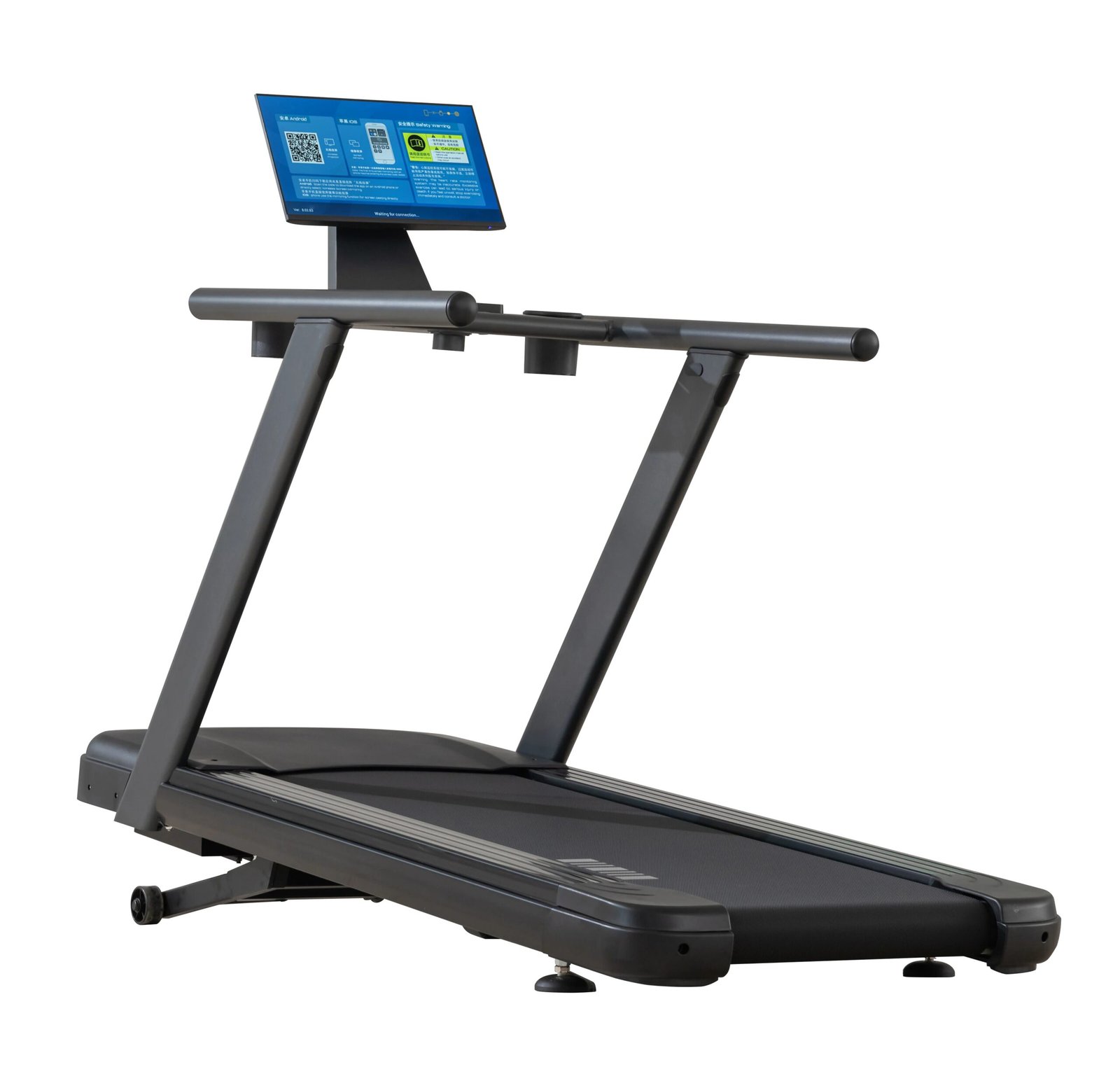
![Hsm Fashion Design Walking Treadmill with Auto-Incline Function [WARN] draft identifier mismatch](https://bicksport.com/wp-content/uploads/2026/08/hsm-fashion-design-walking-treadmill-with-auto-incline-function-warn-draft-identifier-mismatch-4d04f6.webp)
Quiet motorized walking — the W04H1 delivers sub-35dB operation verified in hotel deployments, combining auto-incline capability with a compact footprint for noise-sensitive cardio zones.
Technical Specifications
| Parameter | Value |
|---|---|
| Designation | W04H1 |
| Product Type | Foldable Treadmill |
| Motor Type | Motorized |
| Speed Range | 1-6 km/h |
| Incline Range | Auto-Incline |
| Running Surface | 1000 x 400 mm |
| Programs | 6 |
| Console Type | LED Screen (Speed/Dist./Time/Cal.) |
| Product Dimensions | 1250 x 520 x 125 mm |
| Net Weight | 100-160 kg |
| Foldable | No (Unfolded) |
| Certification | CE, RoHS |
| Customization | Available (Logo, Packaging) |
| Production Capacity | 3000/Month |
Application Suitability
| Deployment Scenario | Typical Use |
|---|---|
| Boutique hotel guest fitness rooms | Compact, quiet walking equipment for guests in space-constrained floors |
| Corporate wellness centers | Accessible low-impact cardio for employees during breaks |
| High-end residential shared fitness amenities | Motorized walking platforms for unsupervised daily use by residents |
| Light commercial wellness studios | Supervised walking stations for rehabilitation and active recovery sessions |
What Peak Horsepower Hides About Continuous Duty on Walking Treadmills
Motorized walking equipment demands continuous duty ratings, not peak horsepower claims, to survive commercial deployment.
When walking treadmills are deployed in shared residential or boutique studio spaces, motor noise and vibration become immediate complaints from adjacent rooms. I have seen home-grade motors burn out within months when subjected to eight hours of continuous walking cycles in chain gym facilities, leading to costly batch replacements and frustrated operators. The W04H1 motorized walking treadmill auto-incline system addresses this by prioritizing thermal management and acoustic output over inflated power specifications [NEED_CITE: motor duty cycle classification for continuous commercial operation].
Positioning the W04H1 in a Mixed Cardio Zone
The W04H1 motorized walking treadmill auto-incline unit serves low-intensity steady-state walking and active recovery, complementing high-speed running treadmills and ellipticals in a diversified cardio layout. Its 1250 x 520 mm footprint allows deployment in tight corridors or secondary wellness rooms where full-size running decks cannot fit. The 1000 x 400 mm running surface accommodates walking gaits comfortably while restricting sprint mechanics, making it appropriate for supervised rehabilitation zones and unsupervised hotel fitness corners. The LED console provides real-time speed, distance, time, and calorie tracking for basic user engagement without requiring complex network integration.
Continuous Operation and Deployment Environment Requirements
Facilities running this equipment for more than four hours daily must verify the motor’s continuous duty rating matches the expected load profile, as walking treadmills experience constant low-speed torque that generates significant heat in undersized motors. Deployments on guest room floors or above occupied spaces require confirmation that operational noise stays within acceptable limits for the adjacent environment [NEED_CITE: EN 957 requirements for commercial cardio equipment]. Voltage and plug standards must align with the target market before shipment to prevent batch-wide electrical mismatches that halt commissioning. Adequate ventilation around the motor housing prevents thermal throttling during back-to-back user sessions, and the unit must sit on a level surface with appropriate clearance behind the deck for safe user egress.
Interpreting the Drive and Control Specifications
The motorized drive system paired with auto-incline functionality enables varied intensity without manual deck adjustment, supporting consistent programming in supervised rehabilitation or unsupervised hotel settings. Auto-incline mechanisms introduce additional motor load and require robust thermal design to prevent premature failure during repeated elevation changes throughout the day. The LED console tracks speed, distance, time, and calorie expenditure, providing essential feedback for user engagement while avoiding the complexity and maintenance overhead of touchscreen systems in humid or high-dust environments. A maximum speed of 6 km/h confirms this platform is engineered specifically for walking mechanics, reducing belt wear and motor strain compared to units designed for running velocities. The 1000 x 400 mm running surface balances user comfort against spatial constraints, though operators should verify it accommodates the stride length of their primary user demographic. CE and RoHS certifications confirm baseline safety and environmental compliance for European market entry [NEED_CITE: CE conformity requirements for motorized fitness equipment].
The Hidden Cost of Specification Compromises
Home-grade motors installed in commercial walking stations fail prematurely under continuous low-speed operation, generating warranty claims and operational downtime that erode facility reputation. Noise complaints from guests or residents living adjacent to cardio zones force operators to relocate equipment or invest in acoustic remediation after deployment. Consoles that cannot export usage data leave facility managers blind to utilization patterns, preventing evidence-based equipment rotation and maintenance scheduling. Voltage mismatches discovered only after container arrival delay commissioning by weeks and incur expensive rewiring or transformer costs across entire equipment batches [NEED_CITE: commercial facility electrical standards for cardio equipment].
Why This Product Line Fits Your Deployment
The W04H1 benefits from sub-35dB whisper-quiet operation verified in hotel deployments, addressing the primary complaint vector for cardio equipment on occupied floors. Components undergo 10,000-hour durability testing on motors, frames, and bearings to ensure survival under continuous high-frequency use typical of corporate wellness and residential amenities. The complete six-series cardio family allows facilities to source walking treadmills, ellipticals, and climbers from a single engineering platform, ensuring consistent maintenance protocols and spare parts logistics. OEM customization covers logo, packaging, and console branding to integrate the unit into facility-specific environments or retail distribution channels. Free 3D cardio-zone layout and airflow planning account for the W04H1’s compact dimensions, ensuring proper spacing, sightlines, and ventilation for the entire walking station cluster. 24/7 technical support response provides operational continuity for facilities running unsupervised cardio zones across multiple time zones.
Documentation & Test Records
- CE declaration of conformity for European market compliance
- RoHS certification confirming restricted substance limits
- EN 957 test report validating safety and performance standards
- Motor noise level test report for acoustic-sensitive deployment verification
- Durability test record covering continuous operation validation
- LED console technical documentation with data output specifications
Installation, Commissioning & Maintenance
- Maintain 500 mm rear clearance behind the 1250 mm deck for safe user egress
- Level the 1250 x 520 mm footprint on solid flooring to prevent frame torsion
- Verify voltage and plug standard match facility supply before powering the motorized drive
- Calibrate auto-incline mechanism during initial commissioning to confirm elevation accuracy
- Inspect belt tension and alignment monthly under continuous commercial walking loads
- Wipe LED console and handrails daily to prevent sweat corrosion on electronic contacts
Equipment Selection and Inquiry Process
Provide your cardio zone square footage and target unit count to receive a 3D layout incorporating the W04H1’s compact dimensions and ventilation requirements. Specify expected daily usage hours so motor duty cycle can be matched to your operational profile. Confirm deployment floor level and adjacent room occupancy to validate acoustic suitability for your environment. State your target market voltage and plug standard to prevent electrical mismatches upon arrival, and indicate whether console data export or facility management system integration is required for your operational workflow.
Frequently Asked Questions
Q: What is the difference between motorized walking treadmills and running treadmills in terms of motor load and noise?
A: Motorized walking treadmills operate at lower belt speeds, which reduces peak motor demand but creates sustained low-speed torque that generates heat differently than running applications. The acoustic profile shifts toward motor hum rather than footfall impact, making motor insulation and cooling design critical for deployments in noise-sensitive environments like hotel guest floors or residential shared amenities.
Q: How does auto-incline functionality affect motor duty cycle and long-term durability?
A: Auto-incline mechanisms introduce cyclic loading as the elevation motor raises and lowers the deck repeatedly throughout operating hours. This additional load generates heat in both the drive motor and the incline actuator, requiring thermal management strategies that account for frequent elevation changes rather than steady-state flat operation typical of basic walking treadmills.
Q: Can the LED console data be exported or synced with facility management software?
A: The LED console provides real-time speed, distance, time, and calorie display for user feedback. Facilities requiring data export for utilization tracking should confirm the specific output format and protocol compatibility with their management system before procurement, as basic LED displays may not support external system integration without optional connectivity modules.
Q: What noise level should be expected during operation in shared residential spaces?
A: Operational noise depends on motor design, belt tension, deck cushioning, and user weight. Facilities deploying walking equipment in shared residential or hotel environments should request motor noise level test reports to verify acoustic output meets the requirements of adjacent occupied spaces before committing to batch procurement.
Q: How does the compact footprint impact user comfort and running surface usability?
A: The 1000 x 400 mm running surface accommodates comfortable walking gaits for most users while restricting the stride length required for running or jogging. Operators should verify this surface dimension matches the primary use case and user demographic of their facility before deployment in mixed-purpose cardio zones.
![Rust Proof Mt026m Fold Running Motorized Treadmill for Training [WARN] draft identifier mismatch](https://bicksport.com/wp-content/uploads/2026/08/rust-proof-mt026m-fold-running-motorized-treadmill-for-training-warn-draft-identifier-mismatch-92741f.webp)