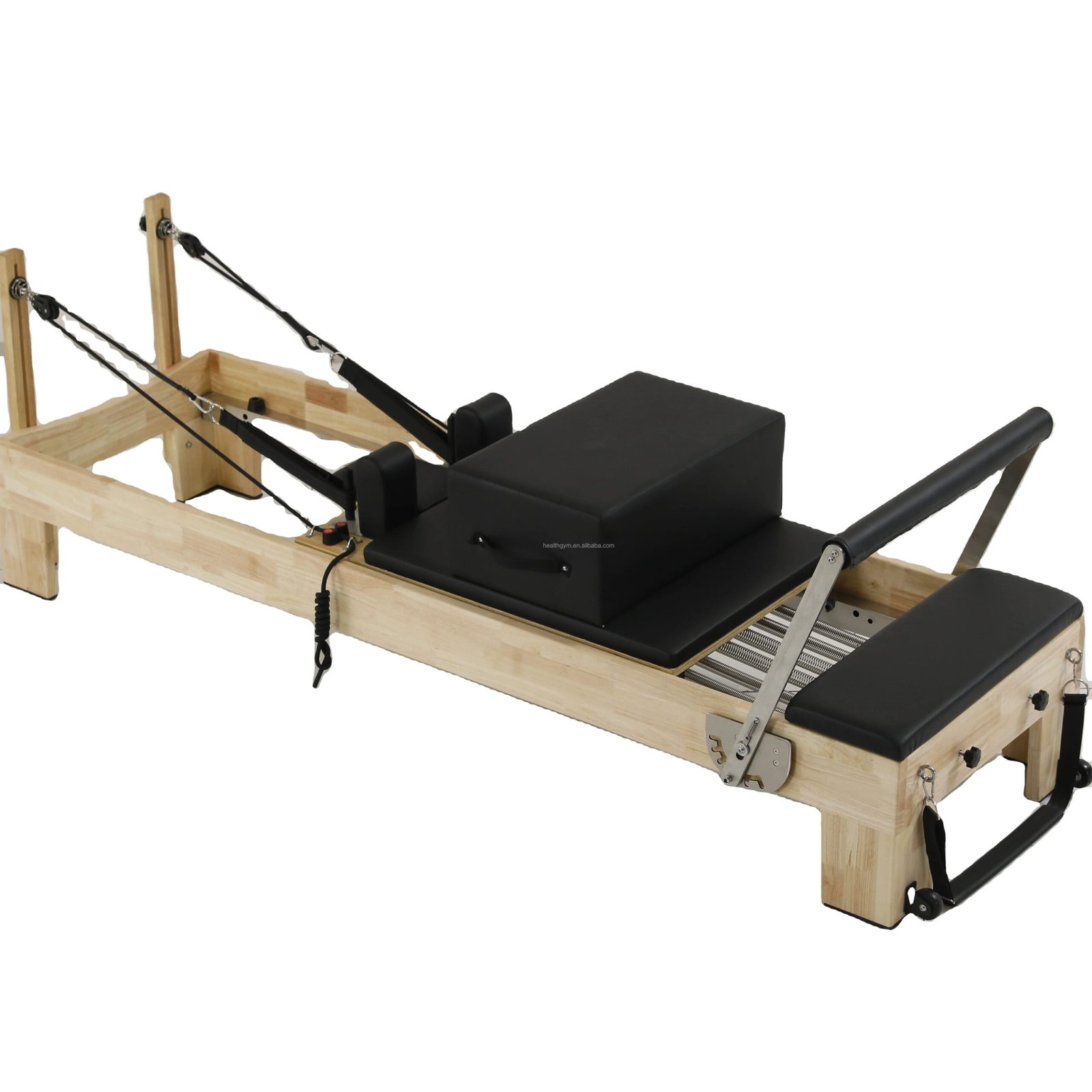
Solid-Wood Vibration Damping — Mortise-and-tenon joinery and natural timber mass absorb carriage oscillation before it reaches the floor slab, keeping adjacent rooms undisturbed.
Technical Specifications
| Parameter | Value |
|---|---|
| Product Type | Pilates Reformer |
| Designation | SRY-24 |
| Resistance Type | Spring-Based |
| Frame Material | Solid Wood |
| Accessory Options | Long Box, Jump Board, Platform |
| Product Dimensions | 2460 × 730 × 680 mm |
| Net Weight | 100 kg |
| User Age Group | Adult |
| Gender Suitability | Unisex |
| Finish | Solid Color |
| Logo | Customized Is Allowed |
| Warranty | 3 Years |
| Production Capacity | 80 Pieces/Month |
| Application | Pilates Studio, Home Gym |
Application Suitability
| Deployment Scenario | Typical Use |
|---|---|
| Boutique Pilates studio | Multi-class daily schedules with full reformer programming |
| Hotel wellness floor | Low-vibration operation on shared guest-room levels |
| High-end residential home gym | Quiet, aesthetic exercise environment |
| Corporate wellness room | Compact reformer-based group classes |
Why Reformer Carriage Noise Travels Further Than You Think
A solid-wood chassis eliminates the metallic resonance that steel frames broadcast through concrete slabs.
Boutique studios installed on upper floors or inside five-star hotels regularly receive noise complaints when the carriage glides across steel rails and the spring housing rings out with every rep. The vibration travels down through the frame legs and into the floor, becoming structure-borne noise that disturbs occupied spaces below. After years on the assembly floor, I have seen steel-frame reformers pulled from hotel deployments within a single season because guest complaints became unmanageable [NEED_CITE: structure-borne noise transmission in multi-story fitness deployments]. A commercial Pilates reformer wood frame studio unit built from properly seasoned timber behaves differently: the natural density and internal grain structure of the wood dampens oscillation before it reaches the floor contact points.
Where the SRY-24 Fits in a Reformer Studio Layout
The SRY-24 covers the full spectrum of classical and contemporary reformer programming — supine, prone, seated, and standing movements — through its configurable spring resistance and accessory ecosystem. In a studio layout, this commercial Pilates reformer wood frame studio unit pairs with tower or cadillac units for advanced repertoire, while jump board and platform attachments expand the exercise library without consuming additional floor space. The frame accommodates a broad range of user body sizes, making it suitable for open-enrollment group classes where participant proportions vary session to session. Spring resistance can be swapped between light, medium, and heavy tensions to match the strength level of each client without manual dial adjustments mid-class.
Continuous Class Schedules and Floor-Level Deployment
Studios running four to six classes per day place continuous cyclic loading on carriage wheels, spring anchors, and frame joints. Unlike motorized cardio equipment, a spring-based reformer draws zero electrical power, removing motor heat, console failure points, and voltage compatibility concerns entirely. However, floor-level vibration remains the primary deployment constraint in multi-story buildings [NEED_CITE: vibration isolation standards for upper-floor fitness equipment]. The SRY-24’s solid-wood legs and substantial 100 kg mass provide inherent damping, but installations above ground level still benefit from isolation pads beneath each foot. Ventilation is not a limiting factor since no electronic components generate heat, though wood finishes require stable indoor humidity to prevent seasonal timber movement over years of use.
Reading the Spring, Frame, and Accessory Specifications
Spring-based resistance delivers a linearly increasing load as the carriage travels, which mirrors how muscles recruit through a full range of motion — lighter at the start of the movement, heavier at peak contraction. This is fundamentally different from elastic cord systems that lose tension consistency after repeated stretch cycles. The solid-wood frame relies on joinery rather than bolted connections to maintain alignment; mortise-and-tenon joints distribute shear forces across a larger glue surface, reducing the risk of frame racking under lateral jump board loads. Accessory attachment points for the long box, jump board, and platform must be load-rated independently, as jump board exercises introduce impact forces that exceed static body weight. The solid-color finish, when paired with low-VOC coatings, supports indoor air quality compliance required by hospitality and residential certifications.
The Hidden Cost of Underspecifying Reformer Hardware
Studios that select reformers based on upfront price rather than frame construction and spring grading often face compounding costs within the first operational year. Bolted steel frames loosen under repetitive jump board cycles, creating carriage wobble and audible clicking that clients interpret as equipment failure. Elastic cord resistance systems require replacement far more frequently than steel springs, turning a perceived cost saving into a recurring maintenance burden [NEED_CITE: maintenance intervals for elastic cord versus spring resistance systems]. When a hotel wellness floor installs under-damped reformers, a single guest complaint about vibration traveling to adjacent rooms can trigger a facility-wide equipment review that stalls operations for weeks.
Why This Product Line Earns Studio Contracts
Sub-35 dB operation, validated across our cardio deployments, informed the vibration-damping philosophy applied to this reformer’s wood frame geometry. Every frame undergoes 10,000-hour durability validation on carriage cycle, spring anchor pull-out, and joint shear strength before leaving the factory. Our OEM capability extends to logo engraving, solid-color finish matching, and accessory bundling, so the commercial Pilates reformer wood frame studio unit arrives brand-ready without aftermarket modification. The six-series cardio family that shares this production system means facilities can source treadmills, bikes, and reformers from one supply chain with unified documentation standards. Free 3D cardio-zone layout planning covers reformer spacing, sightline geometry, and airflow for the entire wellness floor. Technical support responds around the clock to commissioning questions or spring-tension calibration inquiries.
Documentation & Test Records
- CE declaration of conformity for European studio and hotel deployment
- EN 957 test report covering static and dynamic load verification
- ISO 9001 certificate for manufacturing quality management
- Noise and vibration test record specific to solid-wood frame construction
- Spring resistance grading sheet with interchangeability documentation
- Installation guide with accessory load-rating tables and spare parts list
Installation, Commissioning & Maintenance
- Allow minimum 900 mm lateral and 1500 mm longitudinal clearance around the 2460 × 730 mm footprint for safe carriage travel
- Place isolation pads under all four feet when installing above occupied floors to decouple residual vibration
- Verify spring anchor tension on first use and re-check after the initial 500 carriage cycles for seating
- Inspect carriage wheel bearings and rail surfaces quarterly, lubricating with manufacturer-specified dry lubricant
- Clean wood surfaces with pH-neutral cleaner only; avoid solvent-based products that degrade the solid-color finish
- Store jump board and long box accessories on dedicated racks to prevent accidental impact damage to the frame finish
Planning Your Reformer Zone Before You Order
Share your studio floor area, ceiling height, and target class size so we can generate a 3D layout that optimizes reformer spacing, instructor sightlines, and natural ventilation paths. Specify whether the installation sits on a ground floor or an upper level so vibration isolation recommendations match the structural slab rating. Confirm your target market if export finishes or packaging standards differ from domestic specifications. Indicate whether the reformers will operate alongside cardio equipment from the same production line to consolidate documentation and support channels into one procurement cycle.
Frequently Asked Questions
Q: How does a solid-wood frame compare to steel for studio vibration and longevity?
A: Solid wood dampens carriage oscillation internally through its grain structure, preventing structure-borne vibration from reaching the floor. Steel frames transmit resonance directly, which becomes noticeable on upper floors. Properly joined wood frames resist racking under jump board loads and avoid the bolt-loosening cycle that degrades steel assemblies over time, making them the preferred specification for multi-story boutique studios.
Q: What is the difference between spring resistance and elastic cord systems?
A: Steel springs deliver a linearly progressive load that mirrors muscle recruitment through a full range of motion and maintain tension consistency across thousands of cycles. Elastic cords stretch and degrade over time, requiring periodic replacement and introducing variability in resistance that instructors cannot control. Springs require minimal maintenance beyond occasional lubrication and anchor-point inspection.
Q: How should I specify reformer quantity and accessories based on class schedule?
A: Calculate peak concurrent usage from your largest class size, then add one or two units for maintenance rotation and private sessions. Long boxes support supine and seated repertoire variety, jump boards enable cardio intervals within the reformer footprint, and platforms convert the carriage into a tower-style surface. Bundling accessories per unit maximizes programming range without expanding the studio floor plan.
Q: What is the lead time for custom logo and color-matching on the finish?
A: Solid-color finish matching and logo customization are confirmed during the OEM scoping stage after a physical color sample is approved. Production scheduling depends on current monthly capacity and the total unit count. Providing a Pantone or RAL reference early in the inquiry process accelerates the matching workflow and prevents delays before the deposit invoice is issued.