
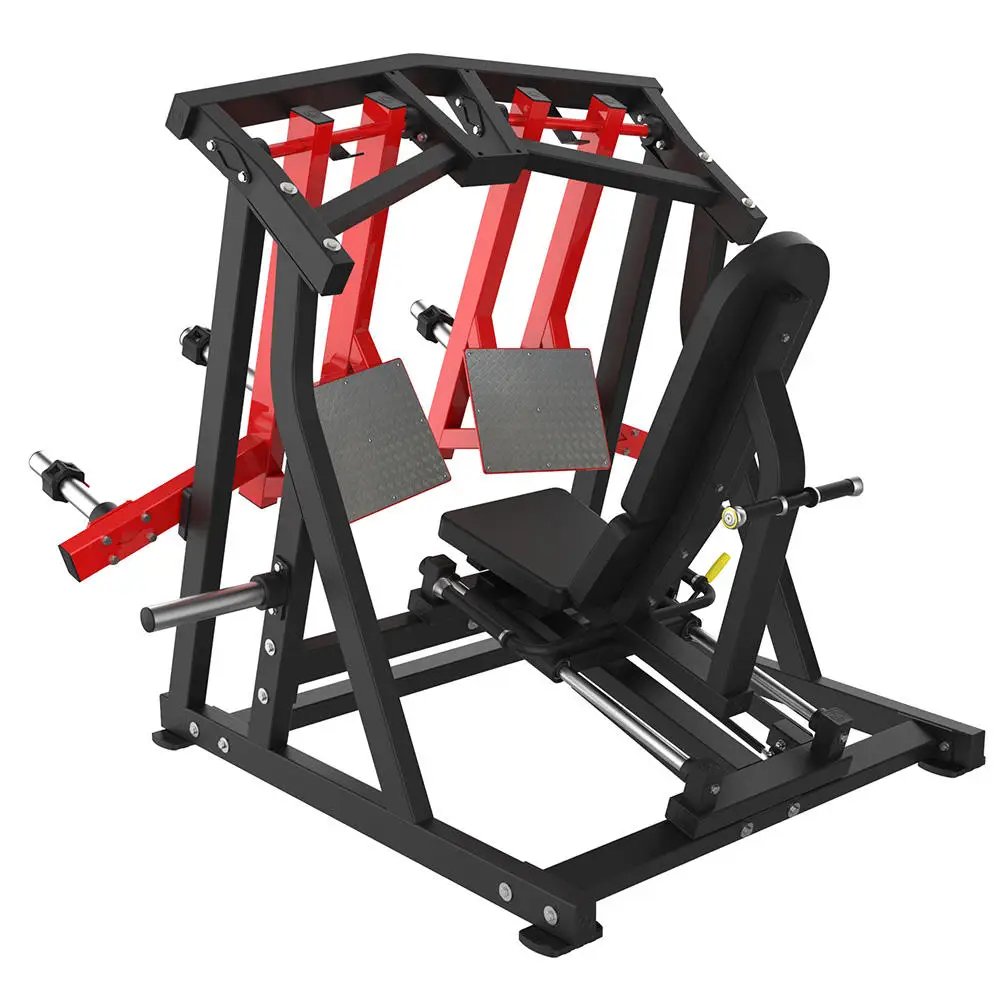
![Hammer Strength Squat Lunge Machine for Commercial Gym Use [WARN] draft identifier mismatch](https://bicksport.com/wp-content/uploads/2026/08/hammer-strength-squat-lunge-machine-for-commercial-gym-use-warn-draft-identifier-mismatch-8ca3cf.webp)
Vibration-Free Steel Frame — sealed bearing joints and plate-loaded resistance eliminate motor noise entirely, delivering zero equipment-generated sound for multi-floor deployments.
Technical Specifications
| Parameter | Value |
|---|---|
| Product Type | Hammer Strength Squat Lunge Machine |
| Model NO. | 5044 |
| Power Source | Manual (Plate-Loaded) |
| Resistance Type | Manual Plate-Loaded |
| Exercise Target | Waist, Leg |
| Frame Material | Reinforced Steel |
| Max User Weight | 180 kg |
| Product Dimensions | 1623 × 1691 × 872 mm |
| Net Weight | 122 kg |
| Foldable | No |
| Customization | OEM/ODM available (frame color, pad upholstery, branding) |
| Certification | ISO 9001, CE |
Application Suitability
| Deployment Scenario | Typical Use |
|---|---|
| Hotel fitness center on guest room floors | Silent lower-body training with no motor noise transferring through floor slabs |
| Chain gym strength zone | High-frequency plate-loaded squat and lunge work for diverse member traffic |
| Corporate wellness room | Compact footprint lower-body station for space-constrained employee fitness areas |
| High-end residential home gym | Heavy-duty manual resistance without electronic noise in shared living environments |
| Sports performance training center | Athlete-grade bilateral and unilateral leg loading with stable frame geometry |
Why Noise Complaints Reach the Front Desk Before Maintenance Does
Plate-loaded design removes every noise source that motorized leg equipment introduces.
Cable-driven and motorized leg machines generate bearing whine and frame resonance that travel through concrete floor slabs, reaching occupied rooms below. In hotel deployments, these complaints arrive at the front desk long before maintenance teams log a service ticket [NEED_CITE: noise transmission pathways in multi-story fitness facility deployments]. A commercial squat lunge machine built on manual plate-loaded resistance eliminates the motor, fan, and cable drum entirely — there is no rotating component generating continuous acoustic output. What remains is the sound of plates being loaded and the user’s own movement, both of which fall well below thresholds that trigger guest or resident complaints.
Lower-Body Positioning Within the Strength Zone
This commercial squat lunge machine targets the quadriceps, glutes, and stabilizing musculature through guided bilateral and unilateral movement patterns. It complements free-weight squat racks by offering a fixed movement path suited for high-volume training sessions where spotter availability is limited. Deployed alongside hip sleds and leg press units, it fills the lunge-specific loading gap in commercial strength configurations. The 180 kg user capacity accommodates a wide range of body types, and the reinforced steel frame geometry supports heavy external loading without lateral deflection.
Continuous Operation and Floor-Level Deployment Requirements
Manual plate-loaded equipment carries no motor duty-cycle constraints, meaning it can serve back-to-back users indefinitely without thermal shutdown risk [NEED_CITE: continuous operation classification for manual vs. motorized strength equipment]. Noise propagation through floor slabs remains the primary deployment concern — the sealed bearing joints and heavy steel frame minimize structure-borne vibration, making this unit viable on suspended floors above occupied hotel rooms or office spaces. Proper floor leveling is required to prevent uneven load distribution across the four-point base. No electrical circuit or dedicated power line is needed, simplifying installation in retrofit projects where available amperage is limited.
Plate-Loaded Mechanics and Structural Load Path
The manual resistance system relies entirely on gravity and external plate mass, which produces a linear resistance curve that matches the biomechanical demand of the squat-lunge movement. Reinforced steel construction with sealed bearing pivot points ensures that the rotational joints operate without lubrication schedules or periodic bearing replacement [NEED_CITE: sealed bearing service intervals in commercial strength equipment]. The 122 kg net weight of the frame itself provides a stable base that resists tipping under asymmetric loading — a critical safety factor when users load one side heavily during unilateral lunge work. The absence of cables, pulleys, and weight stacks removes the three components most frequently flagged in commercial gym maintenance logs.
The Hidden Cost of Specifying Below Commercial Grade
Frames built from lighter-gauge steel develop fatigue cracks at weld junctions when subjected to daily high-load cycles, often failing within the first year of continuous gym operation. Open bearings in pivot joints require frequent lubrication and eventually seize, generating grinding noise that prompts member complaints and unit replacement [NEED_CITE: premature bearing failure rates in high-traffic commercial gym equipment]. Units rated below 180 kg user weight cannot safely accommodate the full spectrum of gym membership demographics, creating liability exposure for facility operators. Equipment specified without floor-deployment noise analysis routinely triggers retrofit costs when vibration complaints surface post-installation.
Why This Product Line Earns Its Place in the Facility
Every unit in the Biketon commercial range undergoes 10,000-hour continuous operation testing on frame joints and bearings before leaving the Shandong manufacturing facility. The sub-35dB acoustic performance standard verified in hotel cardio deployments extends to this plate-loaded station through its zero-motor noise architecture. Full OEM and ODM customization covers frame color, pad upholstery, and branding — matching facility design language without compromising structural specification. The six-series cardio and strength family allows operators to source every discipline from a single manufacturing line, simplifying warranty management and spare parts logistics. Free 3D layout planning accounts for the 1623 × 1691 mm footprint and required clearance zones to maintain proper member flow and ventilation pathways. Round-the-clock technical support ensures that any commissioning question is addressed without waiting for business hours in a different time zone.
Documentation & Test Records
- CE declaration of conformity for European market placement
- EN 957 test report covering structural integrity and safety requirements
- ISO 957-compliant noise level test report verifying zero motor-generated output
- Frame durability test record documenting 10,000-hour bearing and joint performance
- Material certification and weld inspection records for reinforced steel frame
- OEM customization scope sheet covering color, upholstery, and branding options
Installation, Commissioning & Maintenance
- Allocate clearance around the 1623 × 1691 mm footprint for safe plate loading and user entry from both sides
- Level the four-point steel base on a flat surface using precision shims to prevent asymmetric frame stress
- No electrical circuit required — position the unit based on member flow and ventilation planning rather than outlet proximity
- Inspect sealed bearing pivot joints during initial commissioning and confirm smooth full-range articulation
- Wipe down steel frame and upholstery after each use cycle to prevent sweat corrosion on contact surfaces
- Verify plate loading horn security and collar retention as part of daily pre-opening facility checks
Inquiry and Specification Alignment
Provide your strength zone area and unit count to receive a 3D layout that accounts for this machine’s footprint and member circulation requirements. Specify the deployment floor level and adjacent occupied spaces so acoustic transmission can be evaluated. Confirm target market voltage standards if pairing this plate-loaded unit with any motorized cardio equipment in the same shipment. Indicate whether OEM frame color, pad upholstery, or branding customization is required so lead time can be factored into the production schedule.
Frequently Asked Questions
Q: What is the difference between plate-loaded and selectorized leg machines for commercial use?
A: Plate-loaded units like this commercial squat lunge machine rely on external weight plates, eliminating cables, pulleys, and weight stacks entirely. This produces a direct resistance path with fewer maintenance points. Selectorized machines offer quick pin-adjusted weight changes suited for high-turnover environments but introduce cable wear and stack alignment issues over time. Facility operators choose based on maintenance capacity and user preference.
Q: How does frame steel thickness affect long-term durability in high-traffic gyms?
A: Thicker steel sections resist deformation under repeated heavy loading cycles, maintaining joint alignment and preventing weld fatigue. In commercial environments where equipment serves continuous users daily, frame rigidity directly determines service life. Reinforced steel construction tested to 180 kg user weight ensures the frame geometry holds within tolerance across thousands of loading cycles without developing lateral play.
Q: Can the squat lunge machine be customized for facility branding and color matching?
A: Full OEM and ODM customization is available, covering frame powder-coat color, pad upholstery material and color, and logo placement. Customization scopes are confirmed during the quotation phase, and production lead time varies based on the extent of modification requested. This allows facility operators to align equipment appearance with interior design specifications without altering structural components.
Q: What maintenance is required for sealed bearings compared to open bearings?
A: Sealed bearings contain their own lubrication within a protected housing, requiring no periodic greasing or adjustment during normal operation. Open bearings demand regular lubrication schedules and are vulnerable to dust and sweat contamination in gym environments. The sealed bearing specification on this unit eliminates a common maintenance failure point, reducing long-term service labor and preventing noise from degraded pivot joints.
Q: How does manual plate-loaded equipment compare in noise output to motorized alternatives?
A: Plate-loaded equipment generates no motor, fan, or electronic noise, making it inherently quieter than any motorized resistance system. The only acoustic output comes from plates being loaded and user movement. This makes manual stations particularly suitable for hotel fitness floors, residential gym spaces, and multi-story facilities where structure-borne vibration and airborne noise trigger occupant complaints.
![ISO-Lateral Super Incline Press Commercial Gym Equipment [WARN] draft identifier mismatch](https://bicksport.com/wp-content/uploads/2026/08/iso-lateral-super-incline-press-commercial-gym-equipment-warn-draft-identifier-mismatch-9b2b77.webp)
![Commercial Hammer Strength V-Squat Fitness Equipment Gym Machine [WARN] draft identifier mismatch](https://bicksport.com/wp-content/uploads/2026/08/commercial-hammer-strength-v-squat-fitness-equipment-gym-machine-warn-draft-identifier-mismatch-25abba.webp)