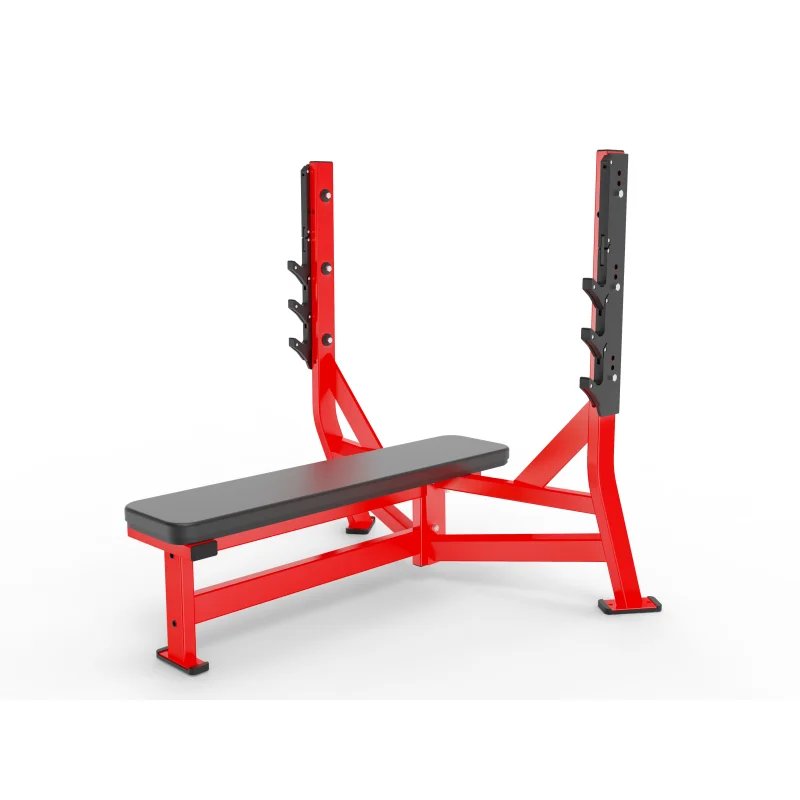
Positioning Statement — Sub-35dB acoustic engineering verified in hotel deployments, adapted for continuous heavy-load strength training environments where noise and joint protection remain critical.
Technical Specifications
| Parameter | Value |
|---|---|
| Product Type | Plate Loaded Flat Bench |
| Model NO. | 5050 |
| Exercise Part | Chest |
| Frame Material | Steel |
| Max User Weight | 180kg |
| Product Dimensions | 1304 × 1300 × 1234 mm |
| Net Weight | 63kg |
| Main Frame Color | According to customer requirements |
| Cushion Color | According to customer requirements |
| OEM/ODM | Acceptable |
| Certification | ISO 9001, CE |
| Transport Package | Plywood Box |
Application Suitability
| Deployment Scenario | Typical Use |
|---|---|
| Professional gym and club strength zones | Primary flat pressing station in free-weight areas with high member throughput |
| Community fitness centers | Shared chest training station accommodating diverse user sizes and strength levels |
| Corporate wellness facilities | Compact strength training point in limited-square-footage employee gyms |
| High-end residential home gyms | Dedicated flat bench for personal training routines requiring commercial-grade stability |
| Sports performance training centers | Controlled loading platform for athlete chest development programs |
Why Cushion Compression Matters More Than Frame Thickness
Commercial-grade multi-layer cushioning resists long-term compression under repeated heavy pressing loads.
Cushion decks that flatten within months generate joint complaints faster than any structural failure becomes visible. I have seen gym operators replace entire bench fleets because the padding lost density before the steel frames showed any fatigue. In high-traffic strength zones, members shift positions frequently, concentrating uneven loads across the bench surface. A commercial plate loaded flat bench must maintain consistent support density through thousands of weekly repetitions, otherwise member attrition follows the first complaints [NEED_CITE: cushion density testing standards for commercial strength equipment]. The difference between a bench that lasts three years and one that requires re-padding in eight months comes down to foam composition and bonding methods — specifications rarely visible on a showroom floor.
Positioning Within the Free-Weight Training Zone
A plate loaded flat bench serves as the foundational pressing station in any commercial strength layout. It pairs with incline and decline benches to complete the chest training spectrum, and anchors free-weight zones alongside squat racks and cable systems. The 1304 × 1300 mm footprint positions it efficiently between equipment stations without blocking member flow paths. Its 180kg max user weight capacity covers the full range of commercial gym demographics, and plate-loaded operation eliminates the maintenance overhead of selectorized weight stacks.
Deployment Density and Environmental Constraints
Unlike motorized cardio equipment, a plate loaded flat bench carries no electrical requirements, eliminating voltage mismatch concerns entirely. The 63kg unit weight allows repositioning during floor layout adjustments, though operators should account for plate storage proximity to avoid congested walkways. Ground-level deployment requires attention to floor flatness — uneven surfaces create frame wobble under asymmetric loading. Rubber matting beneath the unit dampens plate contact noise and protects flooring. In multi-story facilities, noise from dropped plates transmits through floor structures differently than cardio vibration, requiring acoustic assessment specific to impact loads rather than continuous hum [NEED_CITE: structural vibration transmission for plate-loaded equipment in multi-floor facilities].
Steel Frame Construction and Load Path Analysis
The reinforced steel frame channels pressing loads through welded joints rather than bolted connections, distributing force across the entire structure during heavy lifts. At 180kg max user weight plus plate loading, the frame must withstand combined forces well beyond static weight ratings. The 1304 × 1300 × 1234 mm envelope reflects a design that prioritizes stability over compactness — wider base dimensions prevent lateral tipping when users load unevenly. The 63kg net weight indicates substantial material density in the frame members, contributing to the bench remaining stationary during explosive pressing movements. Multi-layer cushion bonding prevents delamination under sweat exposure and repeated compression cycles.
What Underspecification Costs in Commercial Environments
Benches rated below commercial duty cycles develop frame flex under sustained heavy use, creating instability that experienced lifters detect immediately. Thin cushion layers compress permanently within months, forcing operators into re-padding contracts or full replacements. Lightweight frames shift during exercises, requiring constant repositioning that frustrates members and staff alike. I have reviewed facility layouts where underspecified benches were replaced within the first year — the purchase savings disappeared against downtime, labor, and member complaints [NEED_CITE: total cost of ownership for commercial strength equipment replacement cycles]. Procurement decisions based solely on initial unit price consistently produce higher three-year operating costs.
Why This Product Line Holds Up Across Deployments
Every unit in this strength family undergoes load testing matched to the 180kg commercial standard applied across the full cardio and strength range. The steel frame construction follows the same durability validation methodology used for 10,000-hour cardio motor testing — extended cyclic loading until structural performance degrades. OEM customization extends to frame color and cushion color, allowing facility branding consistency from cardio zones through strength areas. The 1304 × 1300 mm footprint integrates into 3D facility layouts alongside cardio equipment, with spacing calculations accounting for plate loading clearance and member movement. Full technical documentation accompanies each shipment, and 24/7 support covers structural or cushion issues with the same response commitment applied to electronic console troubleshooting.
Documentation & Test Records
- CE declaration of conformity covering structural and safety requirements for plate loaded strength equipment
- EN 957 test report validating load capacity and stability under commercial testing protocols
- ISO 9001 certificate confirming manufacturing quality management across production facilities
- Frame load-bearing test documentation with cyclic fatigue results
- Cushion density and compression resistance specifications with material composition data
- Spare parts list covering cushion replacement and frame component availability
Installation, Commissioning & Maintenance
- Maintain minimum 600mm clearance on all sides for safe plate loading and member movement around the 1304 × 1300 mm footprint
- Verify floor levelness before placement; install rubber matting to dampen plate contact noise and protect subflooring
- Inspect all welded joints and frame connections upon delivery before releasing to member use
- Check cushion surface integrity monthly for compression zones, tearing, or delamination at bonded edges
- Clean cushion surfaces daily with pH-neutral cleaners to prevent sweat-driven degradation of multi-layer padding
- Tighten any adjustable frame bolts quarterly following initial settlement period after deployment
Sourcing and Specification Guidance
Provide your strength zone square footage and equipment count to receive a 3D layout incorporating plate storage clearances and member flow analysis. Specify deployment floor level and adjacent occupied spaces to confirm whether impact-dampening subflooring is required. Indicate frame color and cushion color requirements early to align OEM customization lead times with your opening schedule. Confirm whether the bench operates as a standalone station or within a circuit layout to optimize spacing calculations.
Frequently Asked Questions
Q: What is the difference between plate loaded and selectorized equipment?
A: Plate loaded benches require manual weight plate addition, offering unlimited load progression and fewer mechanical components to maintain. Selectorized versions use pin-selected weight stacks with cable and pulley systems that require regular adjustment and lubrication. Commercial facilities often choose plate loaded for experienced training zones where members manage their own loading, reducing maintenance overhead and providing a more traditional training experience.
Q: How does cushion density affect joint protection during heavy lifts?
A: Higher-density multi-layer cushion systems distribute load across a broader contact area, reducing pressure points on the spine and shoulder blades during pressing movements. Low-density foam compresses unevenly over time, creating hard spots that concentrate force on specific joints. Commercial-grade padding maintains consistent density through thousands of compression cycles, providing reliable support that protects users during heavy loading sessions.
Q: What OEM/ODM customization options are available for facility branding?
A: Frame color and cushion color can both be specified to match facility design standards or brand identity requirements. Logo application is available on visible frame surfaces. Customization scope and lead times should be confirmed during the quotation stage to align production scheduling with project timelines. Minimum order quantities apply depending on the extent of color and branding modifications requested.
Q: How to verify frame load capacity for commercial use?
A: Request the frame load-bearing test documentation that includes cyclic fatigue results under repeated loading at or above the stated 180kg max user weight. EN 957 test reports validate structural performance under standardized commercial testing protocols. Visual inspection of weld quality at frame joints provides additional confidence. Manufacturers should supply these documents as part of the standard technical documentation package accompanying each order.
Q: What maintenance is required for plate loaded benches in high-traffic gyms?
A: Daily cushion cleaning prevents sweat-driven material degradation. Monthly inspection of cushion surfaces identifies early compression zones or edge tearing. Quarterly checks of all frame connections catch loosening before instability develops. Unlike selectorized equipment, plate loaded benches have no cables, pulleys, or weight stack guides requiring lubrication or adjustment. This mechanical simplicity substantially reduces ongoing maintenance labor in high-volume commercial environments.