

Wood-Frame Vibration Damping — Natural timber construction absorbs carriage resonance that metal frames transmit into shared-wall studio environments.
Technical Specifications
| Parameter | Value |
|---|---|
| Product Type | Pilates Reformer |
| Material | Wood |
| Model NO. | SRY-02 |
| Color | Solid Color |
| Accessory | Long Box / Jump Board / Platform |
| Product Dimensions | 2460730680mm |
| Net Weight | 100kgs |
| Max User Weight | 180kg |
| Customization | Available (Logo, Color) |
| Warranty | 3 Years |
| Certification | CE |
Application Suitability
| Deployment Scenario | Typical Use |
|---|---|
| Boutique Pilates studio in shared commercial buildings | Group reformer classes and private sessions requiring silent carriage operation |
| Five-star hotel wellness spa | Semi-private reformer suites for guest bookings and spa package add-ons |
| High-end residential home gym | Studio-grade reformer programming for private clients and household members |
| Rehabilitation facility | Low-impact progressive resistance work for post-injury recovery protocols |
Why Carriage Noise Reaches the Studio Owner Before the Equipment Vendor Does
Wood construction eliminates the metal-on-metal resonance that triggers complaints in shared-wall deployments.
Boutique studios operating back-to-back classes in commercial buildings quickly discover that all-metal reformer frames transmit carriage vibration through floors and walls. Guests in adjacent hotel rooms or tenants in neighboring office suites notice the rhythmic spring oscillation long before maintenance logs a fault. Operators then face the choice between restricting class schedules or replacing the entire equipment line. A commercial Pilates reformer machine wood frame absorbs this vibration at the source rather than transferring it into the building structure [NEED_CITE: acoustic performance requirements for fitness equipment in shared commercial spaces].
Where This Reformer Sits in a Studio Equipment Mix
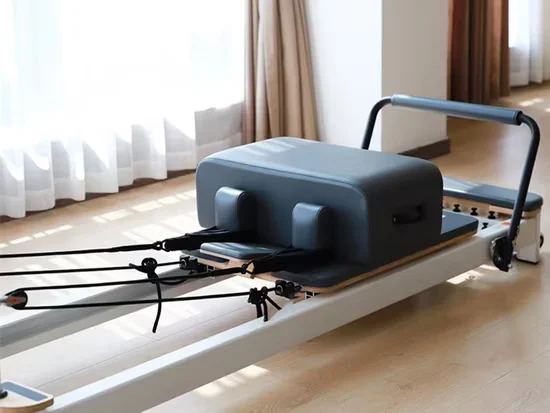
This reformer supports the full continuum from rehabilitation-grade low resistance to advanced athletic conditioning, covering the intensity range that group classes and private sessions demand. In a studio configuration, it pairs with tower units and chairs for apparatus-based circuit programming while occupying a consistent footprint across the training floor. The 2460mm length accommodates tall users through full-range supine and standing exercises. The accessory ecosystem — long box for seated and prone work, jump board for plyometric sequences, platform for standing balance — lets instructors progress clients on a single commercial Pilates reformer machine without reconfiguring the room between sessions.
Continuous Class Schedules and the Studio Environment
Studios running six to eight classes daily push reformer springs and pulleys through thousands of cycles per week. The wood frame requires stable humidity conditions to prevent timber warping that would compromise carriage alignment over time. Floor deployment demands a level surface; uneven flooring introduces lateral carriage drift that accelerates wheel wear. Studios in multi-story buildings benefit from the natural acoustic damping wood provides, though floor-mounted vibration pads further isolate the unit from structural transmission [NEED_CITE: floor loading and vibration isolation standards for group fitness studios]. Adequate clearance around each unit — minimum 600mm on all sides — ensures instructor access during class and safe ingress and egress for participants.
Reading the Spring and Pulley Specifications
Spring resistance on a reformer is not a single number but a progression curve. Light springs deliver gradual tension increase suitable for rehabilitation and controlled eccentric work, while heavy springs provide the linear load advanced practitioners need for strength-focused sequences. The pulley routing determines cable travel and mechanical advantage, affecting how spring tension translates to user-perceived resistance at the carriage. Wood-frame construction introduces natural damping into this system — the timber absorbs high-frequency oscillation from spring recoil, producing a quieter return stroke compared to rigid metal frames. Pulley bearings require periodic inspection for play, and cables need replacement when fraying appears at the carriage attachment point. The three-year warranty signals confidence in spring fatigue life and pulley durability under continuous studio schedules.
The Hidden Cost of Specifying Below Studio Duty Cycle
Reformers built for light home use deploy into boutique studios with predictable results. Springs lose calibration within months under continuous class loads, causing instructors to compensate with verbal cueing that masks inconsistent resistance. Carriage wheels develop flat spots from repetitive stop-start cycles, generating audible thumping that clients notice during quiet concentration phases. Upholstery tears at the shoulder rest and headrest within a single season of high-frequency bookings. The operator then faces partial fleet replacement mid-lease, or worse, negative reviews citing equipment quality [NEED_CITE: equipment failure patterns in commercial Pilates studio environments].
Why This Product Line Addresses Studio Procurement Gaps
Sub-35dB acoustic verification applies across our cardio range, and the same deployment logic governs our Pilates specification — wood-frame damping complements the quiet carriage glide operators require in shared-wall environments. The 10,000-hour durability testing protocol applied to our cardio motors also informs spring and pulley lifecycle validation on this reformer. Full OEM customization extends to logo engraving and color matching, allowing studios to align equipment finish with interior branding. Our 3D layout planning service covers reformer studio configurations, calculating unit spacing, instructor sightlines, and airflow for rooms running heated classes. The six-series cardio family means a facility sourcing reformers can consolidate treadmill, bike, and elliptical procurement through one supply chain. Round-the-clock technical support covers spring calibration guidance and pulley replacement scheduling.
Documentation & Test Records
- CE declaration of conformity applicable to Pilates apparatus classification
- EN 957 test report covering structural load and stability requirements
- ISO 9001 certificate for manufacturing quality management systems
- Noise level test record documenting carriage glide acoustic performance
- Durability test log for spring fatigue and pulley bearing lifecycle
- Motor and mechanical specification sheet with accessory mounting details
Installation, Commissioning & Maintenance
- Allow 2460mm length plus 600mm clearance on all sides for safe participant flow
- Verify floor levelness before positioning; shim if necessary to prevent carriage drift
- Confirm spring tension calibration against manufacturer chart upon first assembly
- Inspect pulley bearings and cable routing quarterly under daily class schedules
- Wipe wood surfaces with pH-neutral cleaner; avoid solvent-based products on timber finish
- Replace carriage wheels when flat-spot vibration becomes audible during slow controlled movements
Request a Studio Equipment Configuration
Provide your studio floor area and planned unit count to receive a 3D layout with instructor sightlines and participant flow mapping. Specify daily class frequency so spring and pulley specifications match your operational duty cycle. Indicate deployment floor level and adjacent occupied spaces to confirm acoustic isolation requirements. State whether logo engraving or custom color matching is needed for brand alignment.
Frequently Asked Questions
Q: How does a wood frame compare to metal for noise in shared-wall studios?
A: Wood naturally dampens vibration from spring recoil and carriage movement, absorbing oscillation that metal frames transmit through floor structures into adjacent rooms. In shared-wall deployments such as boutique studios above retail or beside hotel corridors, this damping reduces audible carriage noise noticeably. Metal frames require supplementary isolation pads to achieve comparable acoustic results.
Q: What spring resistance range should I specify for mixed-level group classes?
A: Mixed-level classes benefit from reformers offering multiple spring weights that instructors can swap between exercises. Light springs suit rehabilitation and controlled eccentric work, while heavier springs deliver the linear load advanced practitioners need. Confirm the included spring set covers this progression before procurement, and verify that spring replacement parts remain available under the warranty period.
Q: Can one reformer support jump board and long box programming simultaneously?
A: The accessory ecosystem on this unit includes long box, jump board, and platform attachments that mount interchangeably to the same frame. Instructors can transition between supine long box sequences and standing jump board work within a single session without relocating the reformer. Confirm accessory mounting hardware is included in the delivery scope when placing your order.
Q: What customization options exist for studio branding alignment?
A: Logo engraving and custom color finishes are available to match your studio interior palette and brand identity. Upholstery color can be coordinated with the wood frame finish. Confirm customization lead time and minimum order quantity during the inquiry stage, as bespoke finishes extend production scheduling beyond standard stock units.
Q: How does wood construction affect long-term carriage alignment?
A: Wood frames require stable humidity environments to prevent timber expansion or contraction that could shift carriage rail geometry. Studios in climate-controlled buildings typically maintain conditions within acceptable ranges. Operators in regions with significant seasonal humidity variation should monitor carriage glide consistency and adjust rail alignment if lateral drift develops over time.


![Beech Wood Pilates Reformer Studio Exercise Pilates Bed [WARN] draft identifier mismatch](https://bicksport.com/wp-content/uploads/2026/08/beech-wood-pilates-reformer-studio-exercise-pilates-bed-warn-draft-identifier-mismatch-8f92fd.webp)