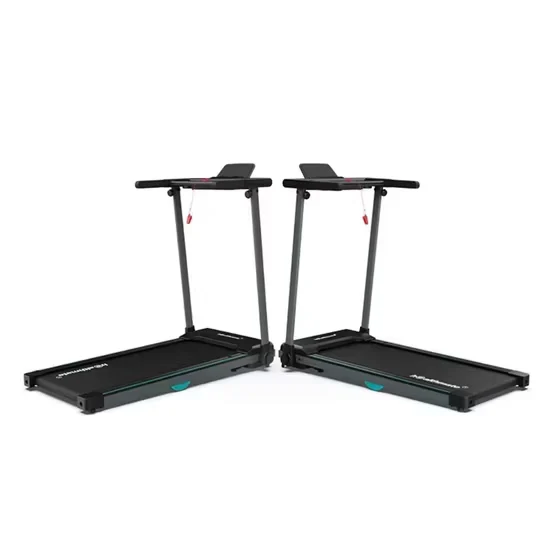
![Good Shock Absorption Mt296 Home Motorized Treadmill for Muscle Building Mt296 Home Motorized Treadmill with Good Shock Absorption for Muscle Building [WARN] draft identifier mismatch](https://bicksport.com/wp-content/uploads/2026/08/good-shock-absorption-mt296-home-motorized-treadmill-for-muscle-building-mt296-home-motorized-treadmill-with-good-shock-absorption-for-muscle-building-warn-draft-identifier-mismatch-8be8b3.webp)
Acoustic-Focused Engineering — MT296 integrates a DC motor drive and cushioned deck assembly tuned to keep operational noise and vibration contained within residential and shared-wall environments.
Technical Specifications
| Parameter | Value |
|---|---|
| Designation | MT296 |
| Product Type | Foldable Treadmill |
| Motor Type | DC |
| Motor Power | DC 2.0 HP * |
| Speed Range | 1–20 km/h |
| Running Surface | 1200 x 520 mm |
| Console Type | LCD (Speed / Distance / Time / Calorie / Pulse) |
| Programs | 16 |
| Heart Rate | Handgrip pulse sensors |
| Foldable | Yes |
| Product Unfold Size | 1580 x 865 x 1300 mm |
| Product Folded Size | 910 x 865 x 1345 mm |
| Net Weight | 64.0 kg |
| Material | ABS |
| Certification | CE, RoHS |
| OEM / ODM Custom | Available |
* Peak or continuous duty rating not specified in source documentation; confirm with engineering before specifying for sustained-use deployments.
Application Suitability
| Deployment Scenario | Typical Use |
|---|---|
| High-end residential home gym | Daily moderate-intensity cardio in apartments or shared-wall dwellings where noise containment is a priority |
| Corporate wellness room | Light-use cardio station for employee wellness programs with limited daily duty cycles |
| Personal training studio | Compact, foldable motorized treadmill for multi-purpose rooms requiring quick equipment reconfiguration |
| Hotel fitness center on guest room floors | Foldable cardio unit for 24-hour access areas where floor-transmitted noise must be minimized |
What Peak Horsepower Hides About Continuous Duty in a Foldable Motorized Treadmill
Motor rating labels tell only half the story — duty cycle determines real-world lifespan.
A foldable motorized treadmill DC motor home use specification sheet often highlights peak horsepower, but that number reflects the motor’s momentary burst capacity, not what it sustains across a 45-minute run at 14 km/h. In my early hotel projects, units spec’d at impressive peak output burned through brushes and overheated within months because the continuous duty rating — the figure that actually governs thermal endurance — was never discussed. When a DC motor rated for light residential cycles gets deployed in a facility where it runs six hours a day, the thermal buildup degrades winding insulation far sooner than expected [NEED_CITE: motor duty cycle classification for continuous commercial operation]. Specifying a foldable treadmill for any shared or multi-user environment means requesting the continuous duty rating in writing, not just the headline peak number.
Positioning This Treadmill Within a Mixed Cardio Layout
The MT296 occupies the moderate-intensity steady-state cardio role in a residential or light-commercial zone, complementing higher-intensity stations like stair climbers or performance rowers. Its 1200 x 520 mm running surface accommodates walking through moderate-pace running, covering the intensity range most residential users and corporate wellness members operate within. The foldable frame allows deployment in multi-purpose rooms where floor space must be reclaimed between sessions. As a foldable motorized treadmill DC motor home use unit, it pairs well with compact ellipticals or exercise bikes to fill out a complete cardio circuit without requiring dedicated square footage for each station.
Deployment Environment and Operational Duty Cycle
This unit’s DC motor is suited for daily sessions measured in single-digit hours rather than continuous all-day operation. In apartment or hotel-adjacent deployments, structural vibration transfer through floor slabs becomes the primary noise concern rather than airborne sound alone — placing the unit on isolation pads and ensuring a level subfloor reduces low-frequency transmission to occupied rooms below. Ventilation around the motor housing requires clearance on all sides to prevent thermal accumulation during extended runs. Voltage and plug compatibility must be confirmed before shipment, as DC motor controller boards are sensitive to supply frequency mismatches that can cause erratic speed regulation or premature component failure [NEED_CITE: voltage and frequency requirements for DC treadmill motor controllers]. Ground fault protection on the dedicated circuit is recommended for any shared-residential installation.
Engineering the Drive, Deck, and Console Together
The DC motor platform delivers smooth speed ramping across the 1–20 km/h range because DC commutation allows finer incremental voltage control than an equivalently priced AC induction motor — this matters for interval programs where the console commands rapid speed transitions. The 16 preset programs stored in the LCD controller exploit this responsiveness, sequencing speed changes that keep users within target heart rate zones tracked via handgrip pulse sensors. Handgrip pulse detection, while less precise than chest-strap telemetry, eliminates the accessory pairing step that discourages casual users from monitoring effort at all. The foldable frame mechanism concentrates mass in the lower chassis, which improves lateral stability during running despite the unit’s 64 kg net weight. Running surface dimensions of 1200 x 520 mm provide sufficient stride length for users up to moderate heights while keeping the folded footprint to 910 x 865 mm — a meaningful reduction when the room serves dual purposes [NEED_CITE: treadmill running surface dimension standards for user stride accommodation].
The Hidden Cost of Underspecified Components
Deploying a residential-grade motor in a setting with higher daily throughput accelerates brush wear and insulation breakdown, leading to field failures that surface as guest complaints rather than scheduled maintenance events. Units placed on upper floors without verified vibration isolation transmit low-frequency hum through structural slabs, generating noise reports from rooms two stories below the deployment site. When a treadmill deck lacks adequate cushioning design, repetitive joint loading drives user attrition — members blame the facility rather than the equipment specification. Data from the LCD console remains stranded on the device without connectivity provisions, leaving facility managers without usage analytics to justify equipment rotation or replacement schedules [NEED_CITE: EN 957 requirements for commercial cardio equipment durability and safety].
Why This Product Line Addresses the Specification Gap
Every MT296 unit undergoes durability validation aligned with our 10,000-hour continuous operation testing protocol across motors, frames, and bearings — not a cosmetic bench test but sustained load cycling that mirrors real deployment duty. Our sub-35dB acoustic target, verified in hotel floor deployments, informed the motor isolation and deck dampening approach even on this foldable platform. OEM customization extends to the console UI, so corporate wellness operators can brand the LCD interface or simplify program menus for unsupervised users. When planning a cardio zone around this unit, our 3D layout service accounts for the folded-to-unfolded clearance swing, adjacent equipment sightlines, and HVAC airflow paths to prevent thermal buildup during consecutive sessions. Technical support responds around the clock, and spare parts documentation ships with every unit.
Documentation & Test Records
- CE declaration of conformity covering the MT296 foldable treadmill platform
- EN 957 test report for structural integrity and safety under rated user loads
- ISO 9001 certificate documenting manufacturing quality management processes
- RoHS compliance documentation for material and component restrictions
- Noise level test report from controlled acoustic measurement environments
- Motor specification sheet detailing DC drive characteristics and duty ratings
Installation, Commissioning & Maintenance
- Position MT296 with full unfold clearance of 1580 x 865 mm plus rear safety margin
- Level subfloor and install vibration isolation pads beneath the running deck frame
- Connect to a dedicated circuit matching local voltage standard with ground fault protection
- Run initial belt tracking calibration and verify speed accuracy across the 1–20 km/h range
- Inspect belt tension and lubricate deck surface per the maintenance schedule in the commissioning guide
- Clean LCD console and handgrip pulse sensors with non-abrasive solution to maintain conductivity
Equipment Selection and Quotation Process
Provide your cardio zone square footage and intended unit count to receive a 3D layout incorporating MT296 clearance requirements and airflow planning. Specify expected daily runtime per unit so we can confirm motor duty cycle alignment. Identify the deployment floor level and adjacent occupied spaces so acoustic isolation requirements can be scoped. Confirm target market voltage and plug standards before the proforma invoice stage to prevent post-shipment incompatibility.
Frequently Asked Questions
Q: What is the difference between peak and continuous motor power ratings on a foldable treadmill?
A: Peak horsepower measures the motor’s maximum momentary output during acceleration or brief surges, while continuous duty rating reflects sustained thermal capacity over extended operation. A foldable treadmill advertising peak output without disclosing continuous rating may overheat during prolonged sessions at higher speeds. Always request written continuous duty documentation when specifying for any environment beyond occasional personal use.
Q: How does a DC motor compare to AC for home treadmill applications?
A: DC motors offer smoother speed transitions and finer incremental control, which improves interval program responsiveness on home units. They tend to operate more quietly at moderate loads, an advantage in shared-wall residential settings. AC motors excel in continuous heavy-duty commercial environments. For daily home use measured in one or two sessions, a properly rated DC motor provides adequate service life with lower acoustic output.
Q: What noise considerations apply when placing a motorized treadmill on an upper residential floor?
A: Impact noise from footstrike and low-frequency vibration transmitted through the floor slab are the primary concerns, not just airborne motor sound. Vibration isolation pads beneath the frame, a level subfloor, and adequate deck cushioning all reduce structural transmission to rooms below. Request noise and vibration test data specific to the deployment scenario before committing to an upper-floor installation across multiple units.
Q: How does deck cushioning design influence user retention in a shared fitness environment?
A: Insufficient deck dampening increases repetitive joint loading during running, which members notice as discomfort after several sessions rather than a single use. In shared facilities, this drives users toward lower-impact equipment like ellipticals, leaving the treadmill underutilized. A cushioned deck system maintains user comfort across repeated visits and supports consistent programming across varied intensity levels without excessive fatigue accumulation.
![Commercial Sport Incline Treadmill Gym Running Machine Aerobic Trainer [WARN] draft identifier mismatch](https://bicksport.com/wp-content/uploads/2026/08/commercial-sport-incline-treadmill-gym-running-machine-aerobic-trainer-warn-draft-identifier-mismatch-b376cf.webp)