
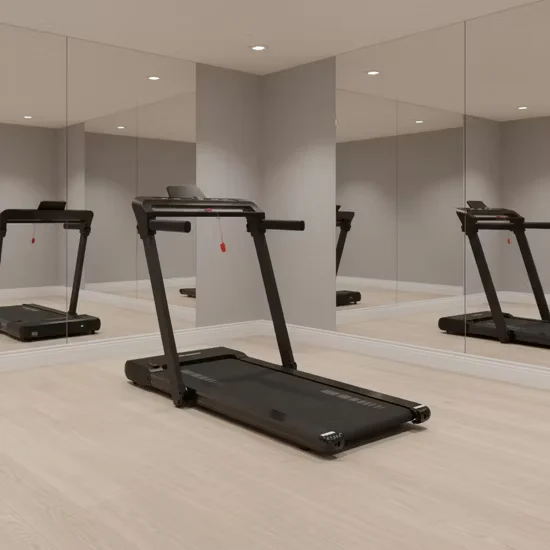
Quiet Operation — DC motor drive keeps noise output low enough for shared residential floors and multi-family deployments where acoustic complaints reach management first.
Technical Specifications
| Parameter | Value |
|---|---|
| Designation | W08 |
| Product Type | Foldable Treadmill |
| Motor Type | DC |
| Motor Power | 1.5 HP* |
| Speed Range | 1–16 km/h |
| Running Surface | 1200 x 450 mm |
| Console Type | LCD (Speed / Distance / Time / Calories) |
| Programs | 16 preset programs |
| Foldable | Yes |
| Product Dimensions (Unfolded) | 1500 x 740 x 1150 mm |
| Product Dimensions (Folded) | 1810 x 740 x 220 mm |
| Net Weight | 42.0 kg |
| Material | ABS |
| Certification | CE, RoHS |
| OEM/ODM Custom | Yes |
| Color Options | Multicolor |
*Peak or continuous duty rating not specified in source documentation — verify with motor specification sheet before deployment planning.
Application Suitability
| Deployment Scenario | Typical Use |
|---|---|
| High-end residential home gym | Daily personal cardio sessions in apartments or compact living spaces where floor area must be reclaimed after use |
| Corporate wellness room | Intermittent employee use during break periods with stowable footprint between sessions |
| Hotel fitness center on guest room floors | Low-impact walking and jogging for guests preferring in-room or adjacent corridor cardio access |
| Boutique home gym integrator projects | Foldable cardio solution for private residences requiring discreet equipment storage |
| Multi-family residential amenity rooms | Shared cardio access in compact common areas with noise-sensitive neighboring units |
Why Acoustic Thresholds Decide Where a Foldable Home Treadmill DC Motor 1.5HP Unit Can Actually Be Deployed
Motor type determines whether the unit runs above occupied rooms without generating noise complaints.
When property managers place cardio equipment on upper floors or beside shared walls, the motor becomes the single most visible failure point — not because it breaks, but because guests and residents hear it. DC motors generate noticeably less acoustic vibration than AC alternatives at comparable output levels, which is why they dominate home and light-commercial deployments. The W08 foldable home treadmill DC motor 1.5HP configuration targets exactly these environments: apartment fitness rooms, hotel guest floors, and corporate wellness spaces where the machine operates intermittently rather than in continuous eight-hour blocks. Specifying a unit without matching motor duty classification to expected daily run-time is how facilities end up replacing entire fleets within a season [NEED_CITE: motor duty cycle classification for intermittent versus continuous commercial operation].
Positioning Within a Compact Cardio Zone
This foldable home treadmill DC motor 1.5HP unit covers walking through moderate-intensity jogging at speeds up to 16 km/h, placing it squarely in the steady-state cardio range rather than high-intensity sprint work. In a small residential or corporate fitness room, it pairs with a compact elliptical or stationary bike to offer lower-body variety without duplicating movement patterns. The 1200 x 450 mm running surface accommodates most adult users at walking and jogging cadences, while the foldable frame allows the room to serve non-fitness functions when equipment is stowed. Deploy it where user turnover is moderate and daily run-times stay within a few hours rather than continuous operation.
Duty Cycle and Deployment Environment Requirements
The DC motor in this unit suits intermittent use patterns — think two to four hours of cumulative daily run-time spread across multiple users — rather than the continuous eight-hour cycles that commercial gym floors demand. Noise output remains compatible with shared-wall residential environments and hotel guest corridors, but confirming actual dB readings at operational speed before installation prevents surprises [NEED_CITE: noise level testing standards for residential cardio deployment]. The 220 mm folded profile fits beneath standard bed frames and inside most closets, which matters when the deployment space doubles as a living area. Ensure the electrical circuit matches your target market voltage and plug standard before the unit ships, and place a vibration-dampening mat beneath the frame when deploying on hard flooring above occupied rooms.
Reading the Drive and Electronics Specifications
DC motors operate at lower acoustic output than AC motors at equivalent horsepower, making them the standard choice for residential and light-commercial cardio where noise travels through floor joists and shared walls. The 1.5 HP rating listed here requires verification against the motor specification sheet to determine whether it represents continuous duty output or peak burst capacity — a distinction that directly affects expected service life under repeated daily use. The LCD console tracks speed, distance, time, and calories across 16 preset programs, providing structured session variety without the app connectivity or touchscreen interfaces found on heavier commercial units. The 1200 x 450 mm belt width and length support full-stride walking and comfortable jogging for most adult users while keeping the overall footprint compact enough for apartment-scale rooms. ABS construction in the shroud and console housing keeps unit weight manageable for repositioning when the frame is folded.
The Cost of Overlooking Specification Details
Facilities that select cardio equipment based on price alone without verifying motor duty ratings against expected daily usage patterns frequently experience premature motor burnout. When light-duty motors fail in shared residential settings, the complaint rarely arrives as a maintenance ticket — it arrives as a noise report from the unit below. Foldable mechanisms on under-specified frames develop hinge play over repeated fold-unfold cycles, creating rattling that compounds acoustic complaints. Voltage mismatches discovered after the container arrives mean either returning units or sourcing transformers, neither of which serves the deployment timeline [NEED_CITE: voltage and plug standard verification before international shipment].
Why This Product Line Earns Its Place in the Portfolio
Every unit in this cardio range undergoes noise verification testing so that dB output can be matched to deployment environment requirements before equipment ships. The 10,000-hour durability testing protocol applies to commercial-grade motors, frames, and sealed bearings across the full six-series lineup — and the foldable models receive additional hinge load-cycle documentation to validate the folding mechanism under repeated use. OEM customization covers console UI, color, and logo so that integrators can align the equipment aesthetic with residential or corporate interior specifications. The free 3D cardio-zone layout service accounts for square footage, sightlines, and member flow patterns specific to each facility, including the clearance envelope this foldable unit requires both when deployed and when stowed. Technical support responds around the clock for commissioning questions and spare parts identification.
Documentation & Test Records
- CE declaration of conformity covering electrical safety and electromagnetic compatibility for European market deployment
- RoHS compliance documentation verifying restriction of hazardous substances in electronic components
- EN 957 test report confirming stationary training equipment safety requirements
- Noise level test report recording dB output at operational speeds for residential deployment approval
- Motor specification sheet detailing continuous versus peak duty ratings and thermal protection thresholds
- Foldable mechanism load-cycle test record documenting hinge durability under repeated deployment
- Installation and commissioning guide with spare parts identification list
Installation, Commissioning & Maintenance
- Maintain at least 500 mm clearance behind the running deck and 200 mm on each side for safe mounting and dismounting
- Place a high-density vibration mat beneath the frame when deploying on hard flooring above occupied rooms to isolate structure-borne noise
- Confirm voltage and plug standard match the target market electrical supply before connecting the DC motor to the circuit
- Run the belt at low speed for several minutes during first commissioning to verify tracking and tension before user handover
- Inspect belt alignment and tension quarterly, adjusting per the installation guide to prevent edge wear and motor strain
- Wipe the LCD console and handrail contact points after each use session to prevent sweat corrosion on electronic surfaces
Planning Your Cardio Equipment Inquiry
Provide the floor area and ceiling height of your intended deployment space to receive a 3D cardio-zone layout showing equipment placement, clearance envelopes, and user flow. Specify expected daily usage hours per unit so that motor duty ratings can be matched to your operational reality. Note the deployment floor and what occupies adjacent or below-grade rooms so that acoustic requirements are confirmed before selection. State your target market voltage and plug standard to prevent post-shipment electrical mismatches. Indicate whether OEM customization for color, logo, or console branding is required for your project.
Frequently Asked Questions
Q: How does a DC motor differ from an AC motor in treadmill applications?
A: DC motors operate at lower acoustic output and suit intermittent duty cycles typical of home and light-commercial use, while AC motors sustain continuous high-frequency operation found in commercial gym floors. Selecting the correct motor type depends on expected daily run-time rather than peak horsepower alone.
Q: Does the 1.5 HP rating represent continuous or peak output?
A: The source documentation does not specify whether 1.5 HP refers to continuous duty or peak burst capacity. Request the motor specification sheet to confirm continuous output ratings, which determine whether the unit can sustain your expected daily usage pattern without thermal overload.
Q: What testing validates the foldable hinge mechanism?
A: Foldable treadmill frames require load-cycle testing that repeatedly folds and unfolds the hinge under rated user weight to confirm latch engagement and structural integrity over time. Request the hinge durability test record before deploying in shared or high-turnover environments.
Q: Is this unit suitable for shared-wall residential environments?
A: DC motor drive produces lower acoustic vibration than AC alternatives, making it appropriate for apartments and multi-family buildings. Confirm actual dB readings at operational speed through the noise level test report to verify compatibility with your specific deployment location and neighboring occupancy.
Q: What workout metrics does the LCD console display?
A: The LCD console tracks speed, distance, elapsed time, and calories burned across 16 preset programs. It does not include Bluetooth, app connectivity, or touchscreen capabilities — external app sync is not supported on this console configuration.


![W08 Folding Motorized Treadmill for Rehabilitation Training [WARN] draft identifier mismatch](https://bicksport.com/wp-content/uploads/2026/08/w08-folding-motorized-treadmill-for-rehabilitation-training-warn-draft-identifier-mismatch-a1d622.webp)
![HSM Walking Pad Durable Design Foldable Treadmill Compact Home Gym [WARN] draft identifier mismatch](https://bicksport.com/wp-content/uploads/2026/08/hsm-walking-pad-durable-design-foldable-treadmill-compact-home-gym-warn-draft-identifier-mismatch-89091f.webp)