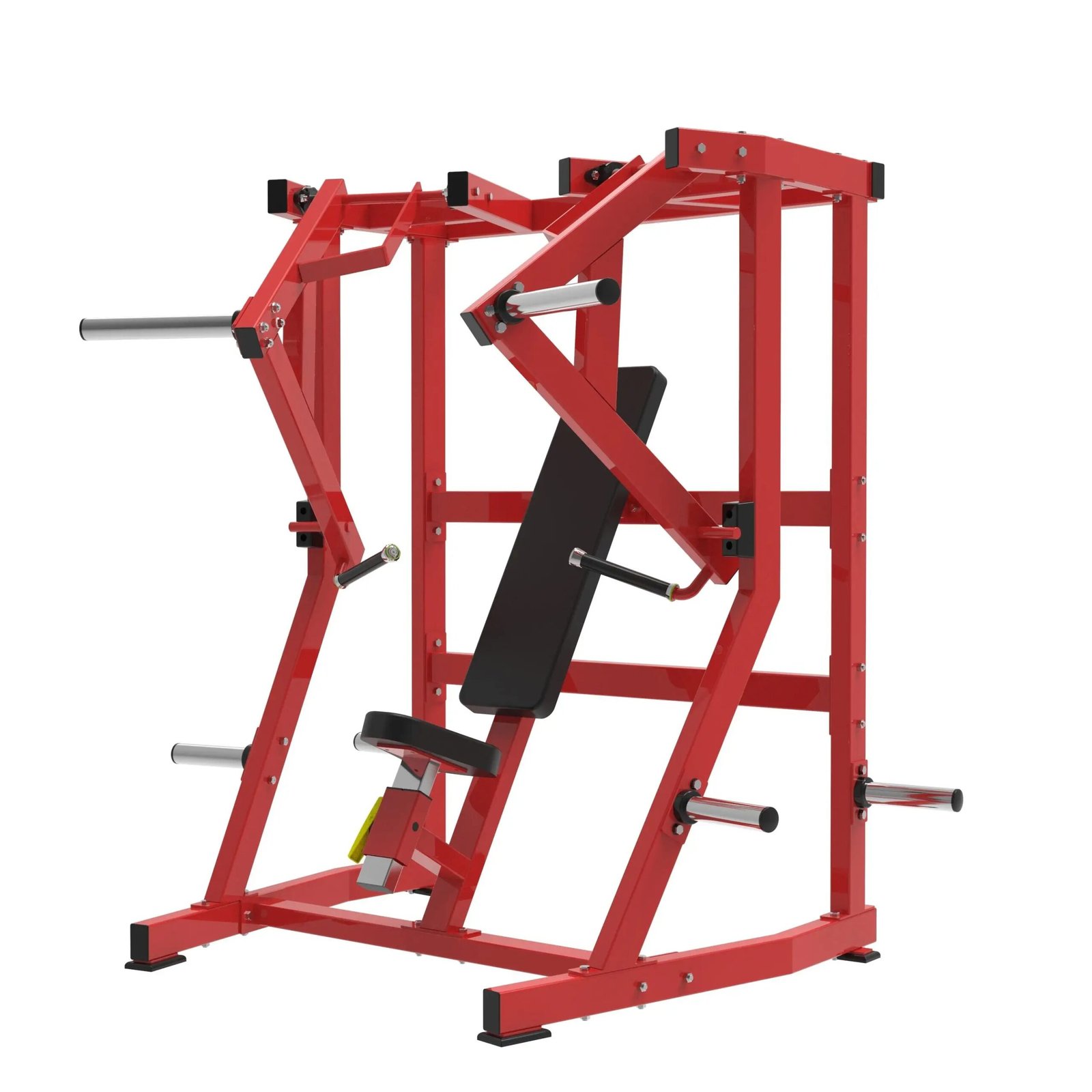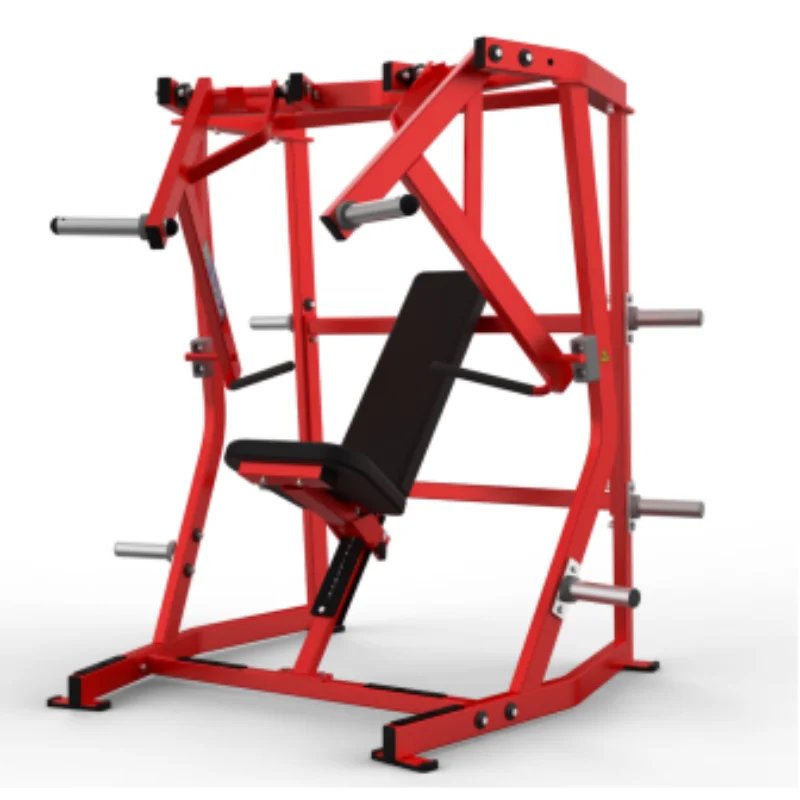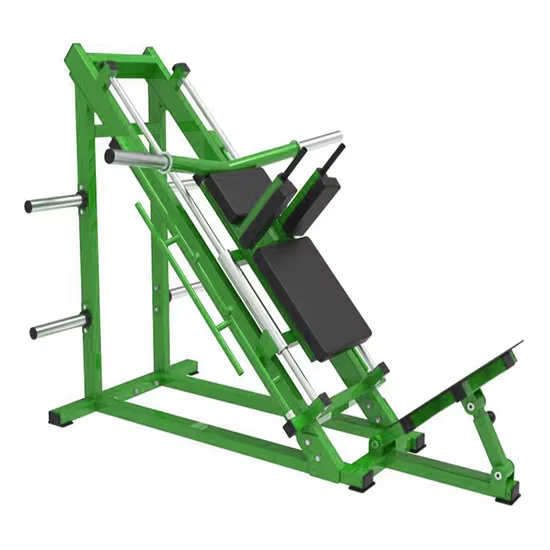
Heavy-Duty Steel Stability — Linear guide rails paired with a reinforced steel frame maintain consistent motion paths even under maximum load during continuous gym rotations.
Technical Specifications
| Parameter | Value |
|---|---|
| Product Type | Linear Hack Press Machine (Strength Equipment — Leg Press) |
| Model NO. | 5038 |
| Drive Type | Linear guide rail with sliding carriage |
| Power Source | Manual (plate-loaded) |
| Exercise Part | Leg |
| Max User Weight | 180 kg |
| Net Weight | 250 kg |
| Product Dimensions | 2375 × 1500 × 1475 mm |
| Frame Material | Commercial-grade steel |
| Foldable | Unfolded |
| Age Group | Adult |
| Gender | Unisex |
| Certification | ISO 9001, CE |
| Customization | Available |
| Appliance | Community, Gymnasium |
| Transport Package | Plywood Box |
| HS Code | 950691190 |
| Production Capacity | 500 PCS/Month |
Application Suitability
| Deployment Scenario | Typical Use |
|---|---|
| Chain gym strength zone | High-frequency leg training with multiple user rotations across peak hours |
| Community fitness center | Accessible leg press for diverse membership base including beginners and seniors |
| Hotel fitness center on guest room floors | Compact linear footprint fitting constrained wellness rooms without vibration transfer |
| Corporate wellness room | Structured leg training for time-limited employee sessions |
| Sports performance training center | Controlled linear movement for athlete lower-body conditioning |
Why Steel Frame Rigidity Matters When Loads Exceed 200 kg on the Sled
A linear hack press machine stands or falls by how its frame handles off-axis force at peak extension.
Commercial gym strength zones see users loading heavy plates and driving through full range, which sends lateral stress into every weld joint. I have watched lighter-gauge frames develop micro-fractures at the carriage-to-rail connection within months of heavy rotation [NEED_CITE: structural fatigue in commercial leg press frames under continuous loading]. When the frame deflects even slightly, the rail alignment shifts, introducing grinding noise and uneven wear. This commercial linear hack press machine addresses that failure point with a 250 kg net weight steel chassis that anchors the guide rails against deflection.
Where This Linear Hack Press Sits in a Commercial Strength Floor
The linear hack press occupies a specific niche between free-weight squats and inclined leg presses. Its vertical sled path recruits quads with reduced spinal loading compared to barbell back squats, making it a go-to for members recovering from lower-back issues or those who lack the mobility for deep free squats. In a fully equipped commercial gym strength zone, this commercial linear hack press machine complements the 45-degree leg press and the leg extension station, covering the full quad development spectrum. The 2375 × 1500 mm footprint requires adequate clearance on all sides for plate loading and user entry. It suits deployment in high-traffic zones where the linear motion path keeps users within a predictable envelope, reducing collision risk in crowded training floors.
Continuous Use Demands and Facility Environment Requirements
In a busy chain gym, a leg press station can see dozens of loaded sets per day, each producing significant downward and lateral force into the floor. The 250 kg steel frame provides a stable base, but the subfloor must be level and rated for concentrated static and dynamic loads [NEED_CITE: commercial gym flooring load requirements for plate-loaded strength equipment]. Deploying on upper floors of hotels or residential buildings requires vibration isolation pads beneath the base feet to prevent structure-borne noise transmission to rooms below. Adequate spacing around the unit ensures plate loading does not interfere with adjacent equipment traffic. Unlike motorized cardio units, this manual plate-loaded machine has no electrical or cooling requirements, simplifying deployment — but the guide rails demand a clean environment free of chalk dust accumulation that can degrade sliding performance over time.
Guide Rail Precision and Frame Weld Integrity Under Load
The linear guide rail system is the heart of this machine’s motion quality. Precision-machined rails with sealed linear bearings reduce friction along the sled path, which directly affects how smooth the press feels at the bottom of the movement where force output peaks. A well-aligned rail also minimizes side-to-side play, keeping the sled tracking true and reducing uneven wear on bearing surfaces. The 250 kg steel frame is welded at critical stress junctions — particularly where the rail mounts meet the base and where the back pad support connects to the main upright. Commercial-grade steel thickness at these junctions resists the cyclic loading that causes fatigue cracks in lighter frames [NEED_CITE: weld fatigue testing standards for commercial strength equipment]. The plate-loaded manual drive eliminates motor and belt maintenance entirely, shifting the service focus to rail lubrication and bearing inspection.
The Hidden Cost of Undersized Frames in Shared Gym Environments
Choosing a lighter, cheaper leg press frame saves on upfront procurement but introduces a cascade of operational problems. Frames that flex under load produce audible creaking during sets, which in hotel and residential deployments travels through floor structures and triggers noise complaints. Rail misalignment from frame deflection accelerates bearing wear, shortening maintenance intervals and increasing spare parts consumption [NEED_CITE: bearing wear rates in misaligned commercial linear guide systems]. Members notice when a sled binds or sticks mid-repetition, and repeat complaints erode confidence in the facility’s equipment quality. In worst-case scenarios, structural fatigue at weld points creates genuine safety hazards that force complete unit removal and replacement — a far greater cost than specifying adequate frame mass from the start.
Why This Product Line Holds Up Across Deployment Types
Every unit in this cardio and strength family goes through durability testing protocols designed for continuous commercial operation, and this linear hack press is no exception. The steel frame and rail system are stress-tested to withstand high-frequency loading cycles that mirror real gym traffic patterns. The 180 kg maximum user weight rating across the commercial range ensures the machine handles the full spectrum of membership demographics without compromise. OEM and ODM customization extends to frame color, logo placement, and pad upholstery, letting chain operators maintain brand consistency across locations. Our 3D layout planning covers strength zone spacing, ensuring this 2375 × 1500 mm unit sits with proper plate-loading clearance and member flow consideration. Documentation includes full maintenance schedules for rail and bearing service, backed by 24/7 technical support response.
Documentation & Test Records
- CE declaration of conformity for commercial strength equipment
- EN 957 test report covering structural integrity and safety
- ISO 9001 quality management system certificate
- Frame and weld fatigue durability test record
- Linear guide rail friction and alignment test report
- Assembly, installation, and commissioning guide with spare parts list
Installation, Commissioning & Maintenance
- Allow minimum clearance around the 2375 × 1500 mm footprint for plate loading access and safe user entry
- Install on level, structurally rated flooring with vibration isolation pads for upper-floor hotel or residential deployments
- Verify rail alignment and sled smoothness during initial commissioning before releasing to member use
- Schedule periodic guide rail cleaning and lubrication based on facility traffic volume and chalk dust exposure
- Inspect weld points and carriage bearings quarterly for signs of fatigue or play under repeated heavy loading
- Wipe down steel surfaces and back pad after each session to prevent sweat corrosion on frame and upholstery
Request a Strength Zone Layout and Equipment Match
Share your facility type, strength zone square footage, and target unit count so we can prepare a 3D layout covering equipment spacing, plate-loading clearance, and member flow. Specify your expected daily traffic volume to confirm this commercial linear hack press machine matches your usage density requirements. Indicate deployment floor level and adjacent occupied spaces so we can advise on vibration isolation and noise transfer prevention. Confirm your target market and any branding customization needs to scope OEM options and delivery timelines.
Frequently Asked Questions
Q: How does a linear hack press differ biomechanically from an inclined leg press?
A: A linear hack press moves the sled along a near-vertical path, placing greater emphasis on quadriceps activation with reduced hip flexion compared to a 45-degree inclined leg press. The vertical track also limits the range of motion at the hip joint, which can benefit users with lower-back sensitivity. Both machines complement each other in a commercial strength zone by covering different angles of lower-body development.
Q: What frame and weld specifications should I verify before purchasing?
A: Request the frame steel gauge thickness, weld penetration depth documentation, and fatigue cycle test records for critical junctions. These documents confirm the frame can withstand repeated off-axis loading without developing micro-fractures at rail mount points. A reputable supplier provides EN 957 structural test reports that validate frame integrity under maximum rated user weight combined with full plate loading.
Q: What maintenance does the linear guide rail system require?
A: Guide rails need periodic cleaning to remove chalk dust and debris that accumulates from heavy use, followed by application of manufacturer-specified lubricant to maintain smooth sled travel. Sealed linear bearings should be inspected quarterly for play or roughness during movement. Facilities with high traffic volumes may need monthly rail service intervals, while lower-traffic deployments can extend to quarterly maintenance cycles.
Q: How should I plan the layout around this machine in a strength zone?
A: The 2375 × 1500 mm footprint requires clearance on at least two sides for safe plate loading and user access. Position the machine away from high-traffic walkways to prevent loaded barbell interference with passing members. Our 3D layout service maps equipment spacing, sightlines, and member flow to ensure the commercial linear hack press machine integrates cleanly with adjacent squat racks and leg press stations.
Q: What OEM customization options are available for chain gym operators?
A: Customization covers frame color, logo placement on the upright, and back pad upholstery material and branding. Console or digital counter options can be discussed for rep-counting integration. MOQ requirements and lead times vary by customization depth, so early communication of branding specifications ensures alignment with your deployment schedule and facility opening timeline.