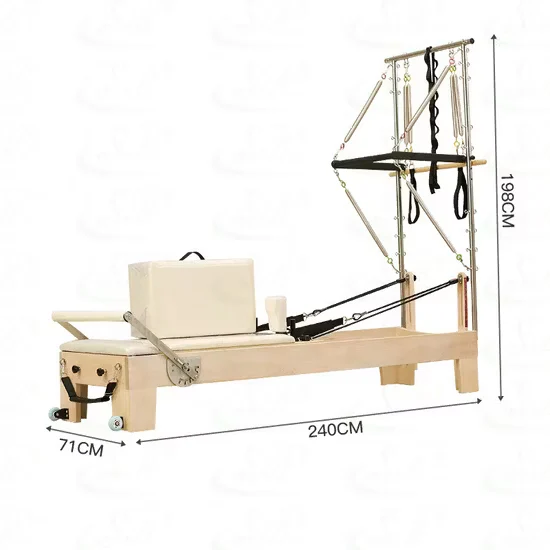
![Factory Wholesale Pilates Reformer for Studio and Home [WARN] draft identifier mismatch](https://bicksport.com/wp-content/uploads/2026/08/factory-wholesale-pilates-reformer-for-studio-and-home-warn-draft-identifier-mismatch-065520.webp)
Reinforced Carriage Stability — Precision rail system eliminates lateral wobble during high-repetition studio sequences.
Technical Specifications
| Parameter | Value |
|---|---|
| Designation | SRY-27 |
| Product Type | Pilates Reformer |
| Frame Construction | Reinforced Steel |
| Carriage System | Precision Rail Glide |
| Product Dimensions | 2570 × 730 × 890 mm |
| Net Weight | 90 kg |
| Accessories Included | Long Box / Jump Board / Platform |
| Logo Customization | Available |
| Color Options | Customizable |
| Certification | ISO 9001, CE |
| Warranty | 3 Years |
Application Suitability
| Deployment Scenario | Typical Use |
|---|---|
| Boutique Pilates studio | Group reformer classes and private sessions requiring accessory versatility |
| Hotel wellness center on guest room floors | Low-noise reformer programming for guests without disturbing adjacent rooms |
| High-end residential home gym | Full-spectrum Pilates training with long box and jump board configurations |
| Corporate wellness room | Compact commercial-grade reformer for employee fitness programs |
Why Carriage Wobble Reaches the Front Desk Before Maintenance Does
A reformer that shakes under continuous class cycles creates noise complaints long before the rail system fails mechanically.
Studios deploying consumer-grade reformers frequently encounter carriage instability during back-to-back group sessions. The lateral wobble generates audible rattling that travels through shared walls, particularly in hotel wellness spaces or multi-tenant fitness facilities. Studio owners often attribute these complaints to instructor technique or member weight variance, when the root cause sits in rail tolerance and frame resonance under repetitive loading [NEED_CITE: rail tolerance specifications for commercial Pilates reformer continuous use].
How the SRY-27 Fits Within a Studio Cardio and Movement Zone
This commercial Pilates reformer studio equipment covers the full spectrum of reformer-based programming, from supine footwork sequences to standing platform exercises and jump board cardiovascular intervals. It complements mat-based stations and tower apparatus by providing spring-loaded resistance across beginner through advanced movement patterns. The 2570 mm length accommodates users of varying heights without requiring reconfiguration between sessions. Deploying this unit in dedicated reformer rooms or shared movement studios supports class densities where multiple units operate simultaneously with minimal acoustic interference.
Continuous Class Scheduling and Studio Environment Requirements
Facilities running four or more group classes daily subject reformer carriages to sustained repetitive loading that tests rail smoothness and frame rigidity. The reinforced steel construction maintains structural integrity under these duty cycles without developing the flex patterns that generate noise transmission through hard flooring [NEED_CITE: structural fatigue testing for commercial reformer frames]. Deployment on upper floors of hotels or mixed-use buildings benefits from the 90 kg unit mass, which provides inherent stability during dynamic jump board work without requiring floor anchoring. Adequate spacing between units—typically 600 mm on each side—ensures instructors can circulate during group sessions while maintaining visual access to member form.
Interpreting Frame Mass, Rail Tolerance, and Accessory Integration
The 90 kg net weight reflects the steel mass required to resist lateral forces during standing and jump board exercises without frame deflection. Lighter reformers often compensate with floor anchoring, which limits reconfiguration flexibility as studio layouts evolve. The precision rail carriage system minimizes the play between carriage wheels and track surfaces, reducing the rattling noise that emerges when rail tolerance widens under continuous use. Accessory compatibility—long box for supine pulling sequences, jump board for cardiovascular intervals, platform for standing balance work—mounts directly to the carriage rail, eliminating the need for separate specialized units that consume additional floor space. This integrated approach lets studio operators expand programming range without proportionally increasing equipment footprint.
What Spec Compromises Cost Studios Over Twelve Months
Consumer-grade reformers with lighter frames develop carriage wobble within months of continuous group class deployment, forcing studios into premature replacement cycles. Incompatible accessory mounting systems limit programming variety, pushing instructors to supplement with mat work that reduces per-member revenue. Noise transmission from frame flex generates complaints from adjacent hotel guests or office tenants, creating lease renewal complications for facility operators [NEED_CITE: noise transmission standards for fitness equipment in multi-tenant buildings].
Why This Product Line Addresses Deployment Pain Points
The reinforced steel frame and precision rail system undergo testing across 10,000 hours of continuous operation to verify carriage smoothness under commercial duty cycles. Full accessory integration—long box, jump board, and platform—ships from a single source, ensuring mounting compatibility across the unit family. OEM customization covers logo placement and color matching for studio chains maintaining brand consistency across locations. The 3D layout planning service accounts for reformer spacing, instructor circulation paths, and airflow requirements specific to movement studio environments. Technical support responds within 24 hours to rail adjustment and accessory mounting inquiries, reducing downtime between scheduled classes.
Documentation & Test Records
- CE declaration of conformity for commercial Pilates reformer studio equipment
- EN 957 test report covering structural integrity and carriage load cycling
- ISO 9001 certificate for manufacturing quality management systems
- Noise level test record documenting carriage glide acoustic performance
- Frame durability test log verifying 10,000-hour continuous operation
- Accessory mounting specification sheet for long box, jump board, and platform
Installation, Commissioning & Maintenance
- Allocate 2570 × 730 mm footprint plus 600 mm clearance on each side for instructor access
- Level floor surface before placement to prevent carriage drift on precision rail system
- Verify accessory mounting interfaces match long box, jump board, and platform configurations
- Inspect rail lubrication quarterly and reapply per manufacturer specification sheet
- Check carriage wheel tension after first 200 hours of use and adjust per service guide
- Wipe steel frame with pH-neutral cleaner after each class to prevent汗液corrosion
Requesting a Studio Layout and Equipment Specification
Provide your reformer room dimensions and planned class capacity to receive a 3D layout with spacing and airflow recommendations. Specify daily class frequency and average member count to confirm the reinforced frame matches your duty cycle requirements. Indicate deployment floor level and adjacent occupied spaces to verify noise transmission aligns with building standards. Confirm target market voltage if integrating electronic accessories, and specify OEM customization scope including logo placement and color requirements for multi-location rollouts.
Frequently Asked Questions
Q: What frame and rail construction details determine carriage stability under continuous studio use?
A: The reinforced steel frame provides mass and rigidity to resist lateral forces during dynamic exercises. Rail tolerance between carriage wheels and track surfaces determines whether wobble develops under repetitive loading cycles. Commercial-grade reformers specify tighter tolerances than consumer units to maintain smooth glide across thousands of class sessions without requiring frequent adjustment.
Q: How does the accessory ecosystem expand programming on a single unit?
A: The long box enables supine pulling sequences for upper body and spinal articulation work. The jump board adds cardiovascular interval training to traditional reformer programming. The platform supports standing balance and lower body exercises. All three accessories mount to the same carriage rail, letting instructors vary class content without moving members between different apparatus.
Q: What OEM customization options are available for studio chain branding?
A: Logo placement, frame color, and accessory finishes can be customized to match studio brand guidelines. Multi-location deployments benefit from consistent visual identity across all units. Minimum order quantities apply for color matching, while logo application accommodates smaller batch sizes for single-studio operators.
Q: How does unit mass affect stability during dynamic exercises without floor anchoring?
A: The 90 kg net weight provides sufficient mass to resist uplift and lateral shift during jump board and standing exercises. This eliminates the need for permanent floor anchoring, allowing studios to reconfigure layouts as class formats evolve. Lighter units typically require anchoring to achieve comparable stability.
Q: What noise considerations apply when deploying reformers in shared-wall environments?
A: Frame flex and carriage rail play generate the primary noise sources in reformer operation. Reinforced steel construction minimizes frame resonance, while precision rail tolerance reduces carriage rattling. These factors combine to keep operational noise low enough for hotel wellness centers and multi-tenant fitness facilities where sound transmission affects adjacent occupied spaces.
![Pilates Reformer Oak Wood Full Track Flat Bed Core Training Equipment [WARN] draft identifier mismatch](https://bicksport.com/wp-content/uploads/2026/08/pilates-reformer-oak-wood-full-track-flat-bed-core-training-equipment-warn-draft-identifier-mismatch-816db0.webp)
![Custom Hot Sale EVA Foam Yoga Block with Soft Non-Slip Surface for Studio Use [WARN] draft identifier mismatch](https://bicksport.com/wp-content/uploads/2026/08/custom-hot-sale-eva-foam-yoga-block-with-soft-non-slip-surface-for-studio-use-warn-draft-identifier-mismatch-0542c9.webp)