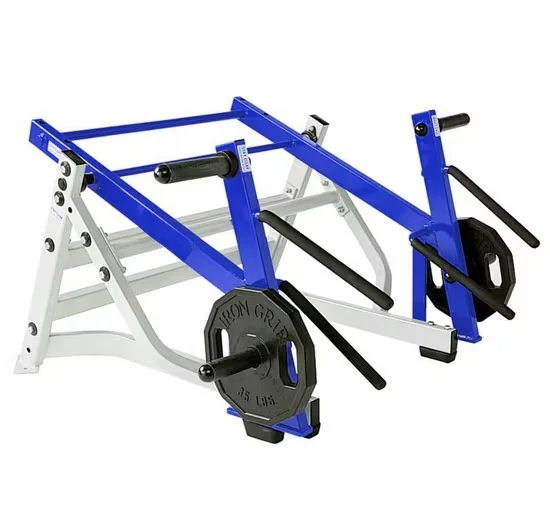
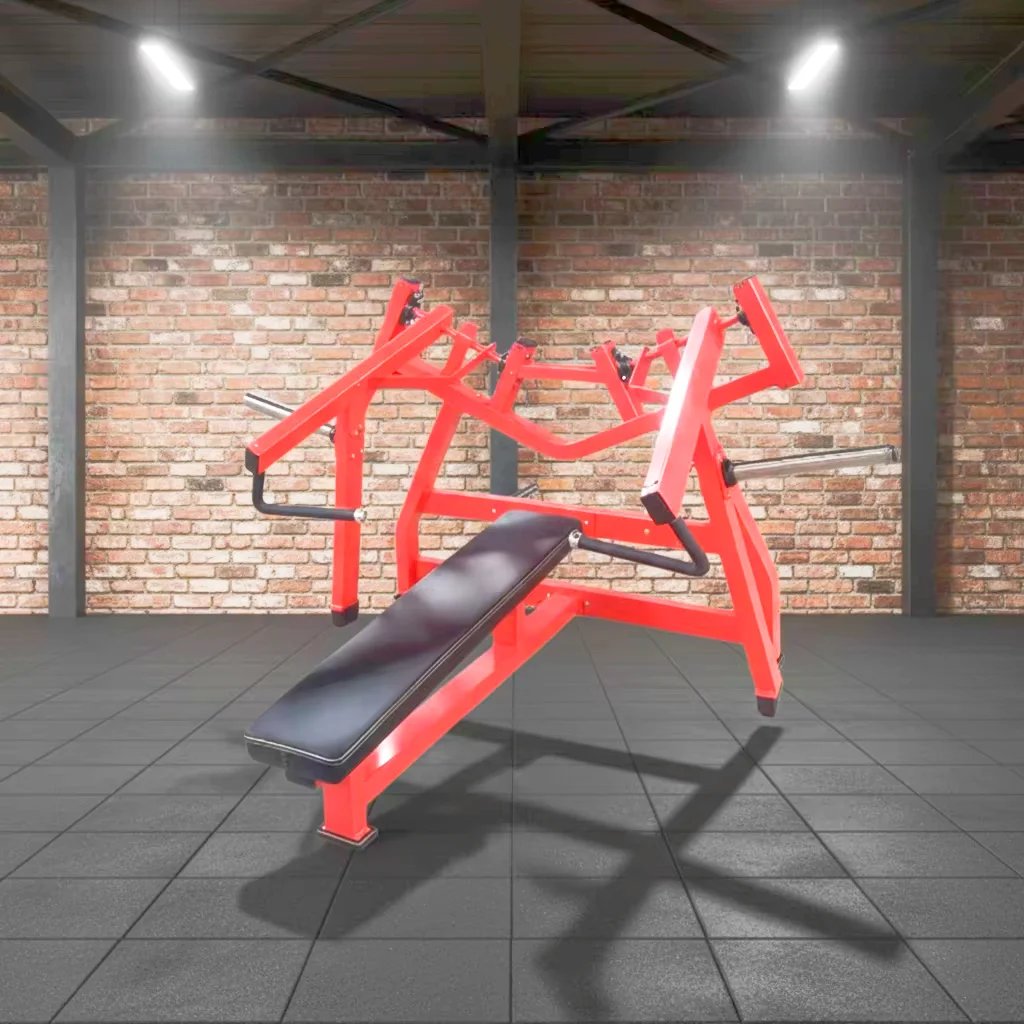
10,000-Hour Durability Validation — The 5016 ISO-Lateral High Row undergoes continuous high-frequency load cycling to verify frame, bearing, and pivot integrity for 24/7 commercial deployment.
Technical Specifications
| Parameter | Value |
|---|---|
| Product Type | ISO-Lateral High Row |
| Designation | 5016 |
| Exercise Target | Back |
| Frame Material | Commercial-Grade Steel |
| Resistance Type | Selectorized weight stack |
| Movement Pattern | ISO-lateral independent arm |
| Max User Weight | 180 kg |
| Product Dimensions | 1837 × 1619 × 2009 mm |
| Net Weight | 149 kg |
| Certification | ISO 9001, CE |
| OEM/ODM | Available with logo, color, and plate customization |
| Transport Package | Plywood case |
| HS Code | 9506911900 |
Application Suitability
| Deployment Scenario | Typical Use |
|---|---|
| Professional gym strength zone | Primary back training station in high-traffic commercial facilities |
| Health club circuit area | Independent arm pulling movements for balanced muscle development |
| Community fitness center | Durable back equipment serving users across varying strength levels |
| Corporate wellness room | Compact high-row station for employee strength programming |
| Hotel fitness center | Guest-accessible back trainer requiring minimal maintenance oversight |
Why Commercial Gyms Replace High Row Machines Within the First Year
Reinforced steel framing and precision pivot bearings keep the 5016 operational when lighter alternatives fail.
Gym operators routinely discover that strength machines rated for light commercial cycles develop play in the pivot assemblies within months of heavy use. The guide rods begin to chatter, the selectorized stack sticks mid-repetition, and members quietly stop using the station. The commercial ISO-lateral high row machine addresses this with sealed bearings and machined guide rods that maintain smooth resistance delivery through thousands of loading cycles [NEED_CITE: commercial strength equipment pivot bearing lifespan under continuous use]. Equipment downtime in a busy gym does not just cost repair invoices — it costs member trust every time a station sits tagged out of order.
Positioning the 5016 in a Commercial Strength Layout
The 5016 occupies the upper-back and lat training slot in a professional gym strength zone, complementing low-row stations, lat pulldowns, and free-weight bench rows. Its ISO-lateral independent arm design allows unilateral pulling so users can address left-right imbalances without switching equipment. The 1837 × 1619 mm footprint fits standard commercial spacing grids, allowing placement along walls or in island configurations with adequate clearance on all sides. The 180 kg user weight capacity accommodates the full range of adult body types encountered in a high-traffic commercial gym. This commercial ISO-lateral high row machine pairs naturally with chest press and shoulder press stations from the same product family to form a complete upper-body training cluster.
Continuous Operation and Deployment Environment Requirements
The 5016 is built for facilities running twelve to eighteen hours daily where strength stations see rotation through dozens of users per shift. Unlike plate-loaded alternatives, the selectorized stack requires no loose weight handling, reducing floor clutter and speeding user turnover. The steel frame requires a level, rigid floor surface — concrete or reinforced composite — with vibration-dampening pads if deployed on upper floors shared with quiet zones. Clearance of at least 600 mm on all sides ensures safe entry and exit during loaded movements. Facilities planning multiple ISO-lateral stations should confirm floor load ratings, as the 149 kg unit weight plus maximum stack loading concentrates force through a compact footprint [NEED_CITE: floor load requirements for commercial selectorized strength equipment].
Selectorized Stack and ISO-Lateral Pivot Engineering
The ISO-lateral mechanism decouples each arm so resistance travels along an independent arc, mirroring natural pulling biomechanics more closely than fixed-bar machines. This design reduces compensatory shoulder rotation when one side is stronger, a common issue with synchronized-arm high rows. Precision-machined guide rods channel the weight stack vertically, eliminating the lateral sway that causes plate friction in lower-tolerance machines. The sealed bearings at each pivot point resist contamination from chalk dust and sweat residue that accumulate in gym environments. Selectorized pin selection allows rapid load changes between users without plate loading, supporting circuit-style programming where timing between stations matters. The steel frame’s reinforced gusseting at high-stress junctions prevents the gradual racking deformation that misaligns pivot geometry over time.
The Hidden Cost of Underspecified Pivot Assemblies
Facilities that purchase strength machines with lightweight pivot hardware face a predictable failure sequence. The bushings wear oval, introducing lateral play that users feel as wobble at the handle. Members stop loading the machine heavily, then stop using it entirely. The selectorized stack begins binding on worn guide rods, and the station earns an out-of-order tag. A commercial ISO-lateral high row machine that cannot maintain alignment under repeated loading becomes dead floor space within a season. Operators who track equipment utilization consistently find that the stations pulled from service earliest are those where pivot tolerances were compromised to reduce manufacturing cost [NEED_CITE: strength machine downtime frequency correlated with pivot bearing specification].
Why the Bicksport Strength Line Fits Your Facility Plan
The 5016 comes from a product family where every station undergoes 10,000-hour continuous load testing before production release. The ISO-lateral pivot assemblies are validated through accelerated cycle testing that simulates years of commercial-frequency use. Bicksport’s engineering team provides 3D strength-zone layouts that account for the 5016’s footprint, user clearance arcs, and sightline positioning so the station integrates cleanly with adjacent equipment. OEM customization extends to frame color, upholstery, and weight stack branding for operators building a consistent visual identity. Full documentation — including frame load test records — ships with every unit so facility managers have verifiable durability data on file. Technical support remains available around the clock for commissioning questions or field adjustments.
Documentation & Test Records
- CE declaration of conformity covering the 5016 ISO-lateral high row
- EN 957 test report validating structural and safety performance
- ISO 9001 certificate for manufacturing quality management
- Frame durability test record confirming 10,000-hour cycle validation
- Selectorized stack and guide rod specification sheet
- Installation guide with floor anchoring and clearance requirements
Installation, Commissioning & Maintenance
- Verify floor is level within tolerance before positioning the 1837 × 1619 mm frame
- Maintain 600 mm clearance on all sides for safe user entry and plate stack access
- Anchor frame to floor using specified bolt pattern to prevent creep under load
- Lubricate guide rods at intervals specified in the commissioning guide
- Inspect pivot bearings quarterly for play and replace if lateral movement is detected
- Wipe handles and frame weekly with non-corrosive cleaner to prevent sweat damage
Equipment Selection and Inquiry Process
Provide your strength zone square footage and planned equipment list so our engineering team can generate a 3D layout with equipment spacing and member flow analysis. Specify your facility’s daily operating hours so we can confirm the 5016’s duty cycle matches your usage profile. Indicate your deployment floor level and adjacent room types so we can address vibration and noise transfer requirements. State your target market voltage and plug standards if any powered accessories are included in your configuration. Confirm whether OEM customization — frame color, upholstery, or weight stack branding — applies to your order.
Frequently Asked Questions
Q: What is ISO-lateral movement and why does it matter for back training?
A: ISO-lateral movement decouples each handle so both arms operate through independent arcs. This allows unilateral pulling that targets each side of the back separately, reducing compensatory patterns where a stronger side dominates the movement. For commercial gym members with muscle imbalances, independent arm action promotes more balanced development and reduces the shoulder rotation common on synchronized-bar machines.
Q: How does independent arm movement help correct muscle imbalances?
A: When each arm pulls independently, a weaker side cannot hide behind a stronger one. The user must generate force symmetrically or the imbalance becomes immediately apparent during the set. Over successive sessions, this feedback encourages equal development. In a commercial gym environment where personal training time is limited, the equipment itself provides corrective stimulus without requiring constant coaching intervention.
Q: What durability testing validates this machine for continuous commercial gym use?
A: The 5016 frame and pivot assemblies undergo 10,000-hour continuous cycle testing that simulates years of high-frequency commercial operation. Guide rods, sealed bearings, and frame welds are inspected at intervals throughout the test to confirm no degradation in alignment or structural integrity. Test records ship with every unit so facility operators can verify the validation data independently.
Q: How do precision bearings and guide rods ensure smooth operation over time?
A: Sealed bearings at each pivot point resist contamination from chalk dust and sweat that accumulate in gym environments. Machined guide rods channel the selectorized weight stack along a true vertical path, preventing lateral sway that causes friction and binding. Together, these components maintain smooth resistance delivery through thousands of loading cycles without the chatter or sticking that signals premature wear.
Q: What maintenance is required for commercial strength equipment in high-traffic facilities?
A: Routine maintenance includes periodic guide rod lubrication at intervals specified in the commissioning guide, quarterly bearing inspections for lateral play, and regular cleaning of handles and frame surfaces to prevent corrosive sweat buildup. Selectorized weight stacks should be checked for smooth pin engagement. Following the documented maintenance schedule keeps the 5016 operational and extends service life in demanding commercial environments.
![OS-H5067 Adjustable Bench Incline Flat Decline Strength Equipment for Commercial Gyms [WARN] draft identifier mismatch](https://bicksport.com/wp-content/uploads/2026/08/os-h5067-adjustable-bench-incline-flat-decline-strength-equipment-for-commercial-gyms-warn-draft-identifier-mismatch-7c4e84.webp)