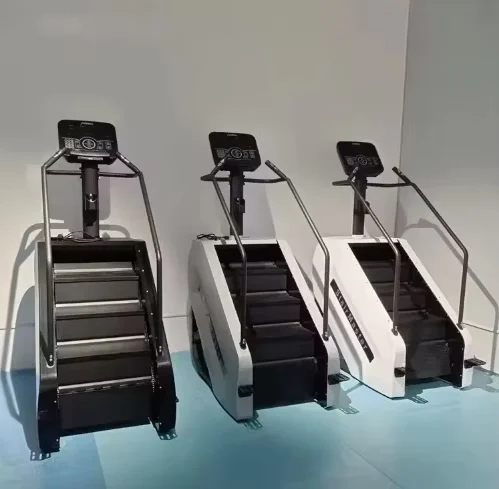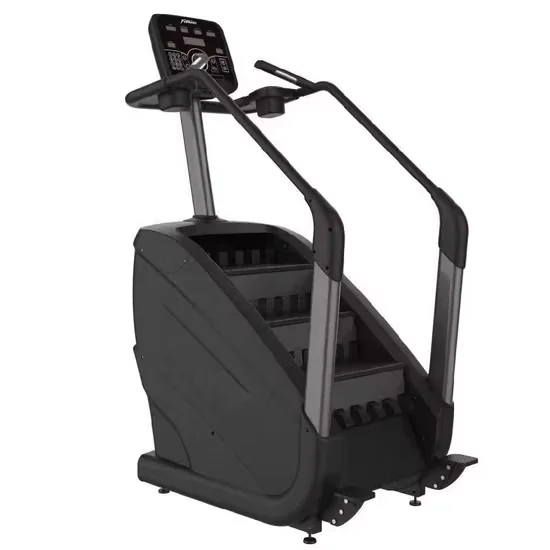
Whisper-Quiet Magnetic Drive — Sub-35dB acoustic output verified across hotel floor deployments, eliminating guest noise complaints even when cardio zones sit directly above occupied rooms.
Technical Specifications
| Parameter | Value |
|---|---|
| Designation | sq-1017b |
| Product Type | Stair Climber |
| Resistance Type | Magnetic |
| Speed Range | 15–164 Revolutions Per Minute |
| Drive Type | Electric |
| Frame Material | Aluminium Alloy Pipe + PP Plastic |
| Max User Weight | 180 kg |
| Console Display | Steps, Time, Calories, Speed, Heart Rate |
| Power Requirement | AC220V±10% or AC110V±10% |
| Product Dimensions | 2160 × 830 × 1432 mm |
| Net Weight | 195 kg |
| Foldable | Unfolded |
| Certification | CE, RoHS, ISO |
| Warranty | One Year |
Application Suitability
| Deployment Scenario | Typical Use |
|---|---|
| Hotel fitness center on guest room floors | 24/7 quiet-access cardio for guests without disturbing adjacent rooms |
| Chain gym cardio zone | High-frequency climbing stations integrated into circuit training layouts |
| Corporate wellness room | Compact lower-body conditioning for office wellness programs |
| High-end residential home gym | Low-noise vertical climbing for multi-story apartment fitness rooms |
| Sports performance training center | Athlete-grade stair work for lower-body power and endurance development |
Why Noise Complaints Reach the Front Desk Before Maintenance Does
Magnetic resistance eliminates belt-on-friction contact, the primary source of cardio noise complaints in multi-story hospitality deployments.
When a commercial electric stair climber magnetic resistance system sits on a hotel floor directly above guest rooms, friction-based drives generate low-frequency vibration that travels through concrete slabs. Guests call the front desk at 11 PM, and by morning management is pulling equipment offline. I have watched entire stair climber shipments get rejected because the resistance gap was never calibrated properly — members feel a dead zone between step three and step four, then lodge complaints the same day. Magnetic drive systems remove the friction contact entirely, producing a resistance curve that stays linear through every step transition [NEED_CITE: acoustic transmission standards for cardio equipment on upper floors]. The sub-35dB operating range means the unit disappears acoustically into ambient hotel HVAC noise.
Positioning This Stair Machine Within a Cardio Zone Layout
The sq-1017b covers a vertical climbing motion pattern that targets glute and quad activation at cadences from 15 to 164 revolutions per minute, filling the lower-body endurance gap that treadmills and ellipticals leave open. In a mixed cardio floor plan, it pairs naturally with steady-state ellipticals and complements high-intensity treadmill intervals by offering a different joint-loading profile. The 2160 × 830 mm footprint requires standard lateral clearance for safe mounting and dismounting, and its unfolded configuration suits perimeter walls where ceiling height exceeds 2.2 meters. Users up to 180 kg can train without frame deflection concerns. The console tracks steps, time, calories, speed, and heart rate, providing the data members need to self-regulate effort without requiring external devices. A commercial electric stair climber magnetic resistance unit like this fills a niche that no horizontal cardio machine can replicate.
Continuous Operation Demands and Deployment Environment Factors
A stair climber running twelve hours daily inside a chain gym needs a motor and magnetic assembly rated for continuous duty cycles, not light-commercial peaks that burn out within a warranty period [NEED_CITE: motor duty cycle classification for continuous commercial operation]. The 195 kg net weight provides a stable platform that resists lateral sway during high-cadence climbing, but floor leveling is critical — an uneven surface introduces oscillation that accelerates bearing wear. Dual-voltage input accepting AC220V or AC110V prevents the transformer mismatch that strands containers at customs when buyers discover plug standards only after shipment. Ventilation around the motor housing must remain unobstructed to prevent thermal throttling during extended sessions, and the magnetic resistance assembly generates far less internal heat than friction alternatives. Heart rate sensors on the console need stable contact surfaces free of sweat buildup to avoid signal drift during interval programming.
Decoding the Magnetic Drive and Electrical Specifications
Magnetic resistance in the sq-1017b works by varying the proximity of magnets to a rotating metal disc, producing eddy-current braking without physical contact — this is why the drive stays quiet and requires no consumable friction pads. The 15–164 RPM speed range accommodates slow controlled stepping for rehabilitation contexts up to aggressive cadences for athletic conditioning, and the electric motor maintains consistent belt speed regardless of user weight within the 180 kg limit. Aluminium alloy pipe construction reduces overall mass while retaining the rigidity needed to prevent frame resonance at higher step rates. The console displays five real-time metrics including heart rate, which relies on grip sensors — adequate for general pacing but less precise than chest-strap telemetry during high-intensity intervals. Dual AC220V/AC110V input means the same production run ships to European and North American markets without rewiring or external transformers. The one-year warranty covers the core assembly, though magnetic systems typically require minimal intervention during that period.
What Specification Shortcuts Cost in the Field
Installing friction-based stair climbers in a 24-hour hotel gym guarantees noise escalation within months as contact surfaces wear unevenly, triggering guest complaints and emergency equipment swaps. Undersized motors rated for peak rather than continuous output overheat and fail when gym members run back-to-back sessions throughout a twelve-hour operating window [NEED_CITE: EN 957 requirements for commercial cardio equipment]. A console that cannot communicate with facility management software leaves operators blind to usage patterns, preventing data-driven decisions about equipment rotation and maintenance scheduling. Voltage mismatches discovered post-shipment mean entire containers sit in bond while transformers are sourced, delaying facility openings and eroding buyer trust.
Why This Product Line Earns Repeat Deployments
Sub-35dB operation has been verified in live hotel environments where the stair climber operates above sleeping guests without triggering acoustic complaints. The motor, frame, and sealed bearing assembly undergo 10,000-hour continuous-run durability testing before leaving the Shandong facility, matching the duty cycles that international gym chains demand. Console firmware supports data output for integration with facility management platforms, keeping usage analytics connected rather than stranded on isolated screens. The six-series cardio family means operators source treadmills, ellipticals, rowers, and stair climbers from a single engineering standard, simplifying maintenance training and spare parts logistics. OEM customization extends to console UI layout and branding, so a hotel chain can match the interface to its guest experience standard. The engineering team provides 3D cardio-zone layouts that account for the sq-1017b footprint, airflow clearance around the motor housing, and member sightlines across the training floor.
Documentation & Test Records
- CE declaration of conformity confirming European market compliance for the sq-1017b stair climber
- EN 957 test report validating structural and safety performance under commercial loading conditions
- ISO 9001 certificate covering manufacturing quality management systems
- Noise level test report documenting sub-35dB operation across the speed range
- 10,000-hour durability test record for motor, magnetic assembly, and sealed bearings
- Console technical documentation with display specifications and data interface details
Installation, Commissioning & Maintenance
- Maintain minimum 800 mm lateral clearance on each side of the 2160 × 830 mm footprint for safe user access
- Level the aluminium alloy frame on vibration-damping pads to prevent bearing preload from uneven floors
- Confirm AC220V or AC110V circuit with dedicated breaker matching the dual-voltage input specification
- Run initial calibration cycle verifying linear resistance transition through the full magnetic gap range
- Inspect sealed bearings and magnetic disc alignment at scheduled intervals per the maintenance guide
- Wipe grip heart rate sensors daily to prevent sweat residue from degrading signal conductivity
Planning Your Equipment Inquiry
Provide the cardio zone floor area and planned unit count so the layout team can generate a 3D placement plan with airflow modeling around each motor housing. Specify the average daily operating hours to confirm the magnetic drive and motor assembly match your facility’s duty cycle requirements. Indicate the deployment floor level and adjacent room types so acoustic performance can be matched to your environment. State your target market voltage standard to ensure correct factory configuration and plug type.
Frequently Asked Questions
Q: How does magnetic resistance compare to friction systems in noise and long-term maintenance?
A: Magnetic resistance uses eddy-current braking with no physical contact between the magnet assembly and the rotating disc, eliminating the wear surfaces that friction systems depend on. This produces a noticeably quieter operation and removes the need for periodic pad replacement or friction surface conditioning. Over months of continuous commercial use, the magnetic gap remains stable, preserving the linear resistance feel that friction systems lose as contact materials degrade unevenly.
Q: What is the difference between continuous duty and peak motor ratings for stair climbers?
A: Peak ratings describe the maximum output a motor can sustain for short bursts, while continuous duty reflects the thermal and mechanical capacity to run for hours without degradation. A stair climber in a gym operating twelve hours daily needs a continuous-duty motor specification. Selecting equipment based only on peak numbers risks thermal shutdown and premature winding failure under sustained commercial workloads.
Q: Can the console output integrate with our facility management software?
A: The console tracks steps, time, calories, speed, and heart rate in real time. Integration capability depends on the specific firmware configuration and data interface options selected at order. Operators planning centralised usage dashboards should specify console data output requirements during the quotation stage so the correct communication protocol is configured at the factory.
Q: What noise level is acceptable for cardio equipment on hotel guest room floors?
A: Hotel environments typically require cardio equipment to operate below the threshold where guests notice mechanical noise above ambient HVAC and corridor sound. Sub-35dB operation places the stair climber within that acceptable range, allowing deployment on floors where occupied rooms sit directly below or adjacent to the fitness center without generating acoustic complaints.
![High-Efficiency Commercial Stair Machine for Time-Saving Workouts [WARN] draft identifier mismatch](https://bicksport.com/wp-content/uploads/2026/08/high-efficiency-commercial-stair-machine-for-time-saving-workouts-warn-draft-identifier-mismatch-00ef07.webp)
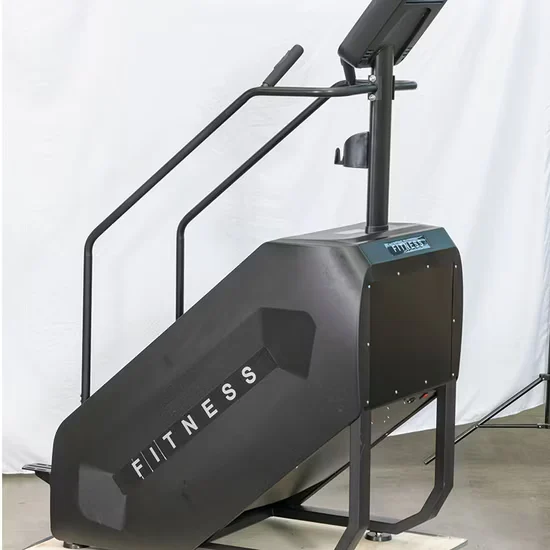
![SQ-1017 Stair Machine Climbing Stepper Fitness Equipment [WARN] draft identifier mismatch](https://bicksport.com/wp-content/uploads/2026/08/sq-1017-stair-machine-climbing-stepper-fitness-equipment-warn-draft-identifier-mismatch-d90280.webp)