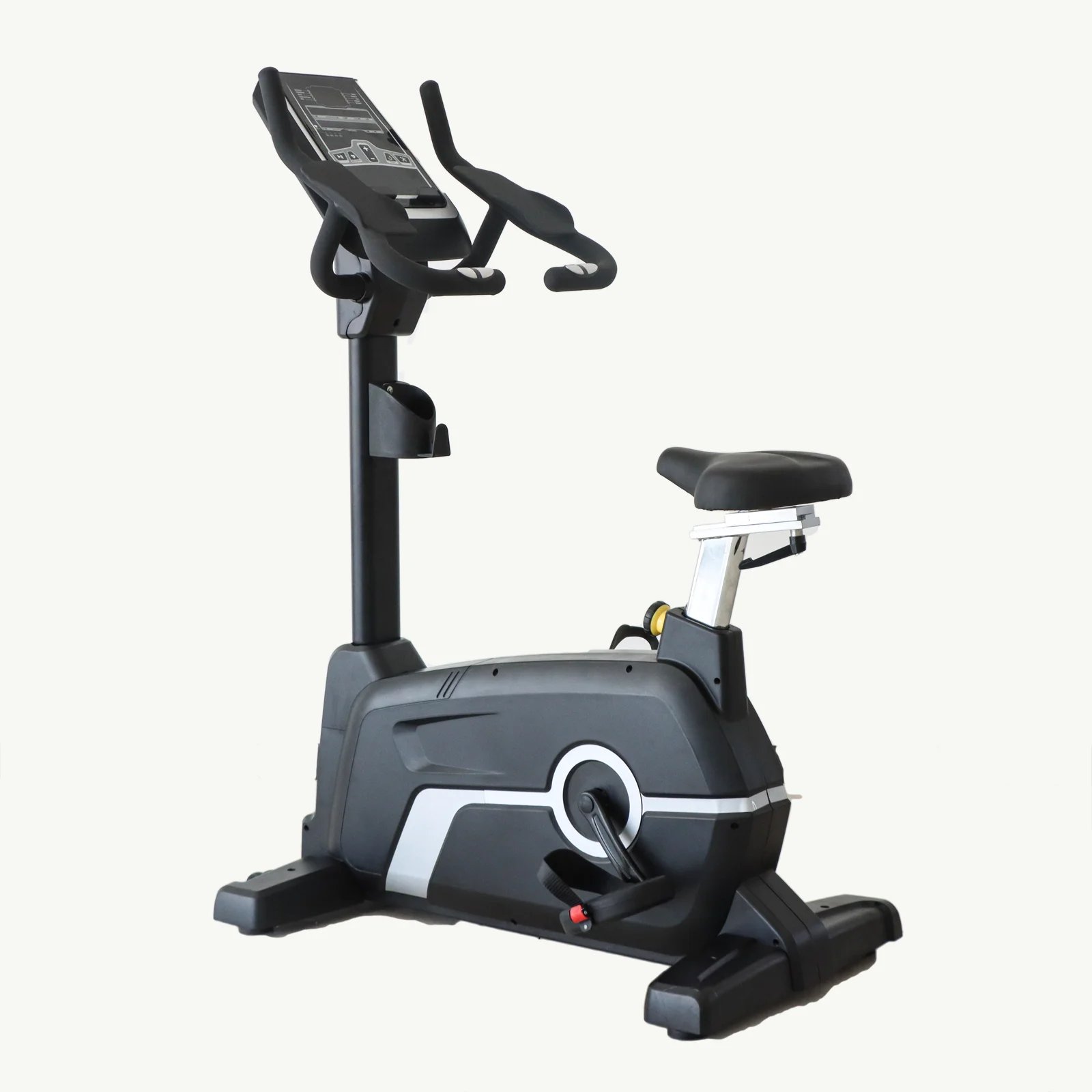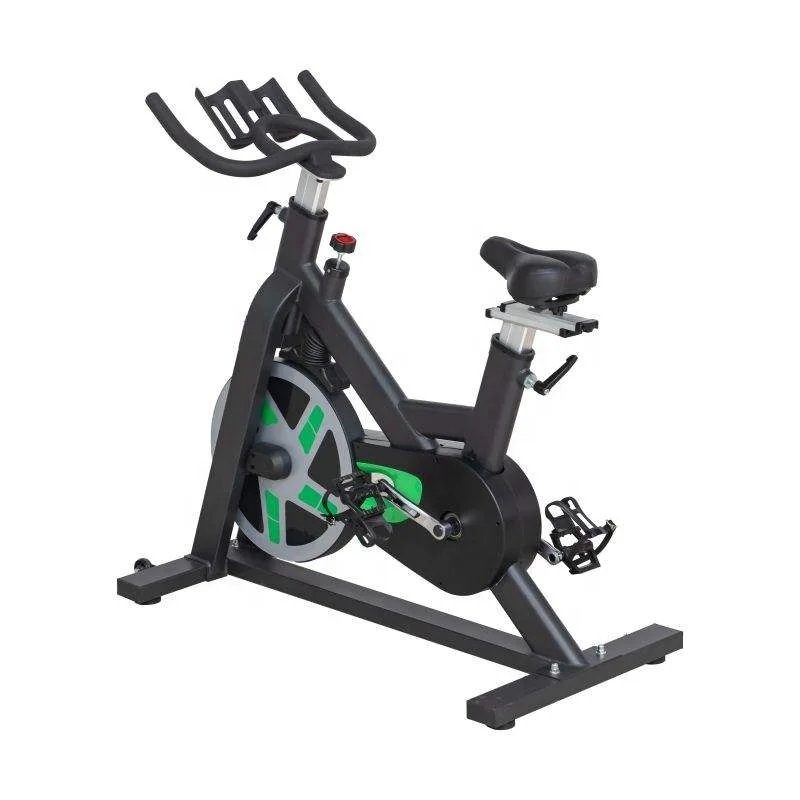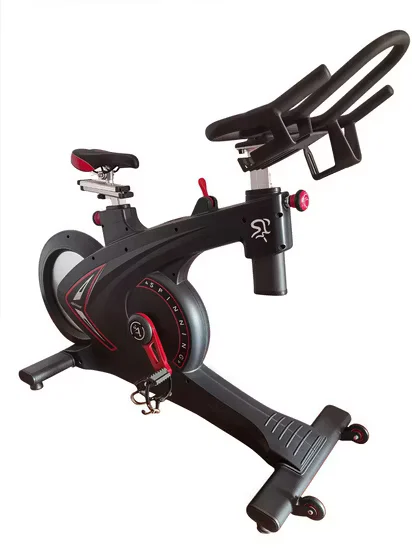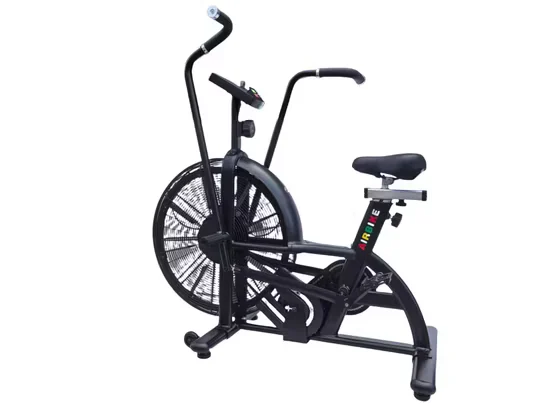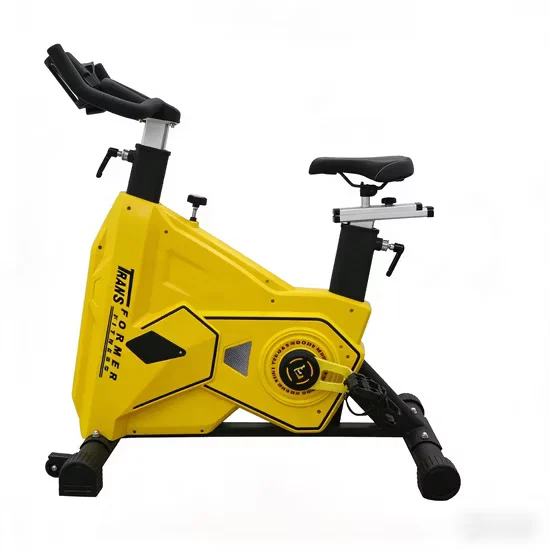
Quiet Belt Drive — Leather belt transmission eliminates chain noise and lubrication for shared commercial fitness floors.
Technical Specifications
| Parameter | Value |
|---|---|
| Product Type | Spin Bike |
| Resistance Type | Power-Style Friction Adjustment |
| Drive Type | Leather Belt |
| Flywheel Weight | Not specified |
| Max User Weight | 150kg |
| Console Type | Optional basic LCD or smart HD touchscreen |
| Connectivity | App sync available with smart console option |
| Heart Rate | Handlebar pulse sensors |
| Noise Level | Sub-35dB operation verified |
| Product Dimensions | 1010 × 580 × 1170mm |
| Net Weight | 50-59kg |
| Foldable | Unfolded fixed-frame |
| Certification | CE, GS, RoHS, FCC |
| Warranty | Commercial warranty available |
Application Suitability
| Deployment Scenario | Typical Use |
|---|---|
| Five-star hotel fitness center on guest room floors | 24-hour self-service cycling with noise containment |
| Chain gym cardio zone | High-frequency group spinning classes and open studio sessions |
| Corporate wellness room | Employee midday cycling with minimal sound transfer to offices |
| High-end residential home gym | Daily use without disturbing adjacent living spaces |
| Sports performance training center | Athlete interval conditioning with consistent friction resistance |
Why Belt Drive Matters When Noise Complaints Reach the Front Desk First
Chain-driven spin bikes create maintenance noise and lubrication mess that commercial facilities cannot ignore.
I remember a five-star hotel in Qingdao that installed chain-drive spin bikes on the same floor as premium suites. Within weeks, guests reported metallic rattling during early morning cycling sessions. The facility manager had to relocate the entire cycling studio to a basement level, losing prime square footage. Belt-drive systems like this commercial spinning bike belt drive gym fitness equipment eliminate that metallic contact noise entirely. The leather belt transmits pedal force to the flywheel without the grinding harmonics that chain links produce under load. For hotel fitness floors and multi-tenant residential gyms, this difference determines whether equipment stays deployed or gets banished to unused corners [NEED_CITE: acoustic standards for cardio equipment on occupied floors].
Cycling Studio Positioning in the Cardio Zone
This spin bike fills the high-intensity interval and endurance cycling role within a commercial cardio layout. It pairs with treadmills for steady-state work and ellipticals for low-impact recovery sessions, giving members a complete cardiovascular training spectrum. The fixed-frame footprint of 1010 × 580mm allows tight studio configurations for group cycling classes where instructors need clear sightlines across rows of riders. The 150kg maximum user weight accommodates the broad commercial demographic without requiring separate heavy-duty units. Friction resistance adjusts through a simple tension knob, letting riders dial from light recovery spins to standing climb intensity without waiting for electronic motor response. The optional smart HD console can capture cadence, distance, and session duration data for facility usage tracking.
Continuous Operation and Deployment Environment Requirements
Commercial spinning bikes in group cycling studios typically run for back-to-back classes with minimal rest between sessions. This leather belt drive system handles continuous duty cycles because the belt does not require lubrication between classes — a chain system would need attention every few days under the same schedule. Noise transmission through floor structures remains a concern when cycling studios sit above conference rooms or guest corridors, and the sub-35dB verified output keeps this unit below typical complaint thresholds. Facilities should provide level flooring with vibration-dampening mats under each bike to prevent resonance transfer to the structure below. Standard voltage compatibility should be confirmed before shipment to match local power grids, especially for international deployments where plug types and frequency standards vary [NEED_CITE: voltage standard requirements for international commercial fitness equipment]. Adequate airflow planning around the cycling zone prevents heat buildup during fully booked group sessions.
What the Leather Belt and Friction Resistance Deliver
The leather belt drive replaces the traditional roller chain with a continuous loop that grips the flywheel pulley through friction rather than tooth engagement. This eliminates the metallic clicking and periodic chain stretch that plague chain-drive bikes in high-frequency environments. Belt tension adjustment is straightforward — a single bolt on the flywheel bracket sets the preload, and replacement intervals extend far beyond chain service life. The power-style friction resistance uses a brake pad pressing against the flywheel rim, generating resistance through direct mechanical contact rather than magnetic eddy currents. This approach trades the infinite micro-adjustment of magnetic systems for mechanical simplicity that field technicians can service without electronic diagnostics. The tradeoff is intentional: friction mechanisms tolerate sweat contamination, temperature swings, and rough handling that would damage magnetic sensor arrays. The fixed unfolded frame eliminates folding hinge joints that develop play and creak over thousands of mount-dismount cycles, maintaining structural rigidity across the full 150kg user range.
The Hidden Cost of Specifying Below Commercial Duty
Facilities that purchase residential-grade spin bikes for commercial cycling studios face predictable failures. Light-duty frames develop cracks at the seat post junction after months of high-frequency mounting. Friction mechanisms designed for occasional home use lose calibration within weeks of daily class schedules, creating inconsistent resistance that frustrates riders and instructors alike. Belt systems on residential units often use lower-grade materials that stretch and slip under sustained heavy loads, requiring constant retensioning. When noise levels exceed what adjacent spaces tolerate, the entire studio relocation cost dwarfs the initial savings on equipment procurement. Data isolation from non-connected consoles means facility managers cannot track peak usage hours or identify underutilized time slots for class scheduling optimization [NEED_CITE: total cost of ownership for commercial versus residential cardio equipment].
Why This Product Line Covers the Cardio Deployment
Every unit in this commercial spinning bike belt drive gym fitness equipment family undergoes sub-35dB acoustic verification before leaving the Shandong facility, ensuring deployment on noise-sensitive floors does not generate guest complaints. The 10,000-hour continuous operation testing on motors, frames, and bearings applies across all six cardio series, meaning facility operators source treadmills, ellipticals, rowers, and climbers from one validated product line. The smart HD console option integrates with facility management software for usage analytics and member app synchronization, eliminating data stranded on standalone displays. OEM customization extends to console UI branding and color matching for hotel or gym chain identity requirements. The free 3D cardio-zone layout service accounts for this spin bike’s specific footprint and spacing needs alongside adjacent equipment, planning member flow and airflow simultaneously rather than treating placement as an afterthought. Technical support responds around the clock with spare parts documentation, reducing downtime when maintenance issues arise.
Documentation & Test Records
- CE declaration of conformity for European market commercial fitness deployment
- EN 957 test report covering structural integrity and safety requirements
- ISO 9001 certificate documenting quality management in manufacturing processes
- Noise level test report verifying sub-35dB operation under loaded cycling conditions
- Durability test record confirming component performance through extended continuous operation cycles
- Installation and commissioning guide with spare parts list for this spin bike model
Installation, Commissioning & Maintenance
- Maintain minimum 600mm clearance behind and beside each bike for safe mounting and instructor access
- Level the floor surface and install vibration-dampening mats beneath the 50-59kg frame to prevent structure-borne noise
- Confirm local voltage and plug standard before powering the optional smart console to avoid commissioning delays
- Set belt tension during initial setup and document baseline friction pad contact pressure for future reference
- Wipe down the leather belt and friction mechanism weekly to remove sweat residue that accelerates wear
- Calibrate the console cadence sensor and verify data output to facility management software after installation
Equipment Selection and Quotation Process
Provide your cycling studio dimensions and target bike count to receive a 3D layout showing member flow paths and ventilation clearance around each unit. Specify the expected daily class schedule and total operating hours so the deployment recommendation accounts for continuous duty requirements. Identify whether the studio sits above occupied spaces that impose noise constraints, and confirm the target market’s electrical standards before production begins. Indicate whether console data integration with existing facility management software or member apps is required, as this determines which console option enters the quotation.
Frequently Asked Questions
Q: How does belt drive compare to chain drive for controlling noise in commercial cycling studios?
A: Belt drive systems transmit pedal force through a continuous leather loop rather than metal-on-metal chain links, eliminating the rhythmic clicking that chain drives produce under load. This makes belt-driven spin bikes suitable for deployment on hotel floors or above occupied commercial spaces where noise complaints escalate quickly. Belt systems also require no lubrication, removing the maintenance mess and recurring service intervals that chain drives demand in high-frequency group cycling environments.
Q: What are the maintenance differences between friction and magnetic resistance on spin bikes?
A: Friction resistance uses a mechanical brake pad pressing directly against the flywheel, creating a system that field technicians can adjust or replace with basic tools and no electronic diagnostics. Magnetic resistance relies on sensors and electronic controllers that can fail from sweat contamination or voltage fluctuations common in busy gym environments. Friction systems tolerate rough handling and temperature variations better, though they require periodic pad inspection and tension recalibration to maintain consistent resistance feel across all bikes in a studio.
Q: What is the practical difference between 150kg and 180kg user weight ratings for commercial spin bikes?
A: A 150kg rating accommodates the vast majority of commercial gym members while keeping frame weight and material costs controlled for large studio deployments. The 180kg rating typically requires heavier-gauge steel tubing and reinforced weld joints, adding unit weight and purchase cost. Facilities serving general commercial populations find 150kg sufficient, while sports performance centers training larger athletes may need the higher rating. The choice affects both upfront procurement budget and long-term structural durability under continuous cycling loads.
Q: Can this spin bike connect to facility management software for usage tracking?
A: The optional smart HD console supports app synchronization and workout data export, enabling integration with facility management platforms that track equipment utilization across a gym network. Basic LCD console variants operate as standalone units without connectivity, suited for facilities that do not require digital usage analytics. Specifying connectivity needs during the quotation phase ensures the correct console enters production, avoiding costly field upgrades after deployment.
Q: What daily maintenance does a leather belt drive require in high-frequency commercial use?
A: Leather belt drives require minimal daily attention compared to chain systems — no lubrication is needed, and sweat contamination wipes clean with a damp cloth. Weekly inspections should check belt tension by pressing the midpoint between pulleys and confirming deflection stays within specification. Monthly checks verify that belt alignment has not shifted and that the tension adjustment bolt remains secure. Belt replacement intervals extend far beyond chain service life, making the system suitable for facilities that lack dedicated daily maintenance staff.