

36kg Steel Frame Rigidity — Manual resistance design eliminates motor noise entirely, keeping the weight training zone quiet during peak hours.
Technical Specifications
| Parameter | Value |
|---|---|
| Designation | OS-H5023 |
| Product Type | Wrist Curl Machine |
| Power Source | Manual |
| Exercise Part | Wrist |
| Material | Steel |
| Net Weight | 36kg |
| Product Dimensions | 562 × 1037 × 443 mm |
| Foldable | Unfolded |
| Main Frame Color | Available per customer requirements |
| Cushion Color | Available per customer requirements |
| Age Group | Adult |
| Gender | Unisex |
| Certification | ISO 9001, CE |
| OEM/ODM | Acceptable |
Application Suitability
| Deployment Scenario | Typical Use |
|---|---|
| Professional gym and club strength zone | Forearm isolation work between compound lift sets |
| Community fitness center | Accessible wrist strengthening for general membership |
| Corporate wellness room | Quick forearm sessions during limited break windows |
| High-end residential home gym | Dedicated wrist training without taking up large floor area |
| Sports performance training center | Grip and wrist conditioning for racket and combat athletes |
Why Steel Mass Matters More Than Plate-Loaded Promises in Wrist Training
A 36kg steel frame keeps the unit planted when users load heavy wrist curls.
When a member sits down for wrist isolation work, the last thing they need is a frame that shifts or wobbles under tension. In the strength zone, lightweight benches drift across rubber flooring during aggressive sets, especially when users change grip positions mid-set. I have seen gym operators replace entire batches of light-duty wrist benches after six months because welds cracked under repeated loading cycles. [NEED_CITE: structural fatigue failure rates in commercial strength equipment under continuous loading] The OS-H5023 addresses this through sheer mass and a compact footprint that stays anchored without bolting to the floor. For facilities running a commercial wrist curl machine strength training station, this translates to fewer maintenance tickets and a unit that holds its position through thousands of sets per month.
Positioning Within the Strength Zone Equipment Matrix
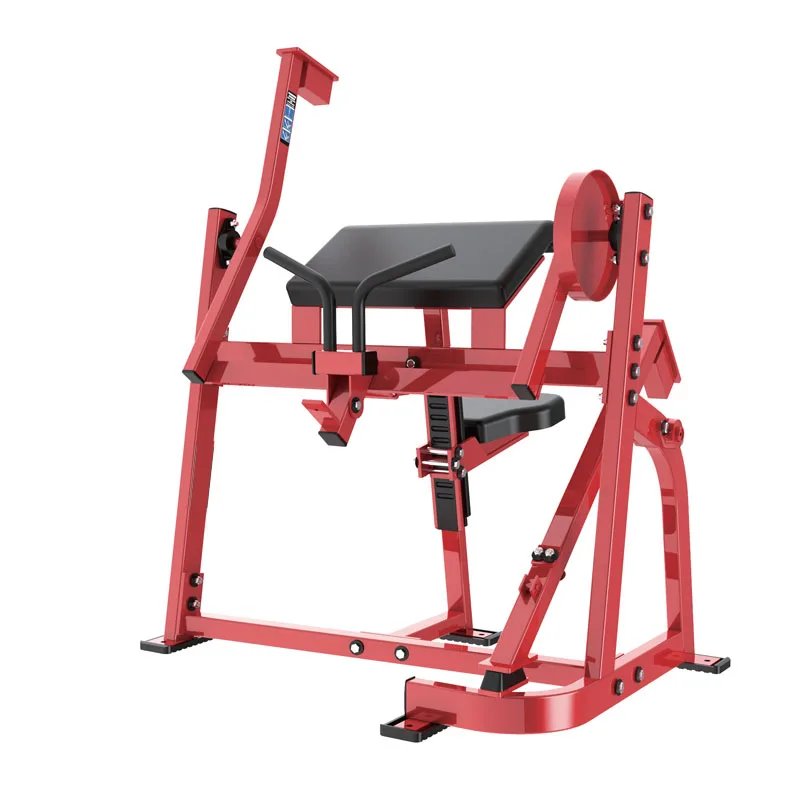
The OS-H5023 serves as a dedicated isolation station for wrist flexion and extension work, complementing compound pulling movements like rows and deadlifts already present in the free weight area. Its compact 562 × 1037 mm footprint allows placement against walls or between larger machines without disrupting member traffic flow. The manual resistance model pairs with plate-loaded or dumbbell-based loading, giving users a stable platform to isolate forearm musculature without requiring cable systems or selectorized stacks. It accommodates adult users across a broad anthropometric range, with the fixed pad geometry suited for both standing and seated wrist curl variations. This commercial wrist curl machine strength training unit fills a gap that most facilities leave open — dedicated forearm work without improvising on flat benches.
Continuous Use and Facility Environment Fit
Because the OS-H5023 operates with manual resistance and contains no motors, electronics, or powered components, it generates zero operational noise and requires no dedicated electrical circuit. [NEED_CITE: maintenance cost comparison between manual and motorized commercial strength equipment] This makes it suitable for deployment on any floor, including upper levels of hotel fitness centers where vibration transfer concerns typically restrict equipment placement. The unfolded steel construction requires a level floor surface with standard rubber matting underneath to protect both the flooring and the frame base. Facilities can position this unit adjacent to free weight racks or cable stations without worrying about power outlet availability or cable management. The absence of electronic components also means no firmware updates, no console calibration, and no data connectivity requirements — a deliberate choice for strength zone equipment where simplicity reduces long-term operational overhead.
Manual Resistance Mechanics and Frame Load Engineering
The manual power source on this unit means resistance comes entirely from the user’s loaded plates or dumbbells, with the machine providing a stable fulcrum and padded support surface. The 36kg steel frame absorbs and distributes reaction forces during loaded wrist curls, preventing the tipping or sliding that lighter benches exhibit under eccentric loading. Steel construction with full-perimeter welding distributes stress across the entire joint network rather than concentrating it at single bolt points. The fixed, unfolded configuration eliminates hinge mechanisms — common failure points on folding fitness equipment subjected to commercial frequency use. Cushion padding density and cover material are specified to resist compression set over extended use, maintaining consistent wrist support geometry through years of daily loading cycles.
The Hidden Cost of Underspecified Strength Stations
Gym operators who source wrist training stations based on price alone frequently encounter frame cracking within the first year of commercial deployment. Lightweight units shift during use, forcing members to reposition mid-set and creating safety concerns that generate complaints. Cushion compression on budget pads leads to uneven wrist support, causing users to abandon the station entirely. [NEED_CITE: member attrition correlation with equipment reliability in commercial fitness facilities] When frames fail, the replacement cycle involves not just equipment cost but also floor space downtime, member inconvenience, and the reputational hit of visible equipment removal. A manual resistance commercial wrist curl machine strength training station built on a 36kg steel platform avoids these cascading costs by removing the mechanical and electronic failure points that drive premature retirement.
Why This Product Line Earns Its Place in the Facility
The steel frame and manual resistance design reflect the same engineering discipline applied across our cardio range — where we test motors for 10,000 hours of continuous operation, this wrist curl unit is built to match that durability standard through structural mass rather than electronic complexity. OEM customization covers frame color and cushion color, allowing chain operators to maintain visual consistency across multiple locations without sourcing from different suppliers. The compact footprint means our 3D layout planning can position this unit within strength zone traffic flow without compromising the spacing requirements of adjacent equipment. ISO 9001 manufacturing processes and CE certification ensure that every unit leaving the facility meets documented quality standards. Technical support availability extends to strength equipment alongside our cardio lineup, giving operators a single point of contact for their entire equipment fleet.
Documentation & Test Records
- CE declaration of conformity covering structural and safety requirements for strength training equipment
- EN 957 test report validating load capacity and stability under prescribed test conditions
- ISO 9001 certificate documenting manufacturing quality management systems
- Noise level test record confirming zero operational sound output from manual resistance design
- Frame durability test record documenting weld integrity under repeated loading cycles
- Installation and commissioning guide with floor preparation and spacing requirements
Installation, Commissioning & Maintenance
- Position the 562 × 1037 × 443 mm unit with clearance on three sides for user access and plate loading
- Place on level rubber flooring to protect the steel frame base and reduce vibration transfer to subfloor
- Verify floor levelness before deployment; uneven surfaces cause frame stress concentration at contact points
- Inspect weld joints and cushion mounting hardware upon delivery and at six-month intervals thereafter
- Clean cushion surfaces daily with non-solvent cleaner to prevent sweat degradation of cover material
- Check frame color coating integrity annually and touch up any scratches to prevent corrosion onset
Scoping Your Strength Zone Equipment Order
Provide your strength area square footage and existing equipment list so we can generate a 3D layout that positions the wrist curl station within natural member traffic patterns. Specify whether frame and cushion color customization is needed to match your facility brand standards or existing equipment palette. Confirm the target deployment country so documentation and labeling meet local regulatory requirements. Indicate whether this unit will operate alongside other manual resistance stations or integrated with selectorized equipment for procurement planning purposes.
Frequently Asked Questions
Q: How does manual resistance differ from selectorized wrist curl machines for commercial deployment?
A: Manual resistance units rely on user-loaded plates or dumbbells, eliminating weight stack cables, pulleys, and selector pins that require regular maintenance. This reduces long-term service costs and removes electronic failure points entirely. Selectorized machines offer convenience for quick weight changes but introduce mechanical complexity. For facilities prioritizing uptime and minimal maintenance overhead, manual resistance provides reliable performance with fewer components subject to wear.
Q: What welding standards apply to commercial strength equipment frames?
A: Commercial-grade steel frames require full-perimeter welding at all structural joints rather than spot welding, distributing load forces across the entire connection surface. Weld penetration depth and bead consistency are verified through visual inspection and documented in durability test records. The frame must withstand repeated loading cycles without crack propagation at stress concentration points. Manufacturers following ISO 9001 processes maintain weld procedure specifications and operator qualification records for traceability.
Q: What is the typical MOQ and lead time for custom frame and cushion colors?
A: Color customization minimums vary by order scope and the number of color variations requested within a single production run. Custom frame powder coating requires color sample approval before production begins, adding sampling time to the overall schedule. Cushion color matching involves material swatch confirmation to ensure consistency across multiple units. Contact the sales team with your specific color requirements and order quantity for an accurate timeline and quotation.
Q: How should strength zone equipment be arranged to support natural member movement patterns?
A: Isolation stations like wrist curl benches should be positioned near related free weight areas so members can incorporate them into existing routines without crossing high-traffic lanes. Allow clearance on all sides for safe loading and unloading of plates or dumbbells. Avoid placing dedicated isolation equipment in primary walkways between major compound stations. A planned layout considers sightlines so members can identify available stations without wandering through the training floor.
Q: What is the expected cushion replacement cycle for commercial wrist training equipment?
A: Cushion lifespan depends on usage density, cleaning protocols, and the quality of the padding foam and cover material specified at manufacture. High-density foam resists compression set longer than standard padding, maintaining consistent support geometry through extended use. Daily cleaning with appropriate solutions prevents sweat and moisture from degrading cover materials prematurely. Facilities should inspect cushion surfaces quarterly for visible wear, seam separation, or compression that affects wrist positioning during use.
![2019 Hammer Strength ISO-Lateral Wide Pulldown Commercial Gym Equipment [WARN] draft identifier mismatch](https://bicksport.com/wp-content/uploads/2026/08/2019-hammer-strength-iso-lateral-wide-pulldown-commercial-gym-equipment-warn-draft-identifier-mismatch-d45e86.webp)

![Commercial ISO-Lateral Shoulder Press Machine for Gym Fitness Centers [WARN] draft identifier mismatch](https://bicksport.com/wp-content/uploads/2026/08/commercial-iso-lateral-shoulder-press-machine-for-gym-fitness-centers-warn-draft-identifier-mismatch-0af91f.webp)