![Commercial White Aluminium Pilates Reformer for Studio [WARN] draft identifier mismatch](https://bicksport.com/wp-content/uploads/2026/08/commercial-white-aluminium-pilates-reformer-for-studio-warn-draft-identifier-mismatch-3eeffd.webp)
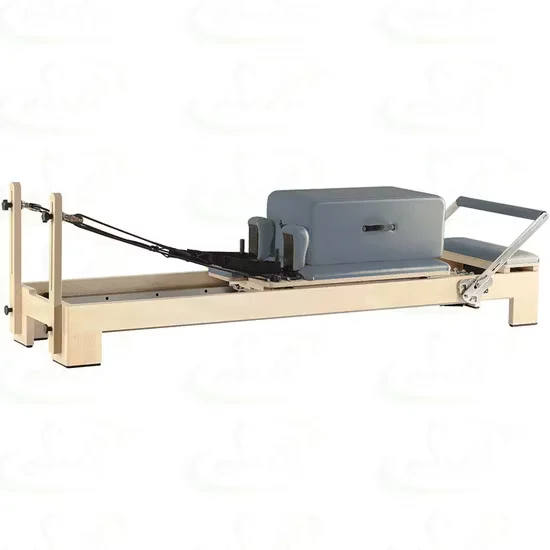
Precision Resistance Control — spring-driven carriage system tested for continuous studio operation with aluminium alloy structural rigidity.
Technical Specifications
| Parameter | Value |
|---|---|
| Product Type | Pilates Reformer |
| Designation | SRY-12 |
| Frame Material | Aluminium Alloy |
| Color | White (custom colors available) |
| Resistance Type | Spring-based |
| Accessories Included | Long Box, Jump Board, Platform |
| Product Dimensions | 2570 × 730 × 270 mm |
| Net Weight | 90 kg |
| Customization | Logo, color, specification |
| Warranty | 3 Years |
| Suitable For | Adult, Unisex |
Application Suitability
| Deployment Scenario | Typical Use |
|---|---|
| Boutique Pilates studio | Daily group reformer classes running 8–10 hours with continuous carriage cycling |
| Rehabilitation clinic | Controlled spring resistance progression for joint recovery and post-injury conditioning |
| Luxury hotel wellness floor | Quiet spring-loaded movement suitable for guest floors without vibration transfer |
| High-end residential home gym | Compact footprint with full-length carriage accommodating taller users |
| Corporate wellness center | Modular accessory configuration supporting varied employee fitness levels |
Why Spring Fatigue Compromises Studio Scheduling Before Anyone Notices
A commercial aluminium Pilates reformer white finish holds up visually, but internal spring degradation is what actually takes equipment out of rotation.
When a reformer sits in a studio running back-to-back classes, the springs absorb thousands of compression cycles weekly. Operators rarely notice resistance drift until instructors start adjusting class choreography around equipment that no longer delivers predictable tension. The aluminium frame itself remains dimensionally stable under this load, which means the spring system becomes the single variable determining whether a reformer stays in service or gets tagged for maintenance. [NEED_CITE: spring fatigue testing standards for commercial resistance equipment]
Where This Reformer Fits in a Multi-Discipline Studio Layout
The 2570 mm carriage length accommodates users across a broad height range, making the commercial aluminium Pilates reformer white configuration suitable for mixed-ability group classes where participants rotate between stations. In a studio with cadillacs and chairs, this reformer handles the foundational movement patterns while specialized apparatus covers advanced progressions. The spring-based resistance delivers progressive loading through full range of motion, and the modular accessories — Long Box for seated work, Jump Board for plyometric intervals, Platform for standing exercises — allow instructors to program varied sessions without moving members to different equipment. Deployment density depends on ceiling height for Jump Board clearance and lateral spacing for instructor circulation during group formats.
Continuous Class Scheduling and Floor-Level Deployment Considerations
Studios running six or more classes daily place reformers under sustained mechanical cycles that reveal construction weaknesses within the first year. The aluminium alloy frame resists corrosion from perspiration exposure and maintains rail alignment under repetitive carriage travel. [NEED_CITE: commercial fitness equipment duty cycle classification for group exercise environments] Noise transmission through floor structures matters when studios operate above occupied spaces — spring resistance systems generate minimal acoustic output compared to motorized equipment, but carriage wheel composition and rail surface finish determine whether upper-floor deployment creates complaints below. Adequate lateral spacing supports ventilation between units during high-density scheduling. Voltage and power requirements do not apply to spring-driven systems, eliminating one category of deployment incompatibility.
Spring Rate Progression and Aluminium Frame Load Transfer
Spring-based resistance operates on a linear progression principle: each additional spring engaged increases the force required to move the carriage proportionally. This differs from elastic band systems that exhibit non-linear stretch characteristics and unpredictable tension decay over repeated use cycles. The aluminium alloy frame transfers load from the spring anchor points through a rigid structure that prevents the flex and deflection common in welded steel frames after years of cyclic loading. At 90 kg net weight, the reformer remains stable during Jump Board exercises without requiring floor anchoring, provided the surface is level. The 270 mm platform height positions the carriage at a working elevation that accommodates both floor-to-reformer transitions and standing exercises on the Platform accessory. Long Box attachment points distribute seated user weight across the carriage bed rather than concentrating load on the rail system.
What Happens When Specs Get Compromised for Unit Price
Studio operators who source reformers based on visual similarity often discover the cost difference within eighteen months. Lightweight frames that save on material expense develop rail misalignment as weld points fatigue under daily carriage cycling. Springs manufactured without consistent wire gauge produce uneven resistance between identical units, forcing instructors to designate certain reformers as unreliable and reduce class capacity accordingly. [NEED_CITE: material fatigue failure modes in commercial Pilates equipment] Non-standard accessory mounting systems create compatibility problems when replacement parts are needed, turning a simple Long Box swap into a procurement delay that takes equipment offline. These failures accumulate silently until member complaints about inconsistent class experiences surface the underlying equipment degradation.
Why This Product Line Addresses Studio Operator Requirements
The three-year warranty reflects confidence in spring fatigue life and aluminium frame durability under commercial scheduling. Sub-35 dB operation during spring compression and carriage travel has been verified in hotel deployments where reformers operate on guest room floors without generating noise complaints. Full OEM customization covering logo application, color specification, and dimensional adjustments allows studios to match equipment to brand identity without compromising structural parameters. The six-series cardio family from the same manufacturing facility means a wellness center sourcing reformers can consolidate equipment procurement across disciplines. Free 3D layout planning addresses studio floor spacing, instructor sightlines, and ventilation requirements specific to reformer class formats. Technical support coverage responds to maintenance questions that arise as springs approach replacement intervals.
Documentation & Test Records
- CE declaration of conformity covering spring resistance equipment safety requirements
- EN 957 test report validating structural load capacity and carriage stability
- ISO 9001 certificate documenting manufacturing quality management processes
- Spring fatigue test record showing compression cycle endurance data
- Assembly and commissioning guide with accessory mounting torque specifications
- Spare parts catalog with spring replacement intervals and accessory compatibility list
Installation, Commissioning & Maintenance
- Allow minimum 600 mm lateral clearance between SRY-12 units for instructor access during group classes
- Level floor surface within tolerance before positioning the 2570 mm frame to prevent carriage drift
- Inspect spring tension consistency across all five resistance positions during initial commissioning
- Clean aluminium rails with non-abrasive solution weekly to maintain smooth carriage travel
- Verify Jump Board mounting security before each plyometric class session
- Rotate spring positions quarterly to distribute compression fatigue evenly across the set
Equipment Selection and Deployment Planning
Provide your studio floor dimensions and planned class capacity to receive a 3D layout addressing reformer spacing, instructor circulation paths, and ventilation requirements. Specify your daily class schedule so spring duty cycles can be matched to expected compression volumes. Confirm whether deployment occurs on elevated floors with occupied spaces below to determine whether additional acoustic isolation measures are necessary. Indicate target market destination so documentation language and compliance marking requirements align with local regulations. State whether customized color or branding specifications are required for the order.
Frequently Asked Questions
Q: How does aluminium alloy frame durability compare to steel for commercial studio use?
A: Aluminium alloy resists corrosion from perspiration exposure that causes steel frames to develop surface oxidation over years of daily use. The material maintains dimensional stability under cyclic loading, meaning rail alignment stays consistent as the reformer accumulates thousands of carriage travel cycles. Steel frames can be heavier, but the 90 kg net weight of this aluminium configuration provides adequate stability during dynamic exercises without requiring floor anchoring.
Q: What maintenance interval should I plan for spring replacement?
A: Spring resistance systems gradually lose tension consistency after extended compression cycling. Studios running eight or more classes daily should inspect spring tension uniformity quarterly and plan replacement based on measurable resistance drift rather than a fixed timeline. Keeping spare spring sets in inventory prevents scheduling disruptions when individual springs approach end of service life.
Q: What training functions do the Long Box, Jump Board, and Platform accessories serve?
A: The Long Box provides a seated surface for rowing and pulling exercises that target upper body movement patterns. The Jump Board attaches to the carriage end for plyometric leg work with spring-loaded resistance. The Platform extends the standing surface area for balance exercises and upright movements. All three accessories mount to standardized attachment points on the SRY-12 frame.
Q: What minimum spacing does this reformer require in a group class layout?
A: The 2570 mm length plus clearance for full carriage travel at both ends determines the longitudinal footprint. Lateral spacing must accommodate instructor circulation between units and member transitions during class rotation. Ceiling height clearance becomes a limiting factor when Jump Board exercises are programmed, as participants leave the carriage surface during plyometric intervals.
![Oak Wood Folding Pilates Reformer Bed for Home Studio Use [WARN] draft identifier mismatch](https://bicksport.com/wp-content/uploads/2026/08/oak-wood-folding-pilates-reformer-bed-for-home-studio-use-warn-draft-identifier-mismatch-89005f.webp)