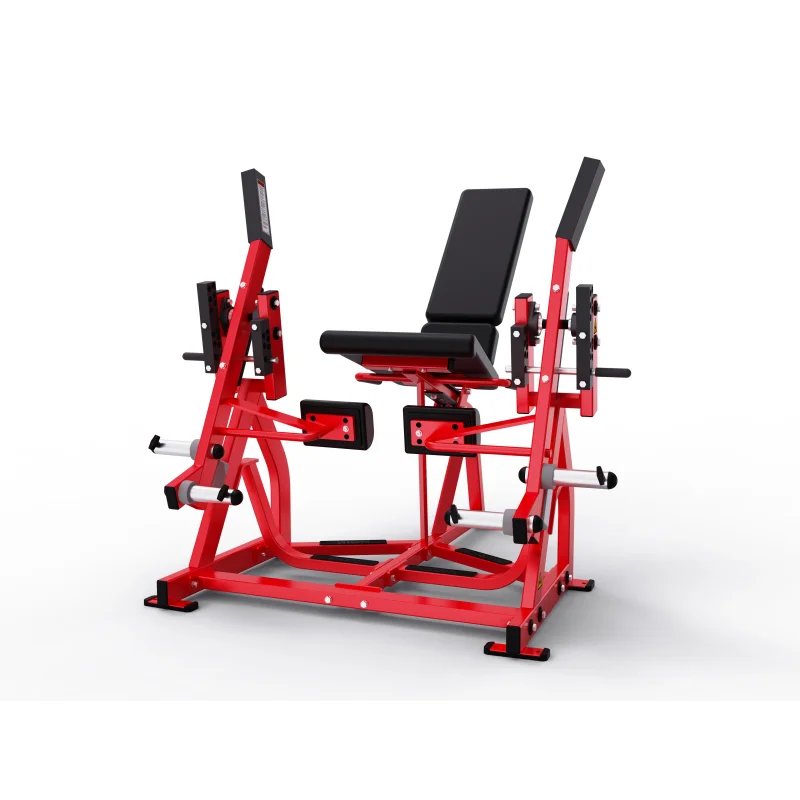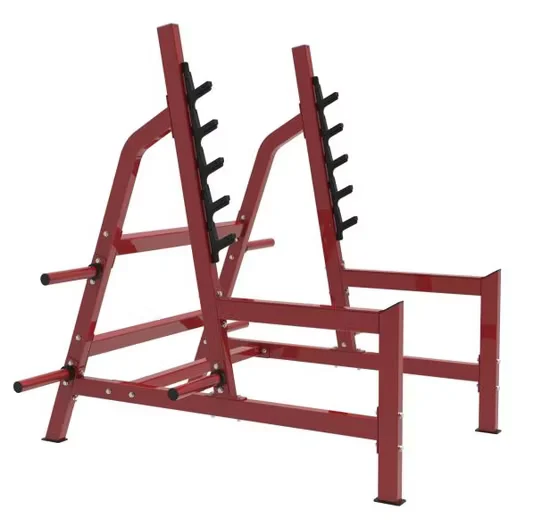
Heavy-Duty Stability — A 98kg steel frame anchors compound lifts without sway in high-frequency professional environments.
Technical Specifications
| Parameter | Value |
|---|---|
| Product Type | Squat Rack Machine |
| Model NO. | 5056 |
| Exercise Part | Leg |
| Material | Steel |
| Product Dimensions | 1830 × 1200 × 1876 mm |
| Net Weight | 98 kg |
| Main Frame Color | Available according to customer requirements |
| Cushion Color | Available according to customer requirements |
| Age Group | Adult |
| Gender | Unisex |
| OEM/ODM | Acceptable |
| Certification | ISO 9001, CE |
Application Suitability
| Deployment Scenario | Typical Use |
|---|---|
| Professional gym and club strength zone | High-frequency compound lifts including squats, lunges, and rack pulls under continuous member traffic |
| Community fitness center | Commercial-grade resistance training accessible to general membership in shared-use facilities |
| Corporate wellness room | Compact integrated training for employees during limited lunch-break windows |
| Sports performance training center | Athlete-grade loading protocols for lower-body power development |
Why Structural Rigidity Determines Member Retention in the Weight Room
Frame mass and weld geometry separate commercial squat racks from liability risks.
When a loaded barbell sits on the catch arms, any lateral flex in the uprights transmits directly to the lifter’s perception of safety. In commercial gyms running back-to-back peak hours, members abandon stations that wobble under load — and they do not return to those zones [NEED_CITE: structural deflection tolerance in commercial strength equipment]. A commercial squat rack machine gym equipment unit must absorb repeated eccentric drops without frame oscillation, and that requirement starts with raw steel mass and joint geometry rather than bolt count alone. I have seen lightweight racks pulled from hotel fitness floors after guest complaints about metallic resonance traveling through concrete slabs at 5 AM.
Positioning Within the Strength Training Floor Plan
This commercial squat rack machine gym equipment occupies the heavy-load anchor position in any free-weight zone, handling barbell squats, front squats, and integrated cable or attachment work when paired with compatible modules. It complements plate-loaded leg presses and hip thrust stations by covering the vertical loading vector that those machines cannot replicate. The 1830 × 1200 mm footprint fits standard commercial spacing grids while leaving clearance for spotter movement and plate loading on both sides. Users across a wide anthropometric range can adjust bar height and catch positions to match their limb lengths and training objectives.
Continuous Use Demands and Floor-Level Deployment
Commercial strength equipment in a busy gym endures loading cycles that accumulate rapidly across a twelve-hour operating day, and the steel frame must resist fatigue cracking at every weld intersection [NEED_CITE: fatigue cycle testing for commercial strength frames]. Deploying this unit on upper floors requires verifying slab load capacity for the combined weight of the rack, loaded barbell, and dynamic impact during controlled drops. Vibration transmission through rigid flooring can disturb adjacent studio classes or quiet zones, making isolation pads a practical consideration. Adequate ceiling height must accommodate the 1876 mm frame plus overhead clearance for tall users performing pull-up attachments if configured. Electrical requirements are minimal since this is a mechanically driven unit, but any integrated cable stack or digital counter would need a dedicated circuit.
Reading the Steel Gauge and Weld Pattern
The 98 kg net weight signals substantial steel cross-section in the uprights and base rails, which directly governs how much the frame resists torsional twist when a lifter unracks an off-center load. Integrated gym trainer designs consolidate multiple movement patterns into one footprint, reducing the total equipment count needed for a complete lower-body station. Color customization across frame and cushion surfaces allows facility operators to align the unit with brand palettes without compromising the underlying steel specification [NEED_CITE: powder coat adhesion standards for gym equipment frames]. The 1830 × 1200 × 1876 mm envelope provides a stable base-to-height ratio that limits sway during heavy eccentric phases. ISO 9001 and CE certification confirm that manufacturing processes and safety margins meet internationally recognized commercial thresholds.
The Hidden Cost of Underspecified Frames
A rack that flexes visibly under moderate load creates a psychological barrier that keeps novice lifters from progressing and experienced lifters from trusting the catch arms. Facilities that procure lightweight units to save on shipping weight often face premature replacement when weld seams develop hairline fractures under daily commercial cycles [NEED_CITE: warranty claim patterns for commercial strength equipment frames]. Noise generated by rattling adjustment pins and vibrating uprights adds to the acoustic fatigue of a crowded gym floor. Member complaints about perceived instability tend to cluster around specific stations, and those units become dead floor space long before they are physically removed.
Why This Product Line Holds Up Under Daily Abuse
Every frame in this series passes through a 10,000-hour durability validation covering cyclic loading, weld inspection, and surface coating adhesion before leaving the Shandong facility. The integrated gym trainer format means a single unit covers squat, lunge, and rack-based movements, which simplifies the 3D strength-zone layout our engineering team provides at no charge — including sightline and airflow mapping around each station. OEM customization extends to frame color, cushion upholstery, and branded logo placement at flexible minimum order quantities suitable for chain rollouts. The six-facility vertical integration from CNC machining to final assembly keeps lead times predictable when a project requires dozens of matched units. Technical support remains available around the clock for commissioning questions once containers arrive on site.
Documentation & Test Records
- CE declaration of conformity covering the complete squat rack assembly
- EN 957 test report validating structural load margins and safety clearances
- ISO 9001 certificate for manufacturing quality management systems
- Durability test record documenting cyclic loading performance
- Installation and commissioning guide with anchor bolt specifications
- Spare parts list covering wear items and replacement hardware
Installation, Commissioning & Maintenance
- Verify 1830 × 1200 mm footprint plus 600 mm clearance on all sides for safe loading and spotter access
- Level the base rails on reinforced concrete using adjustable feet before tightening anchor bolts
- Inspect all weld joints and adjustment pin detents during initial commissioning before releasing to member use
- Lubricate guide rods and adjustment mechanisms on a monthly cycle under commercial-frequency operation
- Wipe down steel surfaces and cushion upholstery daily to prevent sweat-induced corrosion and material degradation
Scoping Your Strength Zone Procurement
Provide the total square footage of your free-weight area along with the unit count you need, and our engineering team will return a 3D layout that maps equipment spacing, member flow, and ventilation corridors around each station. Specify whether units will sit on ground-level slabs or upper floors so we can advise on vibration isolation and anchor requirements. Confirm your target market and any brand-standard color codes early in the process to align OEM customization with your project timeline. State whether you need matched documentation packages for multi-country rollouts.
Frequently Asked Questions
Q: What separates a commercial squat rack from a home-gym version?
A: Commercial units use heavier-gauge steel, higher load-rated weld patterns, and tested fatigue cycles suited to dozens of users per day. Home racks prioritize portability and cost over continuous structural endurance. The 98 kg frame weight here reflects steel mass engineered for professional gym traffic rather than occasional personal use.
Q: How does the 98 kg net weight affect training stability?
A: Greater frame mass reduces oscillation when lifters unrack heavy loads or perform controlled eccentrics. A lighter rack will visibly sway and transmit vibration through the floor, undermining user confidence. This weight class keeps the base planted during compound movements typical in high-frequency commercial environments.
Q: What does OEM/ODM customization cover on this unit?
A: Customization includes main frame powder-coat color, cushion upholstery color and material, and logo placement on steel or padding surfaces. Console interfaces are not applicable to this mechanical unit, but branded visual identity across frame and cushion is fully configurable at flexible minimum order quantities.
Q: How should this rack integrate with cardio equipment in the same facility?
A: Position the squat rack in a dedicated strength zone separated from cardio rows by structural columns or acoustic barriers to contain noise and vibration. The 3D layout service maps sightlines so trainers can supervise both zones, and airflow planning ensures ventilation reaches the high-exertion free-weight area adequately.
Q: Which certifications apply to commercial strength equipment procurement?
A: ISO 9001 confirms manufacturing quality management, while CE marking demonstrates conformity with European safety directives. EN 957 testing validates structural load margins, stability, and entrapment hazards specific to stationary training equipment. These documents form the baseline compliance package for international commercial gym projects.
![Commercial Hammer Strength V-Squat Fitness Equipment Gym Machine [WARN] draft identifier mismatch](https://bicksport.com/wp-content/uploads/2026/08/commercial-hammer-strength-v-squat-fitness-equipment-gym-machine-warn-draft-identifier-mismatch-25abba.webp)
![Commercial Multi-Function Smith Machine Gym Equipment for Professional Gyms [WARN] draft identifier mismatch](https://bicksport.com/wp-content/uploads/2026/08/commercial-multi-function-smith-machine-gym-equipment-for-professional-gyms-warn-draft-identifier-mismatch-93fcc7.webp)