
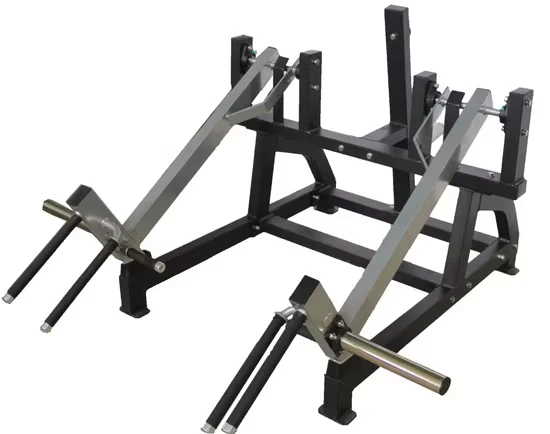
Steel-Frame Durability — All-steel welded construction tested for continuous multi-user loading in professional gym environments.
Technical Specifications
| Parameter | Value |
|---|---|
| Designation | 5043 |
| Power Source | Manual |
| Exercise Part | Arm |
| Resistance Type | Manual |
| Frame Material | Steel |
| Product Dimensions | 1650 × 1150 × 1050 mm |
| Net Weight | 99 kg |
| Foldable | Unfolded |
| Customization | Available |
| OEM/ODM | Available |
| Certification | ISO 9001, CE |
Application Suitability
| Deployment Scenario | Typical Use |
|---|---|
| Hotel fitness center on guest room floors | Compact footprint allows placement in limited spaces while manual resistance eliminates motor vibration transfer to adjacent rooms |
| Chain gym cardio zone | High-frequency multi-user cycling supported by reinforced steel frame and zero-maintenance manual drive |
| Corporate wellness room | Multi-joint squat and pull functionality maximizes training variety within constrained corporate square footage |
| Professional sports training center | Manual resistance delivers consistent loading for athlete strength-power programming without electronic drift |
| Community fitness facility | Reduced maintenance burden from motorless design suits limited on-site technician availability |
Why Equipment Vibration Reaches Occupied Rooms Below the Gym
Manual resistance eliminates the primary source of low-frequency harmonic vibration in commercial strength zones.
When motor-driven equipment operates on upper floors, continuous electromagnetic vibration transmits through structural slabs into occupied spaces below. Facility operators often discover this only after noise complaints reach the front desk and maintenance tickets pile up [NEED_CITE: vibration transmission through concrete slabs from motor-driven gym equipment]. The commercial squat high pull machine strength equipment category addresses this at the source — no motor means no electromagnetic harmonic to propagate through the building structure.
In my years deploying equipment across Southeast Asian hotel properties, I watched motor-driven units generate enough low-frequency resonance to trigger guest complaints three floors down. After one hotel in Kuala Lumpur required pulling an entire equipment line to re-spec for acoustics, I started prioritizing vibration isolation in the selection process before anything else.
Where This Unit Fits in a Mixed-Discipline Strength Layout
This squat high pull trainer covers compound lower-body and upper-back movement patterns within a single footprint, serving users from novice to advanced loading requirements. In a full cardio and strength zone configuration, it complements isolation machines and free-weight racks by consolidating two primary movement patterns — deep squat and high pull — into one station. The 1650 × 1150 mm footprint allows deployment in high-density layouts where floor space constrains equipment count. The reinforced steel frame accommodates a wide range of user body types and loading intensities without structural deflection. The commercial squat high pull machine strength equipment designation reflects its positioning for professional facilities where multi-user throughput demands equipment that holds calibration across thousands of repetitions.
Continuous Loading and Deployment Environment Requirements
Manual resistance systems eliminate the duty-cycle constraints that limit motorized equipment in high-throughput facilities [NEED_CITE: commercial equipment duty cycle standards for 24-hour facilities]. This unit can operate continuously without thermal shutdown windows or motor cooldown periods, making it suitable for 24/7 access fitness centers. The 99 kg steel frame requires level flooring with adequate load-bearing capacity — particularly relevant for upper-floor hotel deployments where structural engineers must verify slab capacity. Ventilation requirements center on user comfort rather than equipment cooling, since the motorless drive generates negligible heat output. Ground-level installations should include vibration-dampening pads beneath the frame feet to prevent resonance transfer to adjacent studio or lounge spaces.
Manual Resistance and Frame Engineering Breakdown
The manual resistance system operates through direct mechanical loading rather than electromagnetic braking, producing zero operational noise from the drive mechanism itself. This contrasts with motor-driven alternatives where electromagnetic coils generate audible hum under load and require periodic recalibration as components age. The all-steel welded frame distributes user-generated forces across multiple structural nodes, preventing the stress concentration points that cause fatigue cracking in lighter-gauge construction. At 1650 × 1150 × 1050 mm, the frame geometry provides sufficient range of motion for full-depth squat patterns while maintaining a footprint compatible with standard commercial spacing requirements. The 99 kg net weight contributes to inherent stability during explosive movement phases, reducing the reliance on floor anchoring in temporary or leased facility deployments. Steel construction with commercial-grade surface treatment resists the accelerated corrosion that humidity-inflicted environments like Southeast Asian hotel basements inflict on inadequately protected frames [NEED_CITE: corrosion resistance standards for commercial gym equipment in high-humidity environments].
The Hidden Cost of Specifying Below Commercial Grade
When procurement decisions prioritize upfront cost over duty-cycle matching, the consequences surface within the first operational year. Light-gauge frames develop fatigue cracks at weld junctions under continuous multi-user loading, creating liability exposure that no amount of warranty coverage offsets. Manual resistance systems on poorly engineered units develop play in the loading mechanism, producing inconsistent resistance curves that compromise programming accuracy. Facilities that deployed under-specified strength equipment in high-humidity environments watched corrosion attack unprotected weld seams and pivot points, requiring premature replacement cycles that destroyed the original cost savings [NEED_CITE: total cost of ownership comparison for commercial versus light-commercial gym equipment]. Voltage mismatch issues do not apply to manual equipment, but the broader pattern remains — specifications that ignore deployment reality generate operational costs that dwarf initial procurement savings.
Why This Product Line Holds Up Under Continuous Deployment
Every unit in this product family undergoes 10,000-hour continuous operation testing on frames and load-bearing components before release. The sub-35dB acoustic profile verified in hotel deployments applies across the cardio range, and the engineering discipline that achieves it extends to strength equipment frame welding and assembly precision. Full OEM/ODM capability covers color, logo, console UI where applicable, and specification customization at flexible MOQ. The six-series product family allows facilities to source every discipline from a single manufacturing line, reducing vendor management overhead. Free 3D layout planning covers square footage, sightlines, and member flow — for this unit, that means calculating safe clearance zones around the 1650 × 1150 mm footprint and positioning within the strength zone traffic pattern. Technical support operates on a 24/7 response basis regardless of deployment geography.
Documentation & Test Records
- CE declaration of conformity covering the full commercial squat high pull unit assembly
- EN 957 test report validating structural integrity and safety requirements
- ISO 9001 certificate covering manufacturing process controls
- Steel frame fatigue and load testing documentation
- Surface treatment corrosion resistance test records
- Spare parts list and exploded assembly diagram
Installation, Commissioning & Maintenance
- Maintain minimum 600 mm clearance on all sides of the 1650 × 1150 mm frame for safe user passage
- Verify floor levelness within 3 mm tolerance before frame placement to prevent load imbalance
- Confirm structural slab capacity for the 99 kg static load plus dynamic user loading on upper floors
- Inspect all welded joints and fastener torque after the first 500 use cycles post-installation
- Apply corrosion-inhibiting treatment to exposed steel surfaces quarterly in high-humidity environments
- Wipe down frame and resistance components after each use cycle to prevent sweat-induced surface degradation
How to Start the Equipment Selection Process
Provide your strength zone square footage and target equipment count to receive a 3D layout plan covering spacing, sightlines, and member flow patterns. Specify your deployment floor and adjacent occupied spaces so acoustic and vibration requirements can be confirmed against structural conditions. Indicate your facility’s daily operating hours and expected user throughput to validate that manual resistance matches your duty-cycle profile. Confirm whether OEM customization including color and branding is required for your project scope.
Frequently Asked Questions
Q: How does manual resistance compare to plate-loaded systems for commercial deployment?
A: Manual resistance systems integrate the loading mechanism into the frame structure, eliminating separate weight stack maintenance and reducing the overall footprint. Plate-loaded systems offer incremental loading flexibility but require users to handle loose plates, increasing changeover time between users and creating plate storage requirements. For high-throughput commercial environments, integrated manual resistance reduces operational friction while maintaining consistent loading curves across the full movement range.
Q: What structural requirements apply when deploying this unit on upper hotel floors?
A: The 99 kg frame weight combined with dynamic user loading requires structural slab verification from a qualified engineer before installation. Upper-floor deployments must confirm load-bearing capacity at the specific placement location, as column spacing and slab thickness vary across building zones. Vibration-dampening pads beneath frame feet further reduce any residual force transmission to occupied spaces below the installation floor.
Q: How does the steel frame perform in high-humidity environments?
A: Commercial-grade surface treatment on the welded steel frame resists corrosion acceleration common in tropical and coastal deployment environments. Quarterly inspection of weld seams and pivot points allows early detection of any surface treatment degradation. Facilities in high-humidity locations should maintain climate control in the fitness zone and ensure adequate airflow around the equipment to minimize moisture accumulation on steel surfaces.
Q: What customization options are available through OEM/ODM programs?
A: Customization covers frame color, branding application, and specification adjustments at flexible minimum order quantities. The manufacturing process supports OEM/ODM requirements from initial design consultation through production and quality verification. Buyers receive documentation covering all customized specifications to ensure consistency across multi-unit deployments.
Q: What is the recommended maintenance schedule for continuous commercial use?
A: Daily wipe-down of frame surfaces and resistance components prevents sweat-induced corrosion accumulation. Monthly inspection of all fasteners and welded joints identifies any loosening from repetitive loading cycles. Quarterly application of corrosion inhibitor to exposed steel surfaces extends frame longevity in humid environments. Annual professional inspection of the complete resistance mechanism ensures consistent loading performance across the full range of motion.
![2019 Hammer Strength PRO Tackler 41 Commercial Gym Back Exercise Equipment [WARN] draft identifier mismatch](https://bicksport.com/wp-content/uploads/2026/08/2019-hammer-strength-pro-tackler-41-commercial-gym-back-exercise-equipment-warn-draft-identifier-mismatch-5929ff.webp)
![Factory Price Fitness Gym Equipment Leg Extension Machine for Commercial Gym [WARN] draft identifier mismatch](https://bicksport.com/wp-content/uploads/2026/08/factory-price-fitness-gym-equipment-leg-extension-machine-for-commercial-gym-warn-draft-identifier-mismatch-b9d5b7.webp)
