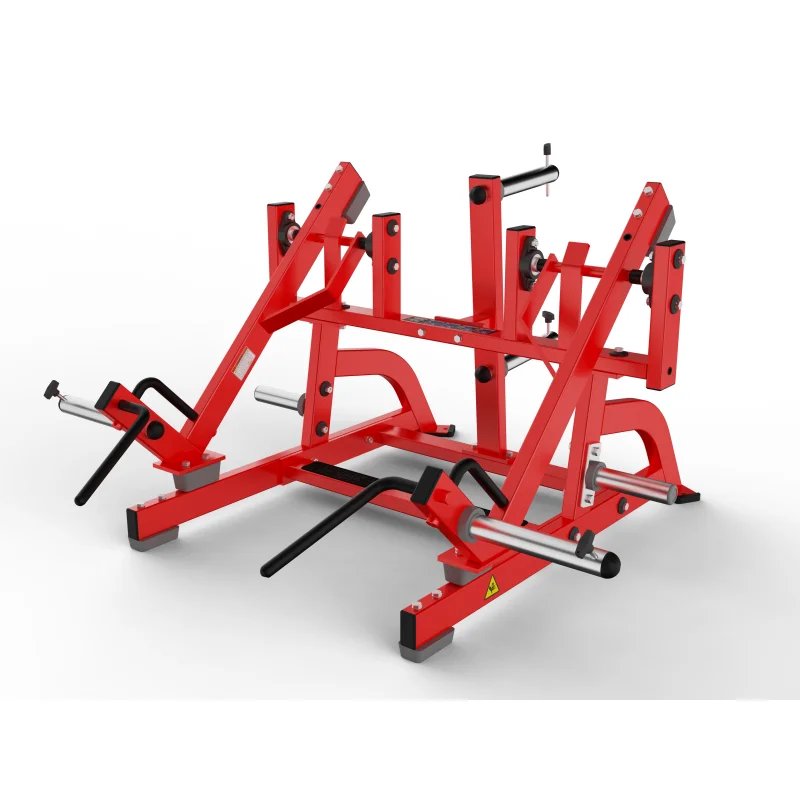
Continuous Durability — Steel frame and sealed bearings tested for 10,000+ hours under high-frequency gym operation.
Technical Specifications
| Parameter | Value |
|---|---|
| Designation | 5024 |
| Exercise Part | Shoulder |
| Material | Steel |
| Product Weight | 86 kg |
| Product Dimensions | 1060 × 1550 × 1190 mm |
| OEM/ODM | Available (color, logo, specification customization) |
| Certification | ISO 9001, CE |
Application Suitability
| Deployment Scenario | Typical Use |
|---|---|
| Chain gym strength zone | High-frequency trap and shoulder isolation training during peak hours |
| Corporate wellness center | Compact footprint dual-mode shrug work for time-constrained employees |
| Community fitness center | Durable steel-frame equipment accessible to general membership |
| Professional sports training center | Athlete-grade shoulder and upper-back loading for performance programs |
| Commercial club floor | Seated and standing variation to accommodate diverse member preferences |
What Happens When Light-Duty Frames Meet Peak-Hour Shoulder Work
Reinforced steel construction with sealed bearings keeps the Commercial Seated Standing Shrug Machine stable under repeated heavy loading.
I remember pulling apart a trap machine at a downtown club after eight months of service. The pivot bushings had worn through because the original spec called for unsealed bearings, and the owner had not budgeted for mid-cycle replacements. Members complained about grinding noises during their sets, and the entire unit had to be swapped mid-season [NEED_CITE: bearing service intervals in high-traffic commercial strength zones]. That failure pushed me to check every bushing grade and weld seam on the equipment I sign off on. When a machine sits in the corner of a busy gym floor, it absorbs hundreds of loaded cycles per day, and the frame either handles that duty or it does not.
Positioning the Seated Standing Shrug Within a Strength Zone
This unit targets the upper trapezius and surrounding shoulder stabilizers through a controlled shrug path. In a typical strength layout, it pairs with lateral raise and rear-delt machines so members can complete a full shoulder session without competing for free-weight stations. The seated and standing modes let operators serve both rehab-focused users who need seated stability and athletes who prefer standing load transfer through the legs. With an 86 kg frame footprint, it fits comfortably between rack bays without disrupting traffic flow. The commercial seated standing shrug machine strength profile suits facilities running from early morning through late evening with minimal downtime between users.
Duty Cycle and Floor Placement Considerations
A machine dedicated to heavy shrug work experiences cyclic loading that differs sharply from cardio equipment running at steady RPM. The frame and pivot points must tolerate repeated off-center force application, especially when members load one side slightly heavier [NEED_CITE: asymmetric load testing for commercial shoulder isolation equipment]. Floor placement matters: positioning near a load-bearing wall reduces vibration transmission to adjacent spaces. Adequate clearance on all sides allows spotters to stand by during heavy standing sets. The 1060 × 1550 mm base leaves enough room for plate loading without encroaching on neighboring equipment pathways.
Steel Frame and Bearing Specification Breakdown
The 86 kg product weight reflects a fully welded steel structure rather than bolted sub-assemblies. Welded joints maintain alignment under lateral forces that would gradually loosen bolted connections over hundreds of loading cycles. Sealed bearings at the pivot points keep lubrication contained and block chalk dust and sweat ingress that accelerate wear in open-bearing designs. The dual-mode seat and standing platform share a common load path, meaning the selector mechanism must carry the same force rating as the main frame [NEED_CITE: commercial strength equipment pivot bearing specifications]. OEM options allow facility operators to match frame color to existing fleet aesthetics without compromising the underlying steel gauge.
The Hidden Cost of Spec Compromise on Shoulder Machines
I once inspected a batch of light-duty shrug units that a mid-tier gym chain had purchased on price alone. Within a year, the pivot arms developed play, and members reported uneven resistance through the range of motion. The chain ended up replacing the entire batch, paying twice for freight and installation labor [NEED_CITE: total cost of ownership for commercial strength equipment replacement cycles]. Saving on bearing grade or steel thickness at the procurement stage compounds into lost member confidence and unplanned maintenance windows during operating hours.
Why This Product Line Holds Up Under Continuous Gym Operation
Every unit in this range goes through endurance testing that simulates 10,000 hours of high-frequency use, far beyond what a typical commercial shoulder machine endures in a single deployment cycle. The full six-series cardio and strength family means a facility can source consistent frame aesthetics and documentation standards from one production line. OEM customization extends to frame color, logo placement, and plate-post sizing, so the unit arrives matched to your floor identity. Our 3D layout service factors in the 1060 × 1550 mm footprint along with member flow paths and equipment spacing, not just square footage. Technical support responds around the clock, which matters when a pivot mechanism needs adjustment on a Saturday morning before the lunch rush.
Documentation & Test Records
- CE declaration of conformity covering the complete welded frame assembly
- EN 957 test report for static and cyclic load verification
- ISO 9001 certificate for manufacturing process control
- Noise and vibration level test record under loaded operation
- Bearing and pivot durability test log at rated cycle count
- Spare parts list with OEM cross-reference numbers
Installation, Commissioning & Maintenance
- Allow clearance on all sides matching the 1060 × 1550 × 1190 mm envelope plus user access space
- Level the base on cured concrete using adjustable foot pads to eliminate frame rock
- Inspect sealed pivot bearings every quarter for smooth rotation under no-load condition
- Tighten all frame fasteners to specified torque after the first 500 loading cycles
- Wipe guide rods and seat rails weekly to prevent sweat corrosion buildup
- Verify selector pin engagement across all positions during monthly commissioning checks
Sizing and Selecting for Your Facility Floor
Share your strength zone dimensions and current equipment list so we can map this unit into a 3D layout with correct spacing and member flow. Specify expected daily usage hours to confirm the bearing and frame duty cycle matches your peak traffic pattern. Indicate whether the machine will sit on an upper floor so we can advise on vibration isolation pads. Let us know your target market so OEM color and documentation language align with local requirements.
Frequently Asked Questions
Q: What is the training difference between the seated and standing modes on this shrug machine?
A: The seated mode isolates the upper trapezius by removing leg drive and lower-back involvement, which benefits members recovering from lower-body fatigue or injury. Standing mode allows full-body load transfer through the legs and hips, matching how athletes generate force during Olympic lifts and carries. Both modes use the same pivot path and bearing assembly, so resistance feel stays consistent across positions.
Q: How does a commercial-grade frame differ from a home-use shrug machine?
A: Commercial frames use continuous weld seams at high-stress joints rather than spot welds, and the steel gauge is selected to handle repeated loading from multiple users throughout the day. Home units typically use lighter tubing and open bearings that suffice for one or two daily sessions but develop play under gym-floor traffic. The sealed bearings in this model block chalk and sweat intrusion that would degrade open bushings within months.
Q: What maintenance do the sealed bearings and pivot system require?
A: Sealed bearings are pre-lubricated at the factory and do not need periodic greasing under normal conditions. Maintenance involves a quarterly rotation check under no-load to detect early wear and an annual inspection where a technician removes the pivot covers to verify seal integrity. If the facility environment has high airborne chalk dust, wiping exposed surfaces weekly extends seal life and prevents particle migration into the bearing race.
Q: What OEM customization options are available for this machine?
A: Frame color can be matched to your existing fleet or brand palette. Logo placement is available on the main upright and weight stack shroud. Plate-post diameter and selector pin type can be adjusted to match your plate inventory. All customization is covered under the same ISO 9001 production controls and ships with updated documentation reflecting your chosen configuration.

![OS-H5084 Half Rack Commercial Gym Equipment [WARN] draft identifier mismatch](https://bicksport.com/wp-content/uploads/2026/08/os-h5084-half-rack-commercial-gym-equipment-warn-draft-identifier-mismatch-2989a4.webp)