
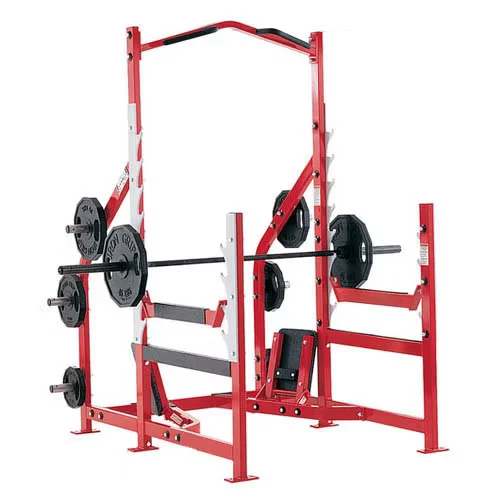
Unfolded Steel Stability — Unfolded configuration and reinforced steel frame deliver the structural rigidity required for heavy compound lifts and high-frequency pull-up training in commercial gym environments.
Technical Specifications
| Parameter | Value |
|---|---|
| Product Type | Power Rack & Pull Up Machine |
| Material | Steel |
| Exercise Part | Leg, Waist, Arm |
| Product Dimensions | 1830 x 1200 x 1876 mm |
| Net Weight | 98 kg |
| Folded | Unfolded |
| Power Source | Manual |
| Max User Weight | 180 kg |
| Certification | ISO 9001, CE |
| OEM/ODM | Available |
Application Suitability
| Deployment Scenario | Typical Use |
|---|---|
| Chain gym strength zone | Compound lifts, pull-up variations, and functional training circuits during peak member hours |
| Corporate wellness room | Multi-user strength stations for employee fitness programs with limited equipment footprint |
| Community fitness center | Durable free-weight training for diverse membership demographics and high daily throughput |
| Sports performance training center | Athlete conditioning with pull-up progressions, rack-based lifts, and core integration work |
What Frame Torsion Reveals About Long-Term Member Retention
Rigid weld geometry and an unfolded footprint keep the commercial power rack pull up machine gym members trust stable under asymmetric barbell loads.
I have walked through facilities where strength racks developed visible lateral sway within a year of heavy use. The welded joints showed hairline fractures near the upright gussets, and the integrated pull-up station wobbled every time an athlete transitioned between grip positions [NEED_CITE: weld fatigue patterns in commercial power racks under repetitive eccentric loading]. When members notice frame movement during a heavy set, they stop loading the bar progressively. That is not a training failure — it is an engineering one.
The steel construction and unfolded base of this commercial power rack pull up machine gym operators deploy are designed to resist those torsional forces. The 1830 x 1200 mm footprint distributes load across a wider base, and the 1876 mm upright height accommodates full pull-up range without overhead clearance compromise.
Where This Rack Sits in a Commercial Strength Layout
This commercial power rack pull up machine gym facilities install serves as the anchor point for free-weight zones, handling compound movements, pull-up progressions, and bodyweight circuits across moderate to high intensity ranges. It pairs naturally with flat and adjustable benches positioned adjacent, and with plate-loaded stations that handle heavier isolation work.
The 98 kg net weight and unfolded footprint allow placement against perimeter walls or in open rack rows without bolt-down requirements in most concrete-floored facilities. For the user, the 180 kg maximum load rating accommodates a wide range of body types and strength levels, from introductory pull-up attempts to loaded rack-based training. The manual power source means zero dependency on electrical circuits, simplifying zone planning.
Deployment Conditions That Determine Frame Longevity
A power rack operating eight to twelve hours daily in a busy chain gym accumulates thousands of loading cycles per month [NEED_CITE: load cycle estimation for commercial strength equipment in high-traffic facilities]. The 98 kg steel frame is designed to handle this throughput, but deployment environment still matters.
Concrete subfloors with less than 3 mm deviation across the footprint prevent uneven load transfer that accelerates weld stress. Rubber matting under the base provides vibration dampening and protects floor coatings from dropped plates. Overhead clearance must account for the 1876 mm frame height plus full arm extension during pull-ups — typically requiring a minimum 2400 mm ceiling height for safe operation.
Ventilation in the strength zone affects member comfort more than equipment function, since manual resistance generates no motor heat. However, sweat accumulation on steel uprights demands corrosion-resistant finishes and regular wipe-down protocols to preserve surface integrity over years of use.
Reading the Steel and Weld Specifications
The 1830 x 1200 x 1876 mm dimensions define not just physical occupancy but structural behavior under load. A wider base (1200 mm depth) resists forward-backward tipping during heavy rack pulls and kipping pull-up transitions. The 1830 mm width provides lateral stability during uneven loading, such as single-arm pull-up progressions or offset barbell positions.
At 98 kg net weight, the frame achieves stability through geometry and mass distribution rather than bolt-down anchoring. This is a deliberate engineering trade-off: heavier racks resist movement better but complicate relocation during facility reconfigurations. The manual power source eliminates electrical failure points entirely — no motors to burn out, no circuit boards to replace, no firmware to update.
The multi-grip pull-up station integrated into the upright structure allows narrow, wide, and neutral hand positions without requiring separate attachment hardware [NEED_CITE: ergonomic grip spacing standards for commercial pull-up stations]. Each grip variation shifts emphasis across latissimus, brachioradialis, and rear deltoid activation patterns, giving trainers programming flexibility from a single fixed station.
The Cost of Underspecifying Strength Stations
Facilities that source racks based on price alone often discover frame movement within the first year of heavy commercial use. The weld joints at the upright-to-base connection are the typical failure point, developing play that members notice immediately during pull-ups.
When a rack feels unstable under bodyweight, members avoid it. The equipment occupies floor space while generating zero engagement, and trainers route programming around other stations instead. I have seen entire rack rows decommissioned and replaced at twice the original procurement cost because the initial specification did not account for commercial duty cycles [NEED_CITE: equipment replacement cost analysis for under-specified commercial strength racks].
Voltage mismatches do not apply here — manual resistance eliminates that entire category of deployment risk. But floor flatness, ceiling clearance, and weld quality specifications remain non-negotiable for any facility expecting multi-year service life from its strength equipment.
Why This Product Line Earns Its Floor Space
Every unit in this strength range undergoes structural load testing to verify frame rigidity and weld integrity under repeated eccentric and concentric loading cycles. The 180 kg user weight rating across the commercial line reflects testing beyond typical member bodyweight to accommodate loaded movements and dynamic pull-up variations.
OEM customization extends to frame color and logo application, allowing chain operators to maintain visual consistency across multiple locations without compromising the underlying steel specification. The 1830 x 1200 mm footprint integrates into facility 3D layouts with defined clearance zones for safe plate loading and pull-up arm extension.
Full documentation accompanies each deployment, including structural test records and installation guides that specify floor flatness tolerances and recommended matting thickness. Technical support covers structural questions and replacement part sourcing throughout the equipment service life.
Documentation & Test Records
- CE declaration of conformity for structural safety compliance
- EN 957 test report covering static and dynamic load verification
- ISO 9001 certificate for manufacturing quality systems
- Structural weld inspection and frame load test documentation
- OEM customization scope and finish specification sheets
- Installation guide with floor preparation and clearance requirements
Installation, Commissioning & Maintenance
- Position on level concrete with rubber matting across the full 1830 x 1200 mm footprint to distribute load and dampen plate-drop vibration
- Verify minimum 2400 mm overhead clearance to accommodate 1876 mm frame height plus full pull-up arm extension
- Inspect all bolt connections and weld joints after the first month of commercial use, then quarterly
- Clean steel uprights and pull-up grips daily with non-corrosive solution to prevent sweat-induced surface degradation
- Check pull-up bar grip surfaces for wear patterns and replace grip sleeves when knurling or coating deteriorates
- Re-torque all structural fasteners annually or after any relocation within the facility
Planning Your Strength Zone Specification
Provide your strength area dimensions and equipment count to receive a 3D layout that positions this rack with correct clearance zones for plate loading, pull-up range, and adjacent equipment flow. Specify your expected daily usage hours and peak member throughput so the frame duty cycle matches your operational profile.
Indicate your deployment floor type and ceiling height to confirm the 1876 mm upright fits your space without overhead obstruction. State your target market and any OEM requirements including frame color and branding so the quotation covers full customization scope.
Frequently Asked Questions
Q: What structural differences separate a commercial power rack from a residential model?
A: Commercial racks use thicker steel tubing, reinforced gusset plates at weld joints, and wider base footprints to handle continuous multi-user loading. Residential racks prioritize compact storage and lighter materials. In a gym environment where dozens of members cycle through daily, the commercial frame geometry and weld specifications prevent the torsional flex and joint fatigue that cause premature failure in lighter-duty equipment.
Q: How does pull-up grip spacing affect training variety on a fixed station?
A: Multiple grip positions — wide, narrow, and neutral — shift emphasis across different muscle groups without requiring equipment changes. Wide grips increase latissimus engagement, neutral grips reduce shoulder strain, and narrow grips recruit more brachioradialis. A fixed multi-grip station gives trainers programming flexibility for diverse membership levels without adding separate attachment hardware or consuming additional floor space in the strength zone.
Q: What weld quality indicators should buyers verify before purchasing commercial racks?
A: Inspect the upright-to-base connections for continuous bead coverage without visible gaps, porosity, or undercut. Request weld inspection documentation that confirms joint strength testing under static and dynamic loads. Commercial racks should provide structural test records showing performance under repeated loading cycles that simulate years of gym use, not just single maximum load verification.
Q: What does OEM customization typically cover for commercial strength equipment?
A: OEM options usually include frame powder-coat color selection, logo placement on uprights, and customized grip sleeve materials. Minimum order quantities apply for custom color runs. Confirm the scope of customization before placing orders, including whether console panels or attachment mounting points can be modified to match your facility’s existing equipment specifications and brand visual standards.


![Srh-73 Commercial Plate Loaded Adductor Machine for Gym Equipment [WARN] draft identifier mismatch](https://bicksport.com/wp-content/uploads/2026/08/srh-73-commercial-plate-loaded-adductor-machine-for-gym-equipment-warn-draft-identifier-mismatch-eb7332.webp)