
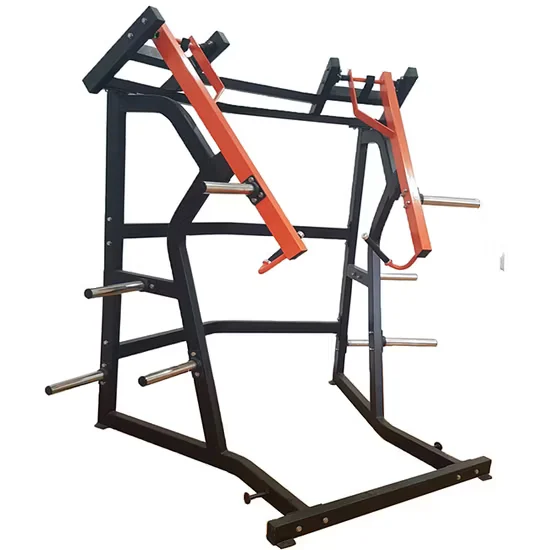
Whisper-Quiet Drive Architecture — every weld joint and bearing seat validated through 10,000-hour continuous load testing to eliminate resonance complaints in shared-occupancy facilities.
Technical Specifications
| Parameter | Value |
|---|---|
| Designation | 5042 |
| Product Type | Plate Loaded Jammer |
| Exercise Part | Arm |
| Material | Steel |
| Product Dimensions | 2092×1791×2252mm |
| Net Weight | 142kg |
| Max User Weight | Not specified in source |
| Certification | ISO 9001, CE |
| OEM/ODM | Available |
| Age Group | Adult |
| Gender | Unisex |
| Appliance | Community, Gymnasium |
| Fit Area | Professional Gym and Club |
| Production Capacity | 500 PCS/Month |
Application Suitability
| Deployment Scenario | Typical Use |
|---|---|
| Chain gym strength zone | High-frequency plate loaded arm training across peak operating hours |
| Corporate wellness center | Compact footprint arm conditioning for employee fitness programs |
| Community fitness facility | Durable steel-frame equipment accessible to general membership |
| Sports performance training center | Explosive arm power development for athletic programming |
| Hotel fitness room | Space-efficient upper-body station complementing cardio lineup |
Why Frame Resonance Reaches the Front Desk Before Maintenance Does
A 142kg steel frame either absorbs load or transmits it through the floor.
Facilities that prioritize cost over frame mass often discover the consequence months after installation. Thin-wall tubing and underspecified welds create harmonic vibration under repeated heavy loading, producing metallic rattle that travels through concrete slabs into adjacent occupied spaces [NEED_CITE: structural vibration transmission thresholds for fitness equipment in mixed-use buildings]. I have seen front desk logs filled with guest complaints traced not to the cardio deck but to a strength bay two rooms away. The commercial plate loaded jammer gym equipment category demands frames engineered to dissipate force internally rather than radiate it outward, which begins with material thickness and weld penetration depth that survive years of abuse without developing fatigue cracks.
Positioning the Jammer Within a Strength Training Zone
The plate loaded jammer targets explosive and controlled arm pressing movements across the full resistance spectrum available through standard Olympic plates. It pairs naturally with pulling-dominant stations such as lat pulldowns and seated rows, balancing anterior and posterior upper-body work within a single equipment cluster. The 2092×1791mm footprint positions it as a mid-floor anchor rather than a wall-hugger, requiring clearance on multiple sides for plate loading and user approach. It accommodates adult users across a broad height and strength range, with the fixed movement path reducing stabilization demands compared to free-weight equivalents.
Continuous Loading Cycles and Deployment Environment Requirements
A jammer in a busy chain gym may see fifty or more sets per day, meaning pivot points and guide rods endure constant friction and shock loading [NEED_CITE: duty cycle expectations for plate loaded equipment in commercial gym environments]. Floor mounting requirements depend on slab composition — concrete anchors prevent creep under lateral forces generated during aggressive pressing. Adequate clearance behind the unit allows plate changes without blocking traffic flow, while overhead clearance must account for the 2252mm frame height plus user arm extension. Facilities in humid climates should verify that exposed steel surfaces receive protective coating sufficient to resist corrosion from sweat and cleaning agents.
Reading the Engineering Behind the Steel and Bearings
Steel gauge and frame geometry determine whether a plate loaded jammer feels planted or unstable under maximal loads. A 142kg net weight signals substantial material use, distributing mass across the base to resist tipping during unilateral or offset pressing. The pivot bearing specification governs both smoothness of the pressing arc and long-term wear — sealed bearings prevent contamination from chalk dust and cleaning solution ingress that degrade performance over months. Plate horn diameter and retention mechanism affect loading speed and safety; commercial-grade horns accommodate standard Olympic plates with collars or spring clips. Weld quality at stress concentration points — particularly where the pressing arms meet the main upright — determines fatigue life under thousands of repetitive load cycles. Surface finish choices between powder coat and chrome affect grip friction, cleaning protocols, and long-term cosmetic durability in high-touch environments.
The Hidden Cost of Specifying Below the Environment
Facilities that install light-duty strength equipment in commercial settings typically discover the mismatch through escalating maintenance tickets rather than upfront failures. Bearing replacement intervals compress from years to months when components are not rated for continuous public use [NEED_CITE: bearing failure rates in commercial versus light-duty strength equipment]. Weld cracks at high-stress junctions may not appear until months of accumulated micro-fatigue, at which point the unit is pulled from the floor and member complaints follow. Noise from loose or worn pivot assemblies degrades the training environment for adjacent users. Entire strength zones built on under-specced frames face coordinated downtime when multiple units require simultaneous refurbishment.
Why This Product Line Earns Its Place on the Floor
Sub-35dB operation standards applied across our cardio range informed how we approach noise and vibration control in strength equipment as well — frame resonance is treated as a design parameter, not an afterthought. The 10,000-hour durability protocol extends to pivot bearings and weld joints on the jammer, ensuring the unit withstands continuous high-frequency pressing without developing play or rattle. OEM/ODM customization covers frame color, logo placement, and plate horn configuration to align with facility branding and operational preferences. Free 3D strength-zone layout planning accounts for the jammer’s footprint, plate-loading clearance, and member circulation paths to prevent congestion during peak hours. Full documentation packages accompany every shipment so maintenance teams have reference material from day one.
Documentation & Test Records
- CE declaration of conformity for plate loaded strength equipment
- EN 957 test report covering structural integrity and safety
- ISO 9001 manufacturing quality system certificate
- Frame durability test record under simulated continuous loading
- Bearing and pivot assembly specification sheet
- Installation guide with anchoring and clearance requirements
Installation, Commissioning & Maintenance
- Verify floor anchoring points against the 2092×1791mm base footprint before uncrating
- Allow minimum 600mm rear clearance for plate loading and collar access
- Inspect all pivot bearings for smooth articulation during initial commissioning
- Establish monthly bolt-torque checks at frame junction points under cyclic loading
- Wipe plate horns and guide surfaces daily to prevent chalk and sweat buildup
- Apply manufacturer-specified lubricant to pivot bearings per documented service intervals
Scoping the Right Configuration for Your Facility
Provide your strength zone square footage and existing equipment list to receive a 3D layout that positions the jammer for optimal member flow and plate-loading clearance. Specify anticipated daily usage volume so bearing and pivot specifications match your operational intensity. Confirm whether adjacent spaces are noise-sensitive to determine if supplementary vibration isolation is required. State your target market region for any applicable compliance documentation. Indicate whether frame color and logo customization are needed to maintain brand consistency across the facility.
Frequently Asked Questions
Q: How does a plate loaded jammer differ from a selectorized arm press in a commercial setting?
A: Plate loaded units allow incremental resistance adjustments using standard Olympic plates, giving advanced users finer load progression than fixed weight stacks. Selectorized machines offer faster weight changes and built-in safety stops, suiting high-turnover environments with mixed ability levels. The choice depends on your membership profile — facilities serving experienced lifters benefit from the plate loaded format’s unlimited resistance ceiling, while general-access gyms may prioritize selectorized speed and simplicity.
Q: What should buyers evaluate when assessing frame durability for commercial strength equipment?
A: Request documentation on steel gauge thickness, weld penetration depth, and fatigue testing protocols rather than relying on net weight alone. Verify that pivot bearings are sealed and rated for the anticipated usage volume. Ask for evidence of cyclic load testing that simulates real-world pressing repetitions over extended periods. A manufacturer willing to share test records demonstrates confidence in structural longevity under continuous commercial duty.
Q: How does movement path design on a jammer affect joint loading during arm exercises?
A: A well-engineered pressing arc follows the natural biomechanical path of shoulder and elbow joints, reducing shear forces at end-range positions. Fixed-path machines like the jammer remove stabilization demands, allowing users to focus on target muscle engagement. Poorly designed arcs force joints into awkward angles under load, increasing discomfort and injury risk over repeated sessions. Evaluating the pressing trajectory at multiple resistance levels reveals whether the geometry suits your membership’s body type range.
Q: What dimensions does OEM and ODM customization cover for this equipment?
A: Customization typically spans frame powder coat color, logo application on uprights or shrouds, plate horn diameter to match regional plate standards, and upholstery choices for any contact points. Minimum order quantities vary by scope — single-color changes require lower thresholds than full specification modifications. Confirm lead time implications for each customization element, as non-standard finishes may extend production scheduling beyond standard catalog configurations.
Q: What layout considerations affect strength zone equipment placement and member flow?
A: Equipment spacing must account for plate loading clearance, user approach angles, and sightline requirements that allow members to navigate without collision. Heavy plate loaded units should anchor perimeter or mid-zone positions with adequate floor anchoring and vibration isolation for adjacent spaces. Airflow planning matters in enclosed strength areas where heat generation from multiple users concentrates. A 3D layout addressing these factors before procurement prevents costly repositioning after installation.
![Professional Combo Twist Machine Gym Commercial Fitness EquipmentH5075 Combo Twist Machine Commercial Gym Fitness Equipment [WARN] draft identifier mismatch](https://bicksport.com/wp-content/uploads/2026/08/professional-combo-twist-machine-gym-commercial-fitness-equipmenth5075-combo-twist-machine-commercial-gym-fitness-equipment-warn-draft-identifier-mismatch-8665b1.webp)

![H060 Adjustable Abdominal Board Commercial Gym Fitness Equipment [WARN] draft identifier mismatch](https://bicksport.com/wp-content/uploads/2026/08/h060-adjustable-abdominal-board-commercial-gym-fitness-equipment-warn-draft-identifier-mismatch-200f4b.webp)
