

Inherent Vibration Damping — Solid wood frame construction absorbs carriage resonance at the source, keeping structure-borne noise out of occupied floors below.
Technical Specifications
| Parameter | Value |
|---|---|
| Product Type | Pilates Reformer |
| Material | Wood |
| Color | Solid Color |
| Accessory | Long Box / Jump Board / Platform |
| Product Dimensions | 2460730680mm |
| Net Weight | 100kgs |
| Warranty | 3 Years |
| Production Capacity | 80 Pieces/Month |
| Customization | Available (logo, color allowed) |
Application Suitability
| Deployment Scenario | Typical Use |
|---|---|
| Boutique pilates and yoga studio in shared commercial building | Daily group reformer classes requiring quiet carriage transitions across multiple sessions |
| High-end residential home gym | Private training where noise transmission to adjacent rooms is unacceptable |
| Rehabilitation and wellness center | Low-impact progressive-resistance programming for post-injury clients |
| Hotel fitness center on guest room floors | 24-hour self-service reformer access with floor-friendly vibration profile |
| Corporate wellness room | Midday movement breaks for employees without disrupting adjacent workspaces |
Why Studio Operators Hear Complaints Before the Instructor Does
Metal-frame reformers transmit carriage impact through floor slabs into occupied rooms below.
When a carriage slams into the end stop during jump board repetitions, the kinetic energy has nowhere to dissipate but downward. In multi-story studio buildings, that impulse travels through concrete slabs and shows up as audible tapping in the office or guest room directly underneath. I have seen operators replace entire fleets of steel-tube reformers after noise complaints escalated past the point of negotiation. [NEED_CITE: structure-borne vibration transmission in multi-story commercial fitness deployments] The frame material is the first line of defense, and choosing the wrong one is an expensive lesson learned after the lease is signed.
Where This Reformer Fits in a Multi-Discipline Studio Layout
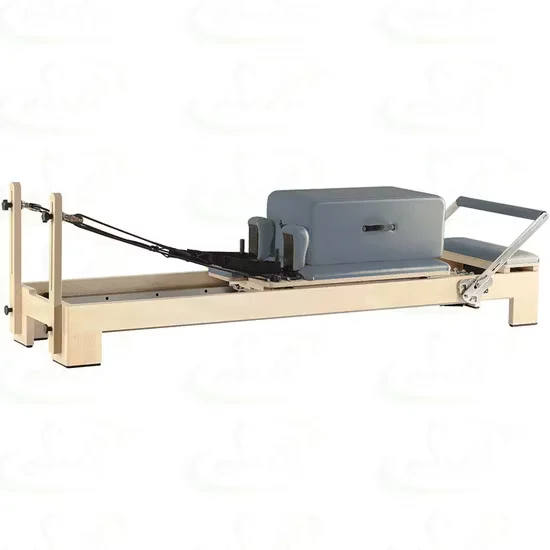
This unit occupies the low-impact, controlled-movement end of the studio spectrum. In a mixed-format space, it pairs with mat zones and small apparatus work while staying clear of high-energy cardio corners. The 2460mm length demands dedicated floor footprint with clearance on both ends for carriage travel and instructor circulation. It accommodates users across a broad height and weight range through adjustable spring configurations and the modular accessory ecosystem. The commercial pilates reformer wood frame serves as the anchor apparatus around which class programming is structured, supporting everything from foundational alignment work to athletic conditioning sequences.
Continuous Class Scheduling and Floor-Loading Realities
A boutique studio running four to six group classes daily puts this reformer through hundreds of carriage cycles between scheduled maintenance windows. The wood frame handles repetitive loading differently than steel — it absorbs micro-vibrations rather than transmitting them, which matters when six units run simultaneously on an upper floor. Ventilation is a secondary concern compared with floor slab stiffness; a suspended timber floor will amplify resonance that a concrete slab damps naturally. [NEED_CITE: floor deflection limits for group fitness equipment on elevated slabs] Ground-level installations on concrete with isolation pads perform best, while upper-floor deployments benefit from the inherent mass damping that solid wood provides over hollow steel tubing.
How the Frame Material and Carriage Interface Shape the User Experience
The solid wood frame delivers mass and internal fiber damping that steel-tube construction cannot replicate. When the carriage transitions under spring load, rolling friction at the wheel-rail interface generates audible noise proportional to surface hardness and contact pressure. Wood-on-wood or wood-on-polymer interfaces run noticeably quieter than metal-on-metal tracks, and the difference compounds over a full class of repeated transitions. The spring resistance progression determines how joint loading scales through eccentric phases — lighter springs suit rehabilitation protocols where controlled return matters, while heavier sets support athletic conditioning with higher peak resistance. The accessory mounting points accept the long box for seated and supine work, the jump board for plyometric loading, and the platform for standing balance sequences, all swapping onto a single footprint without requiring a second machine.
The Cost of Specifying Below What the Schedule Demands
Operators who select residential-grade reformers for commercial class schedules encounter frame joint loosening within the first year of high-frequency use. Carriage wheels develop flat spots from repeated end-stop impacts, and the resulting rumble transmits directly through the frame into the floor. I once worked with a studio that cycled through two sets of replacement wheels before tracing the problem to undersized bearings in the carriage assembly. [NEED_CITE: carriage bearing load rating for commercial group class frequency] The noise problem does not stay contained — it migrates through the building structure and becomes a tenant relations issue that no amount of maintenance can solve after the fact.
What This Product Line Delivers for Facility Planning
The solid-wood construction addresses the noise transmission problem that keeps upper-floor studio operators awake at night. Every unit ships with the full accessory set — long box, jump board, and platform — so a facility covers the complete class curriculum from one footprint without sourcing add-ons separately. Customization extends to logo and color matching, letting operators align equipment aesthetics with studio branding without inflating lead times. The 3-year warranty reflects confidence in frame joint integrity under continuous class scheduling. Our team provides 3D studio layout planning that accounts for instructor sightlines, carriage travel clearance, and member flow between apparatus stations. Technical support remains available around the clock for installation questions and field adjustments.
Documentation & Test Records
- CE declaration of conformity covering the complete reformer assembly
- Frame load test report verifying static and dynamic rating
- Noise level measurement record under loaded carriage operation
- Spring resistance progression curve for each included spring set
- Accessory mounting interface load rating for jump board and platform
- Assembly and commissioning guide with torque specifications
Installation, Commissioning & Maintenance
- Allow minimum 900mm clearance at each end for full carriage travel and instructor access
- Install on level flooring with vibration isolation pads to decouple frame from slab
- Inspect carriage wheel surfaces and rail alignment after the first 200 hours of class operation
- Lubricate carriage rail contact surfaces per schedule to maintain smooth rolling resistance
- Verify spring anchor points and attachment hardware torque quarterly under commercial use
- Clean wood frame surfaces with pH-neutral solution to prevent sweat residue buildup
Sizing the Order to Match Your Studio Schedule
Provide your studio floor area and planned apparatus count so we can generate a 3D layout covering sightlines, carriage clearance, and member circulation paths. Specify your daily class schedule and expected sessions per unit to confirm the spring set configuration matches your programming mix. Confirm the deployment floor level and what occupies the space directly below to finalize isolation pad requirements. Let us know your target market so we align color and branding customization with your studio identity.
Frequently Asked Questions
Q: How does a wood frame compare to steel in long-term noise performance?
A: Solid wood absorbs vibration internally through its fiber structure, while steel tubing transmits carriage impact directly to the floor. Over months of class use, wood frames maintain a quieter profile because the material itself dampens resonance rather than amplifying it. Steel frames often require aftermarket isolation upgrades to reach comparable noise levels in multi-story buildings.
Q: What determines carriage rolling noise as the reformer ages?
A: Wheel material hardness and rail surface finish drive the friction signature during loaded transitions. Softer polymer wheels on smooth rails stay quiet longer but may develop flat spots under heavy jump board use. Harder wheels resist deformation but transmit more vibration. Regular inspection of wheel roundness and rail cleanliness preserves the original noise profile across thousands of carriage cycles.
Q: How should spring resistance be specified for mixed-use studio programming?
A: Rehabilitation clients need lighter springs with gradual progression curves that allow controlled eccentric return without joint strain. Athletic conditioning demands heavier springs that provide meaningful peak resistance during power movements. A commercial studio serving both populations benefits from a full spring set with clearly marked resistance levels, letting instructors dial in the appropriate load for each class format.
Q: Can the included accessories handle repeated jump board loading?
A: The jump board mounts to dedicated attachment points rated for repetitive plyometric impact during group classes. The platform and long box use the same interface geometry for quick swaps between class segments. Verify that mounting hardware torque is checked quarterly, as high-frequency accessory changes can gradually loosen fasteners under commercial scheduling demands.
![Senrui SRY-02 Beech Wood Pilates Reformer for Studio and Home Use [WARN] draft identifier mismatch](https://bicksport.com/wp-content/uploads/2026/08/senrui-sry-02-beech-wood-pilates-reformer-for-studio-and-home-use-warn-draft-identifier-mismatch-d15a00.webp)

