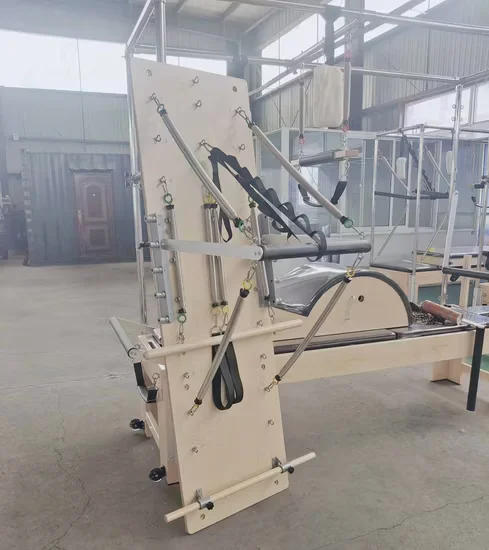
Solid-Wood Vibration Damping — A 150 kg solid-wood frame with full trapeze tower absorbs carriage resonance at the source, keeping structure-borne noise below complaint thresholds on shared residential floors.
Technical Specifications
| Parameter | Value |
|---|---|
| Product Type | Pilates Equipment |
| Material | Solid Wood |
| Specification | 2520 × 760 × 2050 mm |
| Net Weight | 150 kg |
| Accessories | Long Box, Jump Board, Platform |
| Color Options | Solid Color (customizable) |
| Customization | Logo and color available |
| Warranty | 3 Years |
Application Suitability
| Deployment Scenario | Typical Use |
|---|---|
| Boutique Pilates studio in mixed-use buildings | Group reformer classes requiring low structure-borne noise |
| Rehabilitation and physiotherapy clinic | Controlled resistance therapy with minimal acoustic distraction |
| High-end residential wellness suite | Multi-household shared studio with noise-sensitive neighbors |
| Corporate wellness room | Employee Pilates sessions during breaks without disturbing adjacent offices |
| Hotel fitness center on guest room floors | 24-hour access reformer training above occupied rooms |
Why Vibration Complaints Reach the Studio Manager Before the Equipment Vendor Does
The frame itself is the first line of acoustic defense.
Studio operators in mixed-use commercial buildings regularly field noise complaints that trace back to reformer carriages transmitting impact through floor slabs. Hollow steel frames resonate at frequencies that travel efficiently through concrete, while the grain structure of a solid-wood frame dissipates that energy internally. I have seen reformer rooms on second-floor studio spaces generate complaints from the accounting firm directly below — not because the springs were loud, but because the frame acted as a sounding board [NEED_CITE: structure-borne noise transmission in multi-story fitness facilities]. A commercial Pilates reformer full trapeze wood frame addresses this at the material level before any accessory or technique adjustment can help.
Where This Reformer Sits in a Studio Equipment Lineup
This unit covers the full spectrum of classical and contemporary Pilates movements — supine footwork, seated arm work, long box series, and jump board plyometrics — across beginner to advanced intensity ranges. In a studio layout, it pairs with mat zones for warm-up flow and with Cadillac units for advanced rehabilitation progressions, occupying the central training position where most class time is spent. The 2520 mm length accommodates users across a broad height range without requiring carriage extensions. The full trapeze tower provides vertical resistance vectors that complement the horizontal spring work of the carriage, keeping the commercial Pilates reformer full trapeze wood as the primary workhorse in a multi-unit studio configuration.
Continuous Session Throughput and Room-Level Requirements
A busy boutique studio may cycle this unit through six to eight group classes per day, meaning the carriage wheels, springs, and frame joints endure sustained loading with minimal cooldown between sessions. Solid-wood construction requires stable humidity levels to prevent joint loosening over seasonal cycles — a consideration absent in steel-frame alternatives. Floor leveling matters more here than with lighter equipment: the 150 kg mass means the frame transmits load directly through its footprint, and an uneven floor introduces torsion that accelerates wear on carriage rails. Adequate ventilation around the 2050 mm tower height ensures air circulation in rooms with low ceilings [NEED_CITE: environmental requirements for wood-frame fitness equipment in commercial settings]. Power is not a concern for this spring-based system, which simplifies deployment in rooms where electrical circuits are already allocated to electronic cardio units.
Spring Gradation and Carriage Mechanics Explained
The resistance system relies on spring tension rather than magnetic or friction mechanisms, which means the noise profile is determined by spring quality, carriage wheel material, and rail finish. Metal-on-metal contact points are the primary noise sources in any reformer; spring hooks that rattle under load transitions and carriage wheels with insufficient bearing precision generate the clicks and hums that carry through floor slabs. A solid-wood frame adds inherent damping that steel cannot match — the cellular structure of hardwood absorbs high-frequency vibration before it reaches the floor. The full trapeze tower introduces additional load vectors through its attachment points, requiring frame joints rated for multi-directional stress. Spring tension gradation across the set determines whether the unit supports gentle rehabilitation protocols or advanced athletic conditioning without requiring spring swaps mid-session.
The Cost of Underspecifying Frame and Spring Components
Operators who select reformers based on price often discover that lightweight frames and generic springs produce compounding problems. Hollow frames amplify spring noise rather than absorbing it, converting a minor mechanical sound into a room-filling resonance. Springs with inconsistent tension gradation force instructors to spend class time adjusting resistance rather than coaching movement [NEED_CITE: spring tension consistency requirements for group Pilates instruction]. Carriage wheels with basic bearings develop flat spots under daily commercial use, creating rhythmic thumping that worsens with each session until replacement becomes unavoidable. These failures do not appear in the first month — they surface after several hundred hours of loaded cycling, by which point the equipment is already installed and the studio is operational.
What Differentiates This Product Line
Every unit undergoes loaded carriage cycling to verify that spring return is smooth and that the wood frame does not transmit audible resonance under representative commercial loads. The full six-series cardio and equipment family means a studio can source reformers alongside treadmills, ellipticals, and rowing machines from a single engineering team, keeping warranty and service coordination unified. OEM customization extends to logo engraving and frame color matching for studio branding. A complimentary 3D layout service covers reformer spacing, tower clearance, and airflow paths — ensuring that the 2520 × 760 mm footprint fits the room plan before the container ships. Technical support responds around the clock for calibration questions that arise during the first weeks of operation.
Documentation & Test Records
- CE declaration of conformity covering mechanical safety of moving parts
- EN 957 test report validating structural load rating under cyclic use
- ISO 9001 certificate for manufacturing quality management
- Noise level test report measuring carriage and spring sound under loaded cycling
- Durability test record documenting spring and wheel performance over extended use
- Assembly and commissioning guide with torque specifications for wood frame joints
Installation, Commissioning & Maintenance
- Confirm floor flatness within tolerance before placing the 150 kg unit to prevent frame torsion
- Allow clearance around the 2050 mm tower height for full-range trapeze exercises
- Inspect spring hooks and carriage wheel bearings after the first 200 hours of loaded use
- Wipe wood surfaces with pH-neutral cleaner to prevent sweat residue from degrading the finish
- Verify all frame joint fasteners at quarterly intervals as wood responds to humidity cycles
- Test long box and jump board attachment hardware before each group class session
Equipment Selection and Deployment Inquiry
Provide the studio floor plan with ceiling height to confirm that the 2050 mm trapeze tower clears overhead fixtures and HVAC ductwork. Specify the expected daily class count so that spring and carriage specifications match the duty cycle. Identify whether the deployment floor sits above noise-sensitive spaces to determine if additional isolation pads are warranted. State the target market and any branding requirements for logo engraving and color matching.
Frequently Asked Questions
Q: How does a wood frame compare to steel in controlling reformer noise?
A: Solid wood absorbs high-frequency vibration through its cellular grain structure, preventing carriage impact from resonating through the frame into the floor slab. Steel frames transmit those frequencies efficiently, which is why operators in multi-story buildings often hear complaints from tenants below. The 150 kg mass of this wood frame further stabilizes the unit against lateral movement during dynamic exercises.
Q: What spring tension range does this reformer support?
A: The spring set covers resistance levels from gentle rehabilitation loading through advanced athletic conditioning. Instructors can layer springs to increase total tension for jump board plyometrics or use a single light spring for controlled isolation work. The gradation between tension levels is calibrated to provide perceptible steps without abrupt jumps that disrupt movement flow.
Q: How does carriage wheel material affect rolling noise and floor wear?
A: Precision-machined wheels with sealed bearings roll quietly across the wood rail and resist flat-spot formation under continuous loaded cycling. Inferior wheel compounds develop wear patterns that create rhythmic thumping audible to clients. The wheel material is also selected to avoid marking or scuffing the wood rail surface over thousands of repetitions.
Q: What exercises and user weights does the trapeze tower support?
A: The full trapeze tower accommodates vertical pulling, overhead pressing, and assisted stretching movements through its multiple attachment points at varying heights. The frame joints are rated for multi-directional loading during these exercises across the commercial user weight range. The tower height of 2050 mm provides sufficient clearance for standing and suspended work.
Q: What customization options are available for studio branding?
A: Logo engraving on the wood frame and custom color finishes are available to match studio interior design. Accessory bundles including the long box, jump board, and platform can be configured to the studio’s programming needs. Minimum order quantities for customization are flexible to accommodate single-studio and multi-location deployments alike.

![Commercial Aluminum Alloy Half Trapeze Pilates Reformer Machine [WARN] draft identifier mismatch](https://bicksport.com/wp-content/uploads/2026/08/commercial-aluminum-alloy-half-trapeze-pilates-reformer-machine-warn-draft-identifier-mismatch-e689ff.webp)
![Commercial Gym Studio Two-Way Ladder Core Align Pilates Reformer Equipment [WARN] draft identifier mismatch](https://bicksport.com/wp-content/uploads/2026/08/commercial-gym-studio-two-way-ladder-core-align-pilates-reformer-equipment-warn-draft-identifier-mismatch-0a371a.webp)