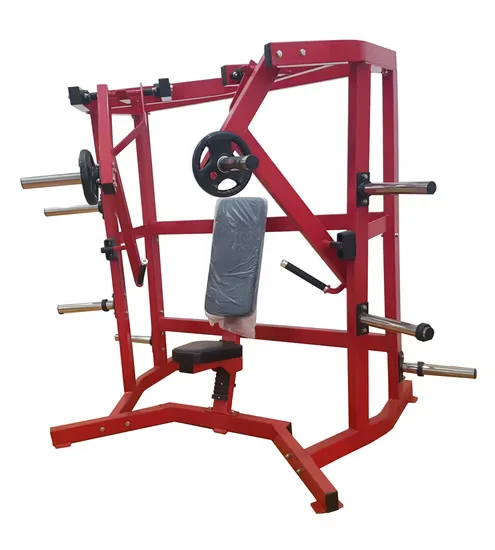
![Commercial Pendulum Squat Machine PRO Gym Exercise Equipment [WARN] draft identifier mismatch](https://bicksport.com/wp-content/uploads/2026/08/commercial-pendulum-squat-machine-pro-gym-exercise-equipment-warn-draft-identifier-mismatch-07cf00.webp)
Heavy-Duty Steel Frame — 50×100×3mm welded tubing maintains structural rigidity under repeated high-load squat cycles in commercial strength zones.
Technical Specifications
| Parameter | Value |
|---|---|
| Designation | SRH-72 |
| Product Type | Pendulum Squat Machine |
| Tube Size | 50×100×3mm |
| Material | Iron |
| Machine Weight | 170 kg |
| Product Dimensions | 1550×1480×1825 mm |
| Max User Weight | Commercial rated |
| Exercise Part | Waist / Lower Body |
| Color | Customized |
| Age Group | Adult |
| Gender | Unisex |
| Appliance | Community, Gymnasium, Home |
| Production Capacity | 200 Pieces/Month |
| Certification | RoHS, ISO 9001, CE |
| Shipment Time | 30–40 Days by Sea |
| Origin | China |
| Trademark | Senrui |
Application Suitability
| Deployment Scenario | Typical Use |
|---|---|
| Chain gym strength zone | High-frequency member rotation across multiple squat variations throughout operating hours |
| Community fitness center | Compact strength station balancing commercial load capacity with limited floor space |
| High-end residential home gym | Customized finish integrating with interior design for private training environments |
| Sports performance training center | Loaded squat patterns for athlete lower-body development programs |
| Corporate wellness room | Durable strength equipment supporting employee fitness during break intervals |
Why Frame Rigidity Dictates Equipment Lifespan in Commercial Strength Zones
A squat machine either holds its geometry under load or it does not — there is no middle ground at the 200th repetition of the day.
Strength equipment in commercial gyms endures forces that reveal structural weaknesses within weeks. When tube walls are too thin, the frame flexes under heavy loads, creating micro-movements at every weld joint [NEED_CITE: structural fatigue in commercial gym equipment frames under cyclic loading]. This flex accelerates bolt loosening, bearing wear, and eventually catastrophic weld failure. Facility operators then face the cost of emergency replacement mid-contract while dealing with member complaints about equipment feeling unstable. The commercial pendulum squat machine SRH-72 addresses this with 50×100×3mm steel tubing — a wall thickness that resists deformation through the full arc of loaded squats, maintaining alignment between pivot points and foot platforms over extended commercial duty cycles.
Lower-Body Force Production in the Strength Training Ecosystem
The pendulum squat pattern loads the quadriceps and glutes through a fixed arc that reduces spinal compression compared to free-weight back squats. In a commercial cardio and strength layout, this machine complements leg press, hack squat, and functional rig stations by offering a guided movement pattern suitable for users across experience levels. It fits into high-traffic strength zones where members cycle through equipment rapidly, and its 1550×1480 mm footprint allows deployment along walls or between rack bays. The movement accommodates a wide range of user heights without requiring seat or pad adjustments between sets.
Continuous Operation Demands and Facility Environment Factors
Commercial strength equipment operates whenever the facility is open — often 18 to 24 hours daily in hotel gyms and budget fitness chains. The SRH-72 carries no motor or electronics, so duty cycle concerns center on pivot bearings, weld joints, and pad material [NEED_CITE: bearing lifespan specifications for pivot-based strength machines]. Noise transmission matters when this equipment sits on upper floors above occupied spaces; the iron frame and 170 kg mass dampen vibration transfer to floor slabs. Ground leveling with shims or rubber mats prevents frame twist that would unevenly load pivot bearings. Facilities planning multiple units should allow adequate lateral spacing for plate loading and user clearance on both sides.
What 50×100×3mm Tubing Actually Means Under Load
The 3mm wall thickness in a 50×100mm rectangular tube provides a moment of inertia that resists bending when loaded at the pivot point during deep squats. Thinner tubing — common in light-commercial or home-rated equipment — deflects noticeably at loads above 150 kg, creating a sensation of instability that discourages users from progressive overload. The iron construction and 170 kg machine weight anchor the unit without requiring floor bolts in most concrete-slab installations. Weld penetration at the pivot gussets and foot platform junctions determines long-term fatigue resistance, which is why CNC-controlled welding fixtures produce more consistent joint geometry than manual welding on high-volume production runs.
The Hidden Cost of Underspecified Frame Material
Operators who purchase squat machines based on price per unit often discover frame flex within the first quarter of commercial use. Thin-wall tubing fatigues at stress concentrations near weld zones, leading to cracking that appears suddenly rather than gradually [NEED_CITE: weld fatigue failure patterns in commercial strength equipment]. The result is equipment pulled from the floor mid-warranty, replacement lead times that leave gaps in the strength zone, and members migrating to competitors whose equipment feels solid under load. Specifying 3mm minimum wall thickness on primary structural members eliminates this failure mode before it enters the maintenance log.
Why This Product Line Addresses Deployment Realities
The 50×100×3mm frame specification runs across the SRH-72 production, ensuring every unit meets the same structural baseline regardless of color or branding customization. The 170 kg mass provides stability without permanent anchoring, allowing facility reconfigurations when layouts change. OEM customization covers color, logo placement, and pad material to match chain gym visual standards. The 1550×1480×1825 mm envelope fits standard freight container loading alongside other strength stations. Full vertical integration from CNC machining to final assembly keeps lead times within 30–40 days for sea freight, and the 200 pieces per month capacity supports multi-site rollout schedules.
Documentation & Test Records
- CE declaration of conformity covering SRH-72 structural and safety compliance
- ISO 9001 certificate for manufacturing quality management system
- RoHS compliance documentation for material composition
- EN 957 test report validating strength equipment safety requirements
- Frame weld inspection and fatigue test records
- Production dimensional verification report per unit
Installation, Commissioning & Maintenance
- Maintain 800 mm clearance on all sides for plate loading and user passage around the 1550×1480 mm footprint
- Level the iron frame on rubber mats to distribute the 170 kg mass and prevent pivot bearing side-loading
- Inspect pivot bolts and frame fasteners monthly under commercial use frequency
- Wipe down pads and frame contact surfaces daily to prevent sweat corrosion on iron surfaces
- Verify weld joint integrity at pivot gussets during quarterly preventive maintenance rounds
How to Specify This Equipment for Your Facility
Provide your strength zone floor plan with square footage and ceiling height to receive a layout showing SRH-72 placement relative to rack bays, plate storage, and member traffic flow. Confirm whether the installation floor is concrete slab or raised flooring, as this affects vibration transfer and anchoring requirements. State your target market so color and branding customization align with regional visual standards. Indicate expected daily user volume to validate whether the production capacity supports your rollout timeline across multiple locations.
Frequently Asked Questions
Q: How does a pendulum squat machine differ from a Smith machine biomechanically?
A: The pendulum squat follows a curved arc that matches natural hip and knee flexion patterns, keeping the torso more upright throughout the movement. Smith machines constrain the bar to a vertical or slightly angled linear path, which can increase shear force on the lower back at certain joint angles. The pendulum pattern reduces spinal loading while emphasizing quadriceps activation through the full range.
Q: What tube wall thickness should commercial strength equipment specify?
A: Commercial strength equipment subjected to repeated heavy loading should use rectangular tubing with a minimum 3mm wall thickness on primary structural members. Thinner walls flex under load, accelerating weld fatigue and creating instability sensations that discourage member use. The 50×100×3mm specification on the SRH-72 provides rigidity appropriate for continuous commercial deployment without frame deflection.
Q: What customization options are available for chain gym deployments?
A: The SRH-72 supports OEM customization of frame color, pad material, logo placement, and branding elements to match chain gym visual identity systems. Minimum order quantities apply for custom color runs. Production lead times remain within the standard 30–40 day window for sea freight when customization specifications are confirmed before production scheduling begins.
Q: How much floor space and structural support does this machine require?
A: The SRH-72 occupies a 1550×1480 mm footprint with 1825 mm height clearance needed. The 170 kg machine weight distributes across the base frame without requiring floor anchoring on standard concrete slabs. Allow 800 mm lateral clearance on each side for plate loading. Upper-floor installations should verify slab load capacity with a structural engineer when deploying multiple units in a concentrated zone.