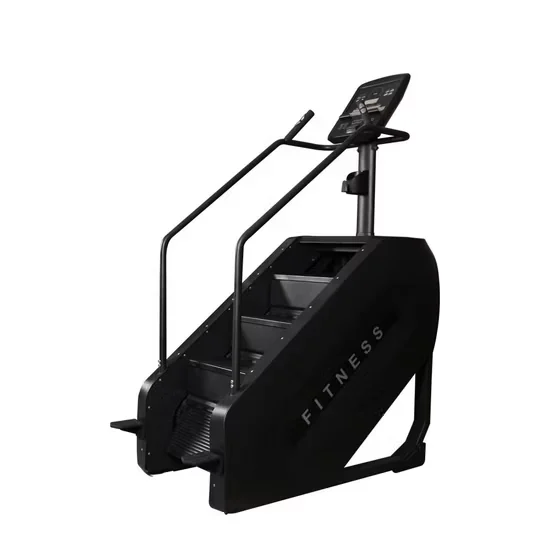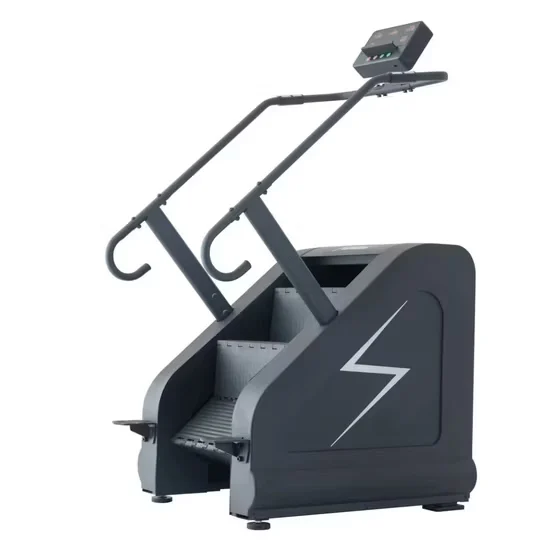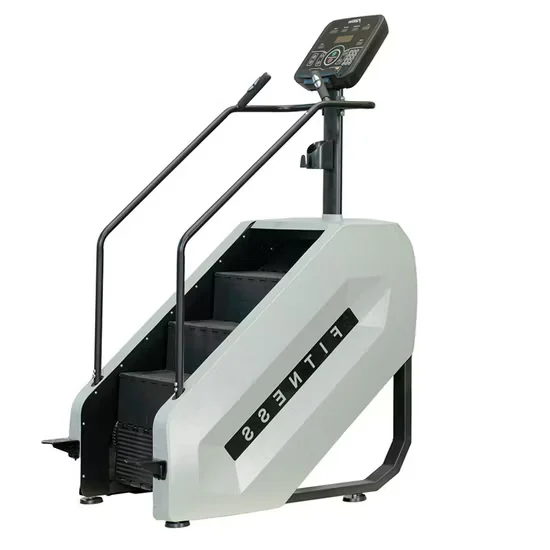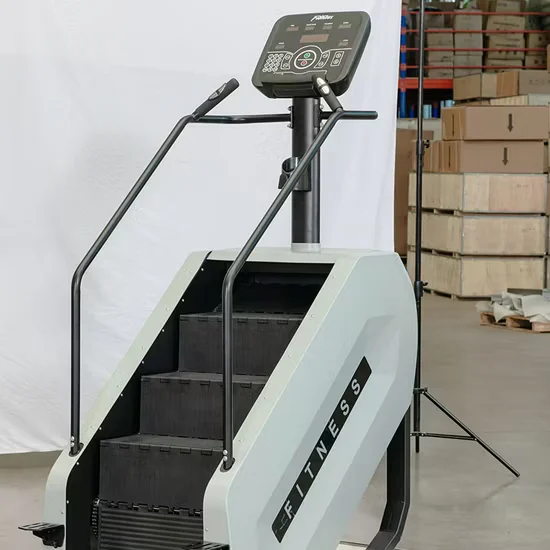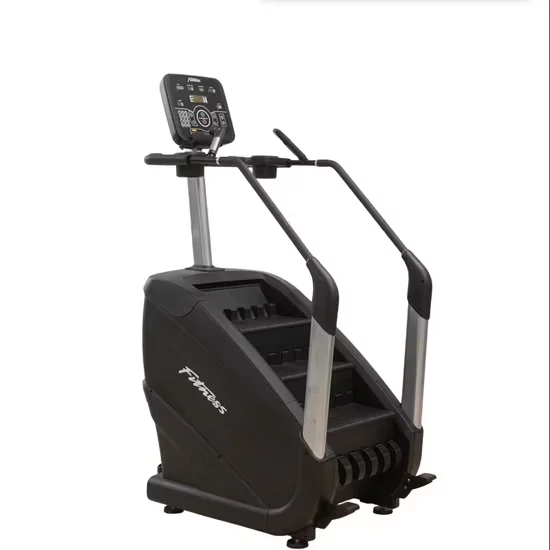
Continuous Duty Verified — motor and step-cycle bearings tested through 10,000 hours of uninterrupted operation before leaving the Shandong facility.
Technical Specifications
| Parameter | Value |
|---|---|
| Product Type | Stair Climber |
| Drive Type | Motor Drive |
| Running Velocity | 15–164 steps/minute |
| Step Area | 560 × 240 × 200 mm |
| Mains Input | AC220V±10% / AC110V±10% |
| Material | Steel Pipe + PP Plastic |
| OSD Readout | Time, Climb, Calories, Steps, Heart Rate |
| Heart Rate | Handgrip |
| Product Dimensions | 1400 × 700 × 2000 mm |
| Net Weight | 148 kg |
| Foldable | No (Unfolded) |
| Certification | CE |
Application Suitability
| Deployment Scenario | Typical Use |
|---|---|
| Hotel fitness center on guest room floors | 24-hour self-service cardio with low-noise requirements |
| Chain gym cardio zone | High-frequency member use across peak and off-peak hours |
| Corporate wellness room | Employee fitness during breaks with moderate daily cycles |
| High-end residential home gym | Daily personal training with adjustable step intensity |
| Sports performance training center | Athlete conditioning with interval programming at varying step rates |
Why Stair Climber Motors Burn Out Before the Warranty Expires
A motor rated for light-duty home cycles will fail within months under continuous commercial operation.
Facility operators rarely see the problem until a stair climber goes silent on a busy Monday morning. The root cause is almost always a duty-cycle mismatch: a motor engineered for thirty-minute daily sessions is asked to run eight or ten hours straight in a public gym. We have pulled units off floors where the windings scorched within the first quarter [NEED_CITE: motor duty cycle classification for continuous commercial operation]. The commercial stair climber motor drive gym facilities deploy must carry a continuous-duty rating, not a peak output number buried in a footnote.
Where This Stepmill Fits in a Mixed Cardio Floor
This unit fills the vertical-climbing slot in a cardio zone, complementing treadmills and ellipticals that handle horizontal and low-impact movement patterns. Step velocity spans from a gentle 15 steps per minute for warm-ups up to 164 for high-intensity intervals, so one machine serves beginners and advanced members without mechanical gear swaps. The 1400 × 700 mm footprint sits comfortably between a treadmill bay and a rowing station, and the 2000 mm height clears standard commercial ceilings. Handgrip heart-rate data feeds the OSD in real time, giving members immediate feedback during climbing sets. The commercial stair climber motor drive gym managers install here pairs naturally with adjacent ellipticals for members seeking lower-impact alternatives on recovery days.
Continuous Run-Time, Noise Path, and Power Delivery
A stair climber in a hotel fitness center may log six to ten active hours daily, demanding a motor and bearing set that tolerate sustained thermal load without derating. Noise transmits through the steel frame into the floor slab, so placement above occupied rooms requires isolation pads and a level subfloor to prevent structure-borne vibration. The dual-voltage input — AC220V±10% and AC110V±10% — means the same unit ships to 230 V European markets and 110 V North American sites without external transformers, eliminating a frequent post-delivery rewiring headache [NEED_CITE: voltage compatibility for commercial cardio exports]. Adequate clearance behind the rear panel allows convective cooling; enclosing the unit in a tight alcove restricts airflow and accelerates insulation breakdown. Data from the OSD remains on-device unless the console supports an external output protocol, a point worth confirming before deploying across a managed network.
Reading the Motor and Drive Specs That Actually Matter
Motor type determines whether the unit can sustain commercial throughput: an AC induction motor typically handles continuous load better than a brushed DC counterpart, which relies on carbon brushes that wear under constant friction. The velocity range of 15–164 steps per minute is achieved through electronic speed control rather than mechanical gearing, keeping the drivetrain simpler and reducing maintenance intervals. Step surfaces molded from PP plastic absorb a portion of foot-strike energy, though the degree of cushioning depends on the thickness and durometer of the molding — something worth verifying with a physical sample when joint comfort is a member concern. Handgrip heart-rate sensors introduce brief signal dropout when users release the rails, a known limitation compared to chest-strap telemetry. The 148 kg net weight reflects the steel-pipe frame, which resists lateral sway during aggressive climbing but demands a solid, level floor to avoid uneven bearing load.
What Specification Shortcuts Cost After Deployment
A light-duty motor installed in a chain gym stair climber often fails before the first annual maintenance contract renewal, forcing an emergency replacement that takes the unit offline during peak membership season. Noise levels that seem acceptable in a showroom become guest complaints once the machine sits above a sleeping floor, leading to costly relocation or wholesale swap-outs. Step surfaces that lack adequate cushioning generate joint-stress feedback within weeks, and members quietly migrate to ellipticals, leaving the climber underused. Voltage mismatches discovered after the container arrives can strand an entire shipment until transformers are sourced or units are rewired locally [NEED_CITE: post-shipment voltage mismatch remediation cases]. OSD data trapped on a standalone console with no export capability leaves operators blind to actual utilization rates, undermining equipment-refresh decisions.
Why Operators Source This Line for Multi-Site Rollouts
Every unit undergoes 10,000-hour continuous-run testing on motor, frame, and step-cycle bearings before shipping, which is the threshold we require for any machine entering a 24-hour facility. Sub-35 dB acoustic verification is available on request, critical when the cardio zone shares a wall with hotel corridors or residential units. IoT-ready console options allow workout analytics and facility-management sync, addressing the data-island problem that plagues operators running mixed-brand floors. The six-series cardio family — treadmills, bikes, ellipticals, rowers, climbers, and spin bikes — lets a single procurement cover an entire zone. OEM customization extends to console UI branding, color, and logo, with flexible minimums. Free 3D cardio-zone layouts factor in this unit’s 1400 × 700 mm footprint, member sightlines, and HVAC airflow so the climber does not end up in a dead corner. Post-delivery, 24/7 technical support covers firmware queries and spare-parts logistics.
Documentation & Test Records
- CE declaration of conformity for the complete unit
- EN 957 test report covering structural and safety requirements
- ISO 9001 quality management certificate
- Noise level test report with third-party acoustic data
- 10,000-hour durability record for motor and bearings
- Console technical documentation with data interface specs
Installation, Commissioning & Maintenance
- Allow 1400 × 700 mm floor space plus 500 mm clearance on each side for safe mounting and dismounting
- Level the subfloor and place vibration-isolation pads beneath all four feet before bolting
- Connect to a dedicated AC220V or AC110V circuit with appropriate breaker rating for motor start-up surge
- Run the full 15–164 steps/minute velocity sweep during commissioning to confirm electronic speed control calibration
- Inspect step-cycle bearings and motor brushes per the maintenance schedule in the installation guide
- Wipe PP step surfaces and handgrip sensors daily to prevent sweat-induced corrosion and signal drift
Equipment Selection and Site Planning
Provide your cardio-zone square footage and target unit count so we can generate a 3D layout that accounts for this climber’s footprint, member flow, and HVAC airflow. Specify average daily run-time so we confirm the motor duty cycle matches your throughput. Identify the deployment floor and adjacent occupied spaces to determine whether sub-35 dB acoustic treatment is needed. State the destination market voltage — 220 V or 110 V region — so the correct power configuration ships from the factory. Indicate whether console data must integrate with your existing facility-management platform.
Frequently Asked Questions
Q: How do I confirm whether a stair climber motor is rated for continuous commercial duty?
A: Request the motor specification sheet and look for a continuous-duty rating expressed in hours, not just peak horsepower. Commercial stair climbers running eight or more hours daily need a motor validated for sustained thermal load. Ask the manufacturer for a 10,000-hour durability test record that documents winding temperature and bearing wear under uninterrupted operation.
Q: Do dual-voltage stair climbers need external transformers when shipped to different markets?
A: Units with AC220V±10% / AC110V±10% input can operate on either standard without an external transformer. However, confirm the plug type and local wiring code before production so the correct power cord ships with the machine, avoiding costly post-delivery adapters or rewiring.
Q: What are the maintenance differences between motor-driven and self-powered stair climbers?
A: Motor-driven units require periodic inspection of the drive motor, electronic speed controller, and associated wiring, but deliver consistent step velocity regardless of user weight. Self-powered climbers eliminate the motor but place greater mechanical load on the user and may show speed fluctuation during interval programming.
Q: Can the OSD metrics sync with facility management software or member apps?
A: Standard OSD displays show real-time data on-device but may not export it externally. If usage analytics must feed a central dashboard, specify an IoT-enabled console during procurement so the correct data protocol is integrated before the unit leaves the factory.