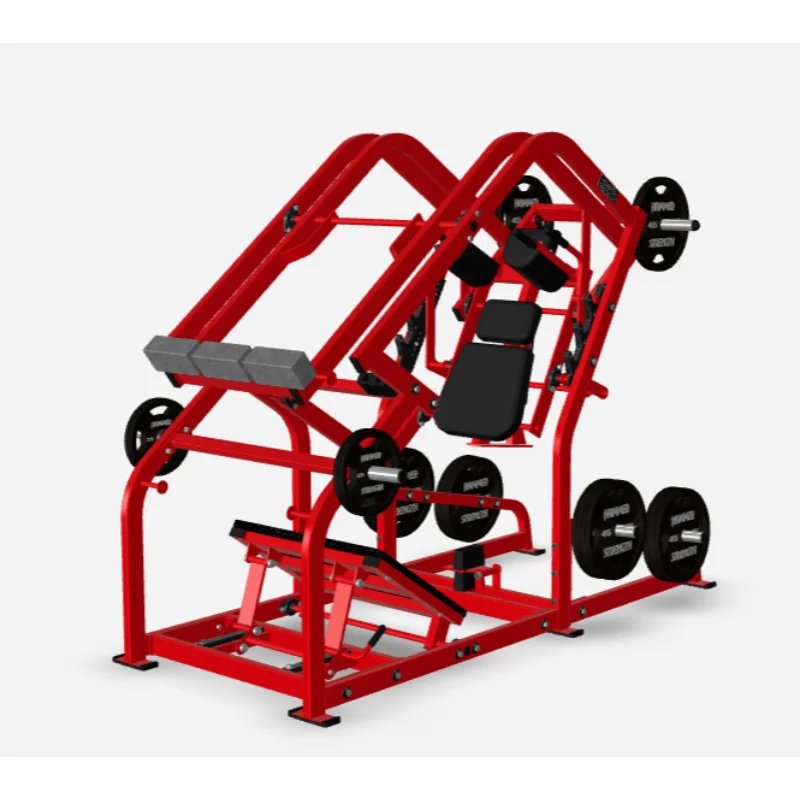
Structural Rigidity Under Load — 50×100×3mm steel tube frame and 170kg net weight eliminate sway during heavy chest and shoulder presses.
Technical Specifications
| Parameter | Value |
|---|---|
| Designation | SRH-01 |
| Product Type | Lateral Hammer Bench Press / Seated Chest Press Machine |
| Tube Size | 50×100×3mm |
| Net Weight | 170kg |
| Dimensions | 1323×1730×1746mm |
| Frame Material | Iron |
| Foldable | No (Unfolded fixed design) |
| Power Source | Manual (plate-loaded) |
| User Group | Adult, Unisex |
| Color | Customized (multiple options available) |
| Target Use | Community, Gymnasium, Home |
| Certification | CE, ISO 9001, RoHS |
Application Suitability
| Deployment Scenario | Typical Use |
|---|---|
| Community fitness center strength zone | Fixed-position chest and lateral press for general membership |
| Commercial gymnasium machine circuit | High-frequency rotation among selectorized and plate-loaded stations |
| High-end residential home gym | Dedicated chest and shoulder training without space-sharing compromises |
| Corporate wellness room | Compact footprint strength option alongside cardio equipment |
| Sports training facility | Heavy-load upper body pressing for athletic conditioning programs |
Why Frame Rigidity Matters More Than Pad Thickness on a Commercial Lateral Hammer Bench Press Seated Chest Press Machine
A 170kg iron frame with 50×100×3mm tubing does not negotiate with lateral torque.
Every time a member loads the lateral hammer bench press seated chest press machine and drives through a heavy set, the frame absorbs rotational forces that thinner-gauge steel simply cannot contain. In community gyms and commercial facilities, equipment failure rarely happens all at once — it accumulates as micro-deflections in the upright posts, loosened welds at the pivot joints, and eventually a sway that trained lifters notice before management does [NEED_CITE: frame deflection thresholds under cyclic loading in commercial strength equipment]. I have walked into facilities where the pressing machines were three years old and already rocking side to side during unilateral work, not because the pads wore out but because the tube wall was never sized for the duty cycle.
Positioning This Press Station in a Strength Training Zone
The SRH-01 covers horizontal and lateral pressing patterns, targeting the pectorals, anterior deltoids, and triceps through a fixed movement path. In a commercial cardio and strength layout, it complements vertical pressing machines and cable crossover stations by handling the mid-range load bracket where free-weight bench pressing introduces spotter dependency. The 1323×1730mm footprint places it in the medium-density category — compact enough to anchor a machine circuit without dominating floor space, yet substantial enough to signal serious training intent. The lateral hammer bench press seated chest press machine suits users across a wide body-mass range, with the fixed rail geometry accommodating limb-length variation without requiring adjustment between sets.
Deployment Environment and Continuous-Use Considerations
A plate-loaded station like this does not draw current, but it does demand structural attention at the installation point. The 170kg net weight means the unit must sit on a level, load-rated floor slab — suspended timber flooring in converted commercial spaces will transmit vibration to adjacent rooms [NEED_CITE: floor load rating requirements for fixed plate-loaded strength equipment]. The unfolded, non-collapsible design guarantees long-term frame integrity but requires dedicated square footage that cannot be reclaimed after hours. Facilities planning a 24-hour access strength zone should account for the noise signature of plates being loaded and unloaded, which propagates differently than cardio motor hum and often reaches further through shared wall assemblies. Ground-level or basement deployment typically resolves this before acoustic treatment becomes necessary.
Reading the Steel: Tube Gauge, Weld Pattern, and Static Mass
The 50×100×3mm rectangular tube specification tells a purchasing manager three things at once. The 50×100mm cross-section provides a high second moment of area against the lateral bending forces generated during unilateral hammer pressing — this is the axis where cheaper machines fail first. The 3mm wall thickness places the frame in the commercial-gauge category, meaning the steel can endure repeated load-unload cycles without fatigue cracking at the weld seams [NEED_CITE: wall thickness standards for commercial-grade strength equipment frames]. The 170kg net weight is not merely a shipping number; it reflects the total mass of iron in the structure, which directly correlates to how much external force the machine can absorb without shifting on the floor. Combined with the 1323×1730×1746mm envelope, the weight-to-footprint ratio ensures stability even when a user loads the lateral hammer bench press seated chest press machine asymmetrically for single-arm work.
The Cost of Specifying Below Commercial Grade
Facilities that install lighter-gauge pressing machines in high-traffic strength zones typically encounter a predictable sequence of problems. Frame sway appears first — subtle enough that members cannot articulate why the movement feels unstable, but measurable in their decision to skip the station. Weld fractures at stress-concentration points follow within eighteen to thirty months under daily commercial loading. Replacement logistics then compound the original purchasing error: a 170kg unit requires freight handling and floor anchoring that was never budgeted for [NEED_CITE: lifecycle cost comparison between commercial and light-commercial strength equipment]. The quieter consequence is membership attrition driven not by complaints but by avoidance, as experienced lifters migrate to facilities where the equipment does not compromise their training.
Why This Product Line Fits the Deployment
The SRH-01 arrives from a manufacturing system that runs full vertical integration from CNC tube cutting through final weld inspection, meaning frame consistency is controlled at the source rather than outsourced to third-party fabricators. The CE, ISO 9001, and RoHS certifications apply to the production process itself, not just the finished unit. Color and branding customization — including frame powder-coat and upholstery selection — allow facility operators to maintain visual continuity across an entire strength zone without splitting orders across multiple vendors. OEM scope extends to logo placement and pad stitching, which matters when hotel groups and corporate wellness rooms demand brand-aligned aesthetics in their fitness spaces.
Documentation & Test Records
- CE declaration of conformity for the SRH-01 frame and pivot assembly
- EN 957 test report covering structural load and safety factor compliance
- ISO 9001 certificate for the manufacturing quality management system
- RoHS compliance record confirming restricted substance limits in coatings and hardware
- Dimensional verification report matching 50×100×3mm tube specifications to production batch
Installation, Commissioning & Maintenance
- Verify floor flatness within tolerance across the 1323×1730mm footprint before anchoring the 170kg frame
- Maintain minimum 600mm clearance on all sides for safe plate loading and unloading
- Inspect all pivot bolt torque values after the first 500 use cycles on the lateral hammer bench press seated chest press machine
- Wipe down iron frame and upholstery with non-corrosive cleaner after each operating day to prevent sweat-induced oxidation
- Re-torque seat adjustment mechanism fasteners quarterly under commercial-frequency use conditions
- Check weld seams at upright-to-base junctions annually for hairline fracture initiation
Requesting a Quote with the Right Technical Detail
Provide the total strength-zone square footage and the planned equipment list so a 3D layout can address sightlines, member flow, and plate-loading clearance around each station. Specify whether the deployment floor is ground-level slab or suspended construction, as this affects vibration transmission planning. State the target market so that any ancillary accessories — such as rubber flooring specification or plate storage racks — align with local compliance standards. Confirm whether frame color and upholstery customization are required and at what quantity, as this determines production scheduling.
Frequently Asked Questions
Q: What distinguishes a commercial-grade pressing machine frame from a home-gym version?
A: Commercial frames use heavier-gauge rectangular tubing — here, 50×100×3mm iron — with full-perimeter welds at every stress junction. The 170kg net weight reflects material volume designed to resist lateral torque during repetitive heavy loading over years of daily use, whereas home-gym frames typically use thinner walls that flex under equivalent cyclic stress.
Q: Is the 50×100×3mm tube sufficient for high-frequency commercial use?
A: Yes. This cross-section and wall thickness place the SRH-01 in the commercial-duty category, capable of withstanding the load-unload cycles typical of gymnasium and community fitness center environments. The 3mm wall specifically resists fatigue cracking at weld points, which is the primary failure mode in lighter-gauge alternatives.
Q: Can the SRH-01 be customized for brand-specific gym fitouts?
A: Color customization is available for both the frame powder-coat and upholstery. Logo placement and pad stitching patterns can be adjusted under OEM terms. The minimum order quantity depends on the scope of customization requested, so provide your brand guidelines and target quantity during the inquiry stage.
Q: How should a strength zone layout account for this machine?
A: The 1323×1730×1746mm footprint requires dedicated floor space with clearance on all sides for plate loading. In a multi-station circuit, position the SRH-01 away from high-traffic walkways to prevent plate-handling congestion. A 3D layout plan helps verify sightlines and airflow between adjacent pressing and pulling stations.
Q: What practical value do CE and ISO 9001 certifications carry for a purchaser?
A: CE marking confirms the machine meets European safety directives for fitness equipment, while ISO 9001 certifies the manufacturer operates a documented quality management system covering production consistency. Together, they reduce procurement risk by ensuring the unit delivered matches the tested prototype in material grade and structural specification.
![Hot Seller Gym Machine / Fitness Equipment Hammer Strength Adjustable Abodominal BoardOS-H5060 Commercial Adjustable Abdominal Board Gym Machine Fitness Equipment[WARN] draft identifier mismatch](https://bicksport.com/wp-content/uploads/2026/08/hot-seller-gym-machine-fitness-equipment-hammer-strength-adjustable-abodominal-boardos-h5060-commercial-adjustable-abdominal-board-gym-machine-fitness-equipmentwarn-draft-identifier-mismatch-37782c.webp)