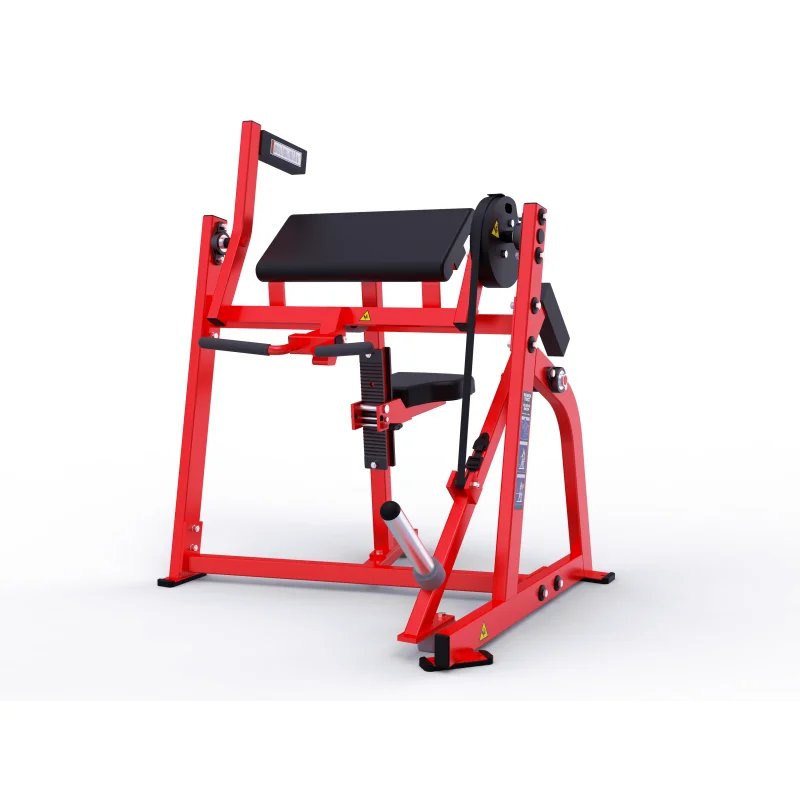
Heavy-Duty Frame Integrity — 135kg reinforced steel chassis with sealed pivot bearings tested for 10,000 hours of continuous ISO-lateral rowing cycles in high-traffic commercial facilities.
Technical Specifications
| Parameter | Value |
|---|---|
| Product Type | ISO-Lateral Row Machine |
| Exercise Part | Back |
| Material | Steel |
| Product Dimensions | 145514762133mm |
| Net Weight | 135kg |
| Max User Weight | 180kg |
| Age Group | Adult |
| Gender | Unisex |
| OEM/ODM | Available |
| Certification | ISO 9001, CE |
| HS Code | 9506911900 |
| Production Capacity | 500 PCS/Month |
Application Suitability
| Deployment Scenario | Typical Use |
|---|---|
| Professional gym and health club strength zones | High-frequency bilateral back training for diverse member bases |
| Community fitness centers | Durable rowing motion accommodating mixed-user traffic throughout operating hours |
| Hotel fitness centers | Quiet ISO-lateral operation suitable for floors adjacent to guest rooms |
| Corporate wellness rooms | Compact footprint back training for employee fitness programs |
| Sports performance training centers | Independent arm engagement for athlete-specific strength development |
Why Vibration Complaints Reach Management Before the Maintenance Team Does
Sealed bearings and a stabilized 135kg base eliminate the shifting and resonance that trigger noise complaints in shared facilities.
Lightweight strength frames with poorly sealed pivots generate audible grinding and floor-transmitted vibration within months of commercial deployment. Facility operators near guest rooms, residential units, or office spaces field complaints long before the mechanical failure becomes visible [NEED_CITE: structural vibration transmission thresholds for commercial fitness equipment on occupied floors]. The commercial ISO-lateral row machine back exercise equipment category sees disproportionate early replacement when pivot components lack sealed protection against sweat ingress and particulate accumulation.
Positioning This Unit Within a Commercial Strength Zone
This machine targets the mid-to-high intensity back training spectrum, complementing lat pulldown stations and cable crossover systems in a complete strength circuit. Its ISO-lateral independent arm movement serves users performing both heavy low-rep and lighter endurance sets without mechanical adjustment between stations. The 1455*1476mm footprint positions it along perimeter walls or as a divider between free-weight and machine zones. Users up to 180kg engage the full commercial range without frame flex or pivot binding.
Continuous Operation Demands and Facility Infrastructure
Facilities running sixteen or more hours daily subject pivot bearings to thousands of articulation cycles between scheduled maintenance windows. Sealed bearing specification determines whether a unit requires quarterly overhaul or runs reliably across annual service intervals [NEED_CITE: bearing service life under continuous commercial articulation loads]. Floor-mounted equipment on suspended slabs transmits low-frequency vibration downward; the stabilized base design and 135kg unit mass reduce resonance transfer to occupied spaces below. Ground-level deployment requires standard leveling with anti-vibration pads, while upper-floor installations benefit from structural assessment of live-load capacity.
Interpreting the Frame and Pivot Engineering Decisions
Reinforced steel construction at 135kg net weight indicates a frame engineered to resist lateral deflection during unilateral loading — when a user applies force through one arm at maximum effort, the opposing side must remain rigid. ISO-lateral pivot mechanisms allow independent arm travel, meaning each side articulates on its own axis without cross-linkage interference. Sealed bearings at these pivot points prevent contamination from chalk dust, sweat aerosol, and cleaning chemicals that accelerate wear in open-bearing designs. The 180kg maximum user weight rating reflects structural validation across the full commercial ISO-lateral row machine back exercise load spectrum, not a theoretical peak. Frame geometry at 1476mm width provides lateral stability during explosive concentric phases without requiring floor anchoring.
The Hidden Cost of Specification Compromises
Lightweight frames under 100kg shift during intense rowing sets, forcing users to brace against equipment movement rather than isolate back musculature. Open bearings in high-humidity environments corrode within months, producing grinding noise that migrates through floor structures to adjacent occupied spaces. Facilities that procured underspecified pivots report complete bearing replacement cycles every six to eight months, generating downtime and member dissatisfaction [NEED_CITE: maintenance frequency comparison between sealed and open bearing pivot systems]. Units deployed on upper floors without adequate base mass transmit impact vibration through structural slabs, triggering complaints from tenants or guests in spaces directly below.
Why This Product Line Delivers for Commercial Operators
Sub-35dB operational verification from our cardio deployments informs how we approach pivot smoothness on strength equipment — grinding bearings generate the same complaint pathway as noisy motors. Every frame undergoes 10,000-hour continuous cycle testing at maximum rated load before release to production. The complete six-series equipment family means a facility sources back training, cardio, and specialty stations from a single engineering standard. OEM customization covers frame color, pad upholstery material, and facility branding applied during manufacturing. Our 3D layout service maps this unit’s 1455*1476mm footprint against adjacent equipment clearances, member flow paths, and ventilation requirements. Technical support responds around the clock with diagnostic guidance and parts dispatch.
Documentation & Test Records
- CE declaration of conformity for commercial strength equipment deployment
- EN 957 test report validating structural integrity and user safety compliance
- ISO 9001 certificate covering manufacturing quality management systems
- Noise level test report documenting operational acoustic performance
- 10,000-hour durability test record for frame, bearings, and pivot components
- Complete spare parts list with replacement intervals and ordering codes
Installation, Commissioning & Maintenance
- Position with minimum 600mm clearance on all sides for safe user entry and plate loading access
- Level on anti-vibration pads to isolate pivot articulation forces from floor structure transmission
- Inspect all pivot bolts at commissioning and retorque after the first 500 operation cycles
- Lubricate sealed bearing interfaces annually or per 10,000-cycle intervals per maintenance schedule
- Wipe frame and upholstery after each session to prevent sweat corrosion on steel contact points
- Verify ISO-lateral arm independence and smooth travel through full range before releasing to member use
Request Technical Documentation for Your Facility
Provide your strength zone square footage and intended equipment count to receive a 3D layout addressing clearances, member flow, and ventilation planning. Specify daily operating hours so we can confirm pivot bearing duty-cycle alignment with your traffic volume. Identify deployment floor level and adjacent occupied spaces to verify acoustic and vibration isolation requirements. Confirm destination market voltage standards if integrating any powered console or data-tracking accessories.
Frequently Asked Questions
Q: What makes ISO-lateral row machines superior to plate-loaded or cable alternatives for commercial back training?
A: ISO-lateral mechanisms allow independent arm movement, preventing dominant-side compensation during bilateral exercises. This ensures balanced muscle engagement across diverse user strength levels in high-traffic facilities. Unlike fixed-path cable systems, ISO-lateral pivots accommodate natural shoulder mechanics, reducing joint stress during high-repetition commercial use while maintaining consistent resistance profiles throughout the full range of motion.
Q: How do sealed bearings and reinforced frames reduce maintenance frequency in high-traffic gym environments?
A: Sealed bearings prevent sweat, chalk dust, and cleaning chemicals from contaminating internal surfaces, extending service intervals from quarterly to annual in most deployments. Reinforced steel frames resist deflection under maximum user loads, eliminating bolt retorque cycles caused by frame flex. Together, these features reduce unplanned downtime and extend component replacement intervals across continuous commercial operation.
Q: What customization options are available for OEM and ODM orders?
A: Customization covers frame powder-coat color selection, pad upholstery material and color matching, logo placement on frame and pads, and branded console fascia where applicable. Lead times and minimum order quantities vary by customization scope. We provide material samples and color proofs for approval before production commencement to ensure alignment with facility design standards.
Q: How does equipment weight and base design affect stability and noise during intense commercial use?
A: The 135kg unit weight with a stabilized base prevents lateral shifting during explosive rowing movements, eliminating the floor-scraping noise that lighter units generate. Adequate base mass also reduces low-frequency vibration transmission through floor structures to occupied spaces below. This is particularly critical for upper-floor deployments in hotels, residential buildings, and multi-tenant commercial facilities.
Q: What documentation is provided for commercial procurement?
A: Standard documentation includes CE declaration of conformity, EN 957 test report, ISO 9001 certificate, noise level test report, and 10,000-hour durability test record. Additional materials cover motor specification sheets where applicable, console technical documentation, 3D cardio zone layouts, installation and commissioning guides, and comprehensive spare parts lists with ordering codes.
![Commercial Weight Tree Machine for Gym & Fitness Centers | OEM [WARN] draft identifier mismatch](https://bicksport.com/wp-content/uploads/2026/08/commercial-weight-tree-machine-for-gym-fitness-centers-oem-warn-draft-identifier-mismatch-9492e9.webp)
![Plate Loaded Reverse Hyper Extension 5073 for Commercial Gyms [WARN] draft identifier mismatch](https://bicksport.com/wp-content/uploads/2026/08/plate-loaded-reverse-hyper-extension-5073-for-commercial-gyms-warn-draft-identifier-mismatch-f3c294.webp)