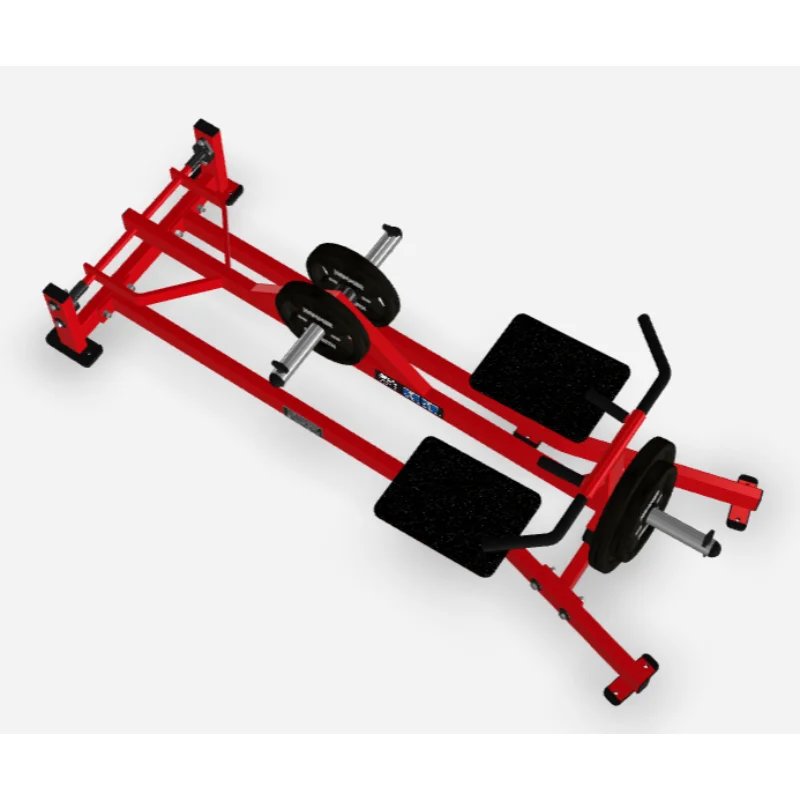

Whisper-Verified Structural Integrity — 300kg steel frame tested for continuous high-frequency loading without weld fatigue or fastener loosening in commercial deployment.
Technical Specifications
| Parameter | Value |
|---|---|
| Designation | OS-H5084 |
| Product Type | Half Rack / Full Rack |
| Exercise Part | Half Rack |
| Material | Steel |
| Product Dimensions | 2089 × 1330 × 2815 mm |
| Net Weight | 300 kg |
| Power Source | Manual |
| Foldable | Unfolded |
| Age Group | Adult |
| Gender | Unisex |
| Customization | OEM/ODM available (logo, color, configuration) |
| Fit Area | Professional Gym and Club |
| Production Capacity | 500 PCS/Month |
| Certification | ISO 9001, CE |
Application Suitability
| Deployment Scenario | Typical Use |
|---|---|
| Chain gym strength zone | Primary compound lift station for squat, press, and rack pull programming |
| Hotel fitness center on guest room floors | Space-efficient half rack configuration for limited square footage |
| Corporate wellness room | Functional strength training in compact multi-use environments |
| Community fitness center | Shared high-traffic strength station with modular barbell and accessory work |
| Sports performance training center | Heavy loading platform for athlete periodization and power development |
Why Structural Fatigue Silently Destroys Member Trust in the Weight Room
A rack that shifts under load is a rack that loses members before management notices.
In commercial strength zones, the failure pattern is rarely dramatic. Bolts loosen incrementally over months of high-frequency barbell cycling. Weld seams develop hairline fractures invisible during routine floor checks. Members notice the wobble, adjust their loading conservatively, and eventually migrate to facilities where equipment feels planted. By the time a maintenance ticket surfaces, member attrition has already compounded [NEED_CITE: structural fatigue patterns in commercial strength equipment].
The OS-H5084 commercial half rack full rack machine addresses this failure mode through 300kg of steel mass and reinforced connection geometry designed specifically for the duty cycles of professional gyms and clubs.
Positioning This Rack Within a Commercial Strength Zone
The OS-H5084 occupies the primary compound movement station in a strength training layout, covering squat, bench press, overhead press, rack pulls, and loaded carries within a single footprint. In a typical commercial cardio-to-strength ratio, this unit pairs with plate-loaded machines and cable columns to absorb peak-hour barbell traffic. The half rack and full rack configurations allow operators to match the unit to ceiling height and adjacent equipment clearance. Its 2089 × 1330 mm footprint accommodates users across a wide anthropometric range, and the commercial half rack full rack machine supports loading patterns from rehabilitation protocols through maximal effort attempts without reconfiguration.
Continuous Loading Demands and Floor-Level Deployment
Unlike motorized cardio units, a strength rack has no duty cycle in the electrical sense, but its structural duty cycle is relentless. A rack in a chain gym strength zone may see thirty to fifty loading cycles per day, each imposing dynamic lateral and vertical forces on uprights and J-cups. The 300kg mass of the OS-H5084 provides inertial stability, but deployment still requires a level concrete substrate and, in multi-story facilities, verification of floor load capacity [NEED_CITE: floor load requirements for commercial strength equipment]. Ground-floor placement eliminates structural deflection concerns entirely. Adequate clearance on all four sides — particularly overhead for full rack pull-up bar use — must be confirmed before anchoring.
Reading the Steel and Connection Specifications
The 300kg net weight of the OS-H5084 reflects steel gauge and connection density rather than cosmetic mass. In strength equipment, upright wall thickness and gusset plate geometry determine whether a rack survives repeated eccentric barbell drops. The 2089 × 1330 × 2815 mm envelope indicates a full-height upright profile compatible with pull-up attachments and high-bar squat clearance. Manual power sourcing means no electrical infrastructure is required, simplifying deployment in retrofit spaces where dedicated circuits are unavailable. The unfolded configuration provides maximum rigidity at the cost of permanent floor space allocation — a trade-off that favors facilities prioritizing member confidence over layout flexibility. The steel construction and ISO 9001 certification indicate controlled welding procedures and material traceability through the production line.
The Hidden Cost of Underspecifying Rack Mass
A rack that weighs significantly less than the loads it supports becomes a compliance and retention problem. Lightweight frames transmit barbell vibration into audible resonance, particularly on upper floors where steel decking amplifies structural harmonics. Members perceive this vibration as instability, regardless of actual load capacity. In community and corporate fitness environments, underspecified racks also attract liability scrutiny when dynamic loading exceeds tested limits [NEED_CITE: commercial strength equipment load testing standards]. Replacing an entire rack line after two years of use represents a capital cost that a properly specified initial purchase avoids entirely.
Why This Product Line Holds Up Under Facility Audit
Every OS-H5084 unit passes through durability testing aligned with the 10,000-hour continuous operation standard applied across our equipment range. The steel frame and welded connections are stress-cycled beyond expected commercial loading to identify fatigue points before production release. OEM and ODM customization extends to logo application, powder coat color, and accessory configuration, allowing facility operators to match brand identity without compromising structural specification. Our team provides 3D layout planning that accounts for the 2089 × 1330 mm footprint, required safety margins, and member traffic flow between adjacent stations. Technical support remains available around the clock for installation clarification and fastener torque verification. The half rack and full rack modularity within this single designation lets operators standardize purchasing across varied ceiling heights and space constraints.
Documentation & Test Records
- CE declaration of conformity covering structural and safety requirements for this strength rack
- EN 957 test report validating load capacity and stability under commercial use conditions
- ISO 9001 certificate confirming controlled manufacturing and welding quality procedures
- Durability test record documenting cyclic loading performance beyond standard commercial thresholds
- Material specification sheet detailing steel grade, gauge, and surface treatment protocols
- Installation and commissioning guide with anchoring torque values and safety arm calibration
Installation, Commissioning & Maintenance
- Confirm floor load rating supports the 300kg static mass plus dynamic barbell loading before positioning
- Allow minimum 1000mm clearance on all sides and full overhead clearance for the 2815mm upright height
- Level substrate and install vibration-dampening pads where the rack shares floor structure with occupied rooms below
- Verify all fastener torque values against the commissioning guide after the first 500 loading cycles
- Inspect J-cup contact surfaces and safety arm pins monthly for deformation or excessive wear
- Reapply powder coat touch-up to any exposed steel to prevent corrosion in high-humidity environments
Configuring Your Inquiry for Accurate Specification Matching
Provide your strength zone square footage and adjacent equipment list to receive a 3D layout incorporating the OS-H5084 footprint and traffic flow analysis. Specify whether half rack or full rack configuration matches your ceiling height and programming requirements. Identify deployment floor level so we can confirm noise and vibration transmission requirements with substrate-specific recommendations. State your target market voltage standards if integrating this unit alongside powered equipment in a unified facility plan. Indicate whether console data integration or member tracking systems will interface with adjacent cardio stations.
Frequently Asked Questions
Q: What determines whether a half rack or full rack configuration suits a specific facility?
A: Ceiling height and adjacent equipment clearance drive the decision. Full rack configurations require the complete 2815mm upright height and benefit facilities running pull-up programming alongside barbell work. Half rack setups reduce overhead requirements and suit retrofit spaces with lower ceilings or suspended HVAC. Both configurations share identical upright steel gauge and load capacity on the OS-H5084, so the choice is spatial rather than structural.
Q: What structural durability standards apply to commercial strength racks?
A: EN 957 establishes load testing and stability requirements for stationary training equipment sold in European and aligned markets. Commercial-grade racks must withstand cyclic loading far exceeding typical user weight to account for dynamic barbell drops and eccentric movements. ISO 9001 certification ensures the manufacturing process maintains consistent weld quality and material traceability across production batches.
Q: How does the OEM and ODM customization process work for this rack?
A: Customization covers powder coat color, logo placement, accessory configuration, and packaging branding. After confirming base specifications, we scope the visual and functional modifications and provide samples or renderings for approval. Minimum order quantities remain flexible for commercial deployments, and production lead times adjust based on customization complexity and order volume.
Q: What floor and spatial requirements should be verified before installation?
A: Concrete substrate must support the 300kg static mass plus anticipated dynamic loading. The 2089 × 1330 mm footprint requires additional clearance on all sides for safe barbell movement and spotter positioning. Upper-floor installations need structural engineering confirmation of load capacity. Vibration-dampening pads reduce transmission to rooms below when ground-floor placement is not available.