
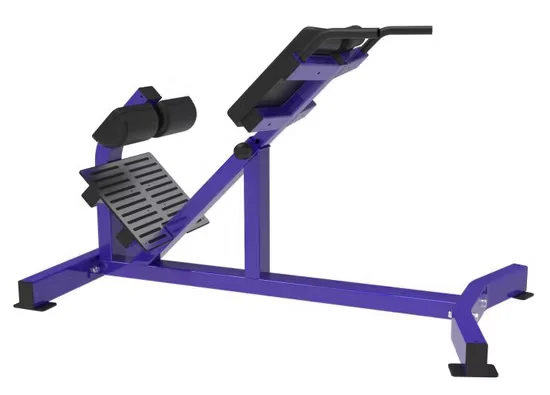
Heavy-Duty Steel Construction — Manual resistance design eliminates electrical failure points while reinforced steel frames endure 10,000+ hours of continuous commercial use.
Technical Specifications
| Parameter | Value |
|---|---|
| Product Type | Back Extension Machine |
| Power Source | Manual |
| Exercise Part | Back |
| Material | Steel |
| Resistance Type | Manual (bodyweight and gravity) |
| Max User Weight | 180 kg (commercial range) |
| Product Dimensions | 1552 × 771 × 876 mm |
| Net Weight | 42 kg |
| Foldable | Unfolded |
| Main Frame Color | Available per customer requirements |
| Cushion Color | Available per customer requirements |
| OEM/ODM | Acceptable |
| Certification | ISO 9001, CE |
Application Suitability
| Deployment Scenario | Typical Use |
|---|---|
| Professional gym and club strength zones | High-frequency back and posterior chain training between free-weight and cable stations |
| Community fitness center workout floors | Durable, low-maintenance back training for rotating membership bases |
| Corporate wellness rooms | Manual operation that requires no electrical circuits or dedicated power lines |
| Hotel fitness centers on guest room floors | Silent equipment placement without motor noise transferring to adjacent rooms |
| High-end residential home gyms | Space-efficient steel frame matching premium interior finishes and custom upholstery |
Why Structural Fatigue Reaches Members Before the Maintenance Team Notices
A reinforced steel frame with tested weld points absorbs thousands of loading cycles that cause lesser frames to shift and squeak.
In high-traffic gyms, back extension machines see constant mounting, unmounting, and loaded repetitions from members across a wide weight range. Frames built to residential tolerances develop play at the pivot and base joints within months. The padding compresses unevenly, and members start avoiding the equipment — not because the exercise is wrong, but because the machine no longer feels stable or comfortable [NEED_CITE: structural fatigue patterns in high-frequency commercial strength equipment]. I have walked gym floors where back extension benches wobbled visibly during use, and the maintenance log showed repeated bolt retightening that never solved the root problem. A commercial back extension machine gym fitness equipment unit must withstand loading patterns far beyond what home-use standards require.
Where This Equipment Fits Within a Commercial Strength Floor
This commercial back extension machine gym fitness equipment targets the posterior chain — erector spinae, glutes, and hamstrings — through controlled hip extension under bodyweight or added plate loading. On a typical strength floor, it complements squat racks, deadlift platforms, and cable machines by offering isolated spinal erector work without requiring a barbell setup. The 1552 × 771 mm footprint fits between plate-loaded stations or along perimeter walls where sightlines keep the strength zone open. The 180 kg maximum user weight capacity accommodates the full range of commercial gym members, and the fixed unfolded configuration means no daily setup or folding mechanisms to maintain.
What Continuous High-Frequency Use Demands From Frame and Padding
A back extension bench in a busy gym may see 80 to 150 uses per day across morning rushes, midday sessions, and evening peaks. Each use concentrates force on the hip pad and ankle rollers. Padding that compresses permanently within weeks forces members into awkward hip positions, and complaints follow [NEED_CITE: cushion compression standards for commercial gym upholstery]. The steel frame must maintain alignment across its base, pivot, and pad mount without developing lateral play. In facilities operating 16 to 24 hours daily, the machine sits on rubber-matted floors that shift with cleaning routines, so leveling feet and a wide base footprint prevent rocking. Manual resistance means no motor heat buildup and no ventilation clearance needed — a practical advantage when equipment is placed against walls or in tight strength-zone corners.
Understanding the Specs That Matter for Manual Resistance Equipment
The manual power source eliminates every electrical failure point: no motor to burn out, no circuit board to short in humid environments, no power cable to trip over during peak hours. The 42 kg steel frame mass provides the stability required for loaded back extensions without requiring bolted floor anchoring in most commercial settings. The 180 kg maximum user weight across the commercial range reflects frame thickness, weld quality, and pivot pin diameter engineered for repeated heavy-user cycles. Customizable frame and cushion color options allow facility operators to match existing equipment lines or brand palettes without compromising structural specifications. OEM and ODM customization extends to logo placement, upholstery density selection, and pad geometry adjustments. Unlike motorized equipment, this machine’s maintenance cycle focuses entirely on mechanical fasteners, pivot lubrication, and padding integrity — items that facility technicians can inspect and service with standard hand tools.
The Hidden Cost of Specifying Below Commercial Duty Requirements
Purchasing back extension equipment built to light-commercial or residential standards seems economical until the pivot bushings develop play within the first quarter. Padding that flattens under continuous use generates member complaints about hip bruising and lower back discomfort — the exact opposite of what the exercise should deliver [NEED_CITE: member retention impact from equipment comfort degradation]. Frames that flex under heavier users create a perception of unsafety that spreads through gym communities faster than any maintenance team can respond. Replacing an entire batch of under-specified benches costs far more in downtime, member dissatisfaction, and repeat procurement than specifying commercial-grade construction from the start.
Why This Product Line Holds Up in Daily Commercial Operation
Every unit in this cardio and strength family undergoes 10,000-hour continuous use testing on frames and load-bearing components. The sub-35 dB operation standard across the powered equipment range means this manual back extension machine integrates into shared spaces without adding acoustic disruption. Full OEM and ODM capability covers frame color, cushion color, logo application, and upholstery specification — so a five-hotel chain or international gym network receives visually consistent equipment across locations. Free 3D strength-zone and cardio-zone layout planning accounts for this machine’s footprint, member flow around adjacent stations, and ventilation paths. Technical support responds around the clock, and spare parts documentation covers every mechanical component from pivot pins to replacement pad covers.
Documentation & Test Records
- CE declaration of conformity confirming European commercial equipment safety standards
- EN 957 test report validating structural and mechanical requirements for stationary training equipment
- ISO 9001 certificate covering manufacturing quality management systems
- Durability test record documenting frame and pivot performance under continuous load cycling
- Cushion material density and compression testing records for long-term comfort retention validation
- OEM customization specification sheet detailing frame color, cushion options, and logo placement scope
Installation, Commissioning & Maintenance
- Maintain minimum 600 mm clearance on all sides of the 1552 × 771 mm footprint for safe member mounting and dismounting
- Level the steel frame base on commercial rubber flooring using adjustable feet to eliminate rocking during loaded repetitions
- Inspect all mechanical fasteners and pivot hardware within the first 30 days, then quarterly under high-frequency use
- Check hip pad and ankle roller padding compression monthly; replace cushion covers when surface wear exposes underlying foam
- Apply pivot-point lubrication per the maintenance schedule to prevent squeaking and bushing wear in 24/7 facilities
- Wipe down steel frame and upholstery with non-corrosive cleaner daily to prevent sweat-induced oxidation and material degradation
Matching Equipment Specifications to Your Facility Requirements
Provide your strength zone square footage and planned equipment list to receive a 3D layout that positions this back extension machine for proper member flow and sightline integration. Specify your facility’s daily operating hours and expected member throughput so duty-cycle expectations align with manual equipment advantages. Confirm whether OEM customization is needed for frame color matching or brand logo application across a multi-location rollout. Indicate your target market and deployment environment so documentation and finishing specifications match local compliance and climate requirements.
Frequently Asked Questions
Q: Why choose a manual back extension machine over motorized alternatives for a commercial gym?
A: Manual resistance eliminates motor, wiring, and circuit board components that fail under continuous commercial use. There are no electrical failure points, no power outlet requirements, and no heat generation from motors. Facility maintenance focuses entirely on mechanical fasteners, pivot lubrication, and padding condition — tasks that in-house technicians handle with standard tools. This reduces equipment downtime and simplifies long-term parts inventory for high-traffic gym environments.
Q: What steel frame construction standards ensure durability in 24/7 gym environments?
A: Commercial-grade back extension machines use reinforced steel tubing with full-penetration welds at load-bearing joints. The frame must withstand repeated loading cycles from users up to 180 kg without developing lateral play or base flex. EN 957 testing validates structural integrity under cyclic loading. Frame thickness and weld quality inspection records should accompany procurement documentation to confirm the unit meets continuous commercial duty requirements rather than light-use residential tolerances.
Q: How does cushion material selection affect long-term performance in high-frequency use?
A: High-density closed-cell foam retains its shape and support characteristics through thousands of compression cycles, while lower-density foam flattens permanently within months of commercial use. Cushion compression testing records verify material performance over time. The upholstery cover must resist sweat absorption and cleaning chemical exposure without cracking. Proper cushion selection prevents member complaints about hip discomfort and eliminates premature pad replacement costs in busy gym environments.
Q: What OEM/ODM customization options are available for facility branding integration?
A: Customization covers main frame color, cushion color, and logo placement to match existing equipment lines or facility brand standards. OEM and ODM scope includes upholstery material selection, pad geometry adjustments, and specification matching for multi-location rollouts. Minimum order quantities remain flexible for facility operators outfitting a single location or an entire chain. All custom specifications are documented and verified before production begins.
Q: How should the back extension machine be positioned within a strength zone layout?
A: Place the machine along perimeter walls or between plate-loaded stations where its 1552 × 771 mm footprint does not obstruct primary traffic lanes. Allow sufficient clearance for members to mount, perform repetitions, and dismount without interfering with adjacent equipment users. Consider sightline requirements so trainers can monitor form from the main floor area. Proper placement ensures the equipment receives consistent use rather than becoming overlooked in a crowded corner.


![Commercial Seated Triceps DIP Machine Strength Equipment OS-H5014 [WARN] draft identifier mismatch](https://bicksport.com/wp-content/uploads/2026/08/commercial-seated-triceps-dip-machine-strength-equipment-os-h5014-warn-draft-identifier-mismatch-bd924f.webp)