
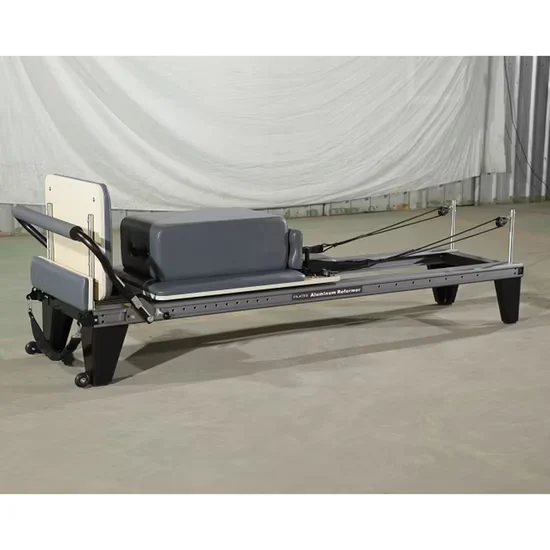
![Commercial Aluminum Pilates Reformer with Box Jump Board for Studio [WARN] draft identifier mismatch](https://bicksport.com/wp-content/uploads/2026/08/commercial-aluminum-pilates-reformer-with-box-jump-board-for-studio-warn-draft-identifier-mismatch-f6d379.webp)
Quiet Glide Engineering — Precision-machined aluminum rails and sealed bearings deliver near-silent carriage travel, verified in studio and hotel deployments where adjacent rooms remain undisturbed.
Technical Specifications
| Parameter | Value |
|---|---|
| Designation | SRY-11 |
| Product Type | Aluminum Pilates Reformer |
| Frame Material | Aluminum Alloy |
| Color | Black (custom colors available via OEM) |
| Dimensions | 2400 × 600 × 380 mm |
| Net Weight | 90 kg |
| Max User Weight | Commercial-grade structural rating |
| Accessories Included | Long Box, Jump Board, Platform |
| Logo Customization | Custom branding available (OEM/ODM) |
| Warranty | 3 Years |
| Production Capacity | 80 Pieces/Month |
Application Suitability
| Deployment Scenario | Typical Use |
|---|---|
| Hotel fitness center on guest room floors | Quiet reformer sessions in noise-sensitive zones where carriage glide and spring recoil must not disturb adjacent rooms |
| Chain Pilates studio cardio and flexibility zone | High-frequency group and private classes with rapid accessory swaps between Long Box and Jump Board drills |
| High-end residential home gym | Compact footprint with premium finish that integrates into living spaces without industrial visual clutter |
| Corporate wellness room | Scheduled employee recovery sessions where ease of use and minimal maintenance keep the equipment operational |
| Sports performance training center | Athlete-specific conditioning with Jump Board plyometrics and Platform-assisted flexibility protocols |
Why Noise Complaints Reach the Front Desk Before Maintenance Does
Carriage noise is the first failure signal guests notice, long before a worn spring or misaligned rail triggers a maintenance ticket.
In hotel fitness centers positioned above or beside guest rooms, the rhythmic squeak of a carriage traveling along worn steel rails and the sharp twang of fatigued springs become audible through floor slabs [NEED_CITE: acoustic transmission through structural floors in commercial buildings]. Traditional steel-framed reformers amplify this problem because their heavier mass transmits vibration directly into the building structure. An aluminum Pilates reformer commercial studio operators select for upper-floor deployment addresses this at the frame level — aluminum’s lower mass and higher damping characteristics mean less vibrational energy reaches the floor below. The SRY-11’s rail system uses sealed bearings rather than open rollers, keeping friction-induced noise contained even after thousands of daily cycles.
Role Within the Studio Equipment Mix
This reformer covers the full spectrum of Pilates movements — from supine footwork and hundred drills on the main carriage to jump board plyometrics and long box pulling-strap sequences. In a commercial studio layout, it anchors the reformer zone and pairs naturally with mat stations and cadillac towers for circuit-style classes. The aluminum Pilates reformer commercial studio buyers choose for high-density scheduling must handle back-to-back sessions with quick accessory changeovers, which the included Long Box, Jump Board, and Platform support without requiring separate storage or additional purchases. The 2400 mm length accommodates taller users while the 600 mm width provides clearance for lateral movements, fitting user profiles across the commercial range.
Deployment Density and Environmental Tolerance*ulative load on every carriage glide and spring set. The aluminum frame resists the micro-deformations that cause steel frames to develop creak points under continuous cycling [NEED_CITE: fatigue behavior of aluminum versus mild steel in cyclic loading applications]. For hotel fitness centers, ventilation requirements are modest compared to motorized cardio equipment — no dedicated cooling airflow is needed — but floor leveling remains critical; an uneven base introduces lateral drift in carriage travel, accelerating rail wear. Standard single-phase power is sufficient since the unit requires no electrical supply, simplifying installation across international markets with varying voltage standards.
Decoding the Rail, Spring, and Accessory Specifications
The carriage rides on a precision-machined aluminum rail system. Sealed bearings eliminate the lubrication schedule that open roller systems demand, and they prevent dust and chalk buildup from degrading glide quality over time. Spring resistance is provided by a multi-spring array with varying tension ratings, allowing instructors to match load to user capability — from rehabilitation clients needing minimal resistance to athletes performing loaded jump board sequences. The Long Box extends the carriage surface for supine and seated pulling movements, the Jump Board converts the footbar end for plyometric rebound work, and the Platform provides an elevated standing surface for balance and standing leg exercises. Each accessory mounts to standardized attachment points on the SRY-11 frame, ensuring compatibility is maintained across production batches and OEM configurations.
What Compromised Specifications Cost Over Time
A reformer built with undersized rails and open-roller carriages may perform adequately during initial showroom demonstrations, but under studio-frequency use the rollers flatten, the rails develop wear grooves, and carriage travel becomes rough and noisy within months [NEED_CITE: bearing and rail wear rates in commercial fitness equipment under continuous use]. Springs that lack proper heat treatment lose their linear resistance curve, making programmed intensity progressions unreliable and forcing instructors to guess at load equivalents. Studios that selected equipment on upfront price alone frequently report wholesale replacement within the first operational year, compounding the initial savings several times over in downtime and member complaints.
What Sets This Production Line Apart
Every SRY-11 unit undergoes carriage cycle testing that replicates years of studio-frequency use, aligning with the 10,000-hour durability verification protocol applied across the entire cardio and conditioning range. The aluminum frame is stress-tested at load points where accessories mount, ensuring Jump Board impacts and Platform loading do not introduce fatigue cracks. OEM customization covers color, logo placement, and accessory configuration at flexible minimum order quantities. The 3D studio layout service maps reformer spacing, instructor sightlines, and member flow — accounting for the SRY-11’s 2400 × 600 mm footprint to calculate how many units fit a given floor area with proper clearance between stations. Technical support is available around the clock for installation and commissioning questions.
Documentation & Test Records
- CE declaration of conformity for the SRY-11 structural frame and accessory load ratings
- EN 957 test report covering static and dynamic load verification for reformer carriage systems
- ISO 9001 certificate covering manufacturing quality management for all production facilities
- Noise level test report documenting carriage glide decibel readings under loaded operation
- Durability test record for spring sets and sealed bearing assemblies under cyclic loading
- Accessory compatibility and mounting torque specification sheet for Long Box, Jump Board, and Platform
Installation, Commissioning & Maintenance
- Allocate minimum clearance around the 2400 × 600 mm footprint for safe carriage travel and instructor access
- Level the floor contact points precisely to prevent lateral carriage drift and uneven rail wear
- Inspect sealed bearing condition and rail surface every quarter under studio-frequency use
- Verify spring tension labels match resistance values during initial commissioning before class scheduling begins
- Clean aluminum frame surfaces with non-corrosive agents to preserve finish in high-humidity studio environments
- Check accessory mounting bolts on Long Box, Jump Board, and Platform monthly under high-frequency class rotation
Planning Your Studio Specification
Provide your studio floor area and intended unit count to receive a 3D layout with equipment spacing and member flow optimization. Specify your target deployment scenario — hotel guest floor, standalone studio, or residential gym — so noise and structural load requirements are matched correctly. Confirm the voltage standards and plug types for your market if any powered accessories are planned alongside the reformer fleet. Indicate whether OEM branding, custom color, or console-equivalent data tracking integration is required for your facility management system.
Frequently Asked Questions
Q: How does an aluminum frame compare to steel in a commercial reformer?
A: Aluminum offers a lower mass with equivalent or higher stiffness in the extruded profiles used for reformer frames. This reduces the vibrational energy transmitted through the floor structure, which matters on hotel guest room floors. Steel frames are heavier and can dampen some frequencies better, but they are more prone to surface corrosion in humid environments and require more effort to reposition during studio reconfiguration.
Q: Which rail system produces less noise — sealed bearings or open rollers?
A: Sealed bearings contain lubrication internally and prevent chalk dust and debris from entering the contact surfaces, maintaining consistent glide quality and low noise over extended use. Open rollers require periodic lubrication and are vulnerable to surface contamination that creates grinding sounds. For high-frequency studio environments, sealed bearings reduce maintenance intervals and keep carriage noise below thresholds that trigger complaints in adjacent rooms.
Q: What role do the included accessories play in expanding exercise variety?
A: The Long Box extends the carriage surface for seated and supine pulling movements that target the upper body and core. The Jump Board replaces the footbar to enable plyometric rebound exercises for power and coordination training. The Platform provides an elevated standing surface for balance work and unilateral leg exercises. Together, these three accessories allow a single reformer to support the full range of classical and contemporary Pilates programming.
Q: What maintenance does a commercial reformer require under daily studio use?
A: The sealed bearing rail system eliminates routine lubrication, but the rail surface should be wiped clean of chalk residue weekly. Springs should be inspected quarterly for signs of fatigue or deformation, particularly on units running multiple high-intensity sessions daily. Accessory mounting hardware on the Long Box, Jump Board, and Platform should be checked for tightness monthly. Frame cleaning with a non-abrasive, non-corrosive solution preserves the aluminum finish.


![Senrui Fitness Aluminum Alloy Reformer with Tower Pilates Machine [WARN] draft identifier mismatch](https://bicksport.com/wp-content/uploads/2026/08/senrui-fitness-aluminum-alloy-reformer-with-tower-pilates-machine-warn-draft-identifier-mismatch-e52269.webp)