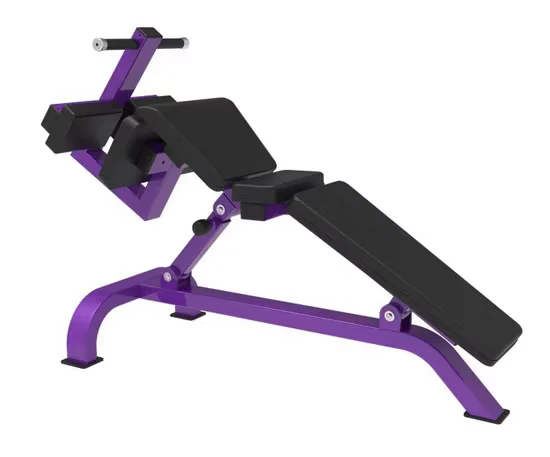
Heavy-Duty Steel Frame — 60kg fully welded structure eliminates resonance and wobble during high-frequency commercial abdominal training sessions.
Technical Specifications
| Parameter | Value |
|---|---|
| Product Type | Integrated Gym Trainer (Abdominal Board) |
| Model NO. | 5061 |
| Exercise Part | Leg |
| Material | Steel |
| Net Weight | 60kg |
| Product Dimensions | 1670600790mm |
| Max User Weight | 180kg |
| Main Frame Color | Available according to customer requirements |
| Cushion Color | Available according to customer requirements |
| OEM/ODM | Acceptable |
| Age Group | Adult |
| Gender | Unisex |
| Certification | ISO 9001, CE |
| Applications | Community, Gymnasium, Professional Gym and Club |
Application Suitability
| Deployment Scenario | Typical Use |
|---|---|
| Chain gym functional training zone | Core stabilization circuits and group training stations |
| Corporate wellness room | Quick mid-day core activation without complex setup |
| Community fitness center | High-traffic abdominal and lower-body stations with minimal supervision |
| Professional sports training center | Athlete conditioning and sport-specific core endurance work |
| High-end residential home gym | Dedicated strength corner requiring compact footprint |
Why Rigid Frames Prevent Midnight Complaints From Adjacent Spaces
Structural vibration travels farther than sound through building slabs.
When lightweight abdominal trainers sit on upper floors, repeated movement cycles transmit low-frequency vibration through concrete and steel decking. Guests or tenants in adjacent rooms feel the resonance long before they hear it. A commercial abdominal board gym equipment unit built on a 60kg steel chassis distributes load across a wider base, preventing point-loading that triggers slab vibration [NEED_CITE: vibration transmission standards for fitness equipment in multi-story buildings]. I have seen lightweight boards replaced in batches after hotel managers traced guest complaints not to airborne noise but to structure-borne tremor from floors directly below the fitness zone.
Positioning This Trainer Within the Cardio and Strength Floor Plan
This abdominal board occupies the bridge zone between pure strength racks and open cardio decks. It pairs naturally with cable towers and functional rigs where members rotate through core stations after compound lifts. The 1670600790mm footprint fits standard lane spacing, leaving clearance for adjacent equipment without sacrificing the range of motion required for full extension. It accommodates users up to 180kg, covering the size variance you find in commercial membership bases. This commercial abdominal board gym equipment anchors a station that sees rapid turnover — members cycle through in two to three minutes, keeping floor flow steady during peak hours.
What Continuous High-Frequency Use Demands From the Floor and Frame
Facilities running sixteen or more hours daily need equipment that does not shift, rattle, or require weekly bolt tightening. The 60kg mass holds the unit in place without anchor bolts, though a level rubber-matted surface remains necessary to prevent micro-migration during aggressive decline work [NEED_CITE: EN 957 stability testing criteria for body-weight training stations]. Heat is not a factor since there is no motor, but sweat accumulation on steel contact points demands sealed welds and powder-coated surfaces that resist corrosion. Grounding and electrical circuits are irrelevant here, which simplifies deployment on floors where adding dedicated outlets is cost-prohibitive.
Reading the Steel Gauge and Weld Pattern
The frame carries the entire load path — every user movement cycles stress through the main tube and the weld joints connecting the base to the inclined rail. Commercial-grade rectangular steel tubing resists torsional flex that would otherwise produce creaking under load. Cushion mounting plates must be welded, not bolted through slotted holes, because repeated tightening of hardware under vibration leads to elongation and play. The 180kg max user weight rating reflects both the frame yield point and the cushion compression rating working together. A heavier unit does not automatically mean a stronger one — wall thickness and cross-section geometry determine how the frame handles repeated eccentric loading over thousands of cycles.
The Cost of Choosing Under-Specified Boards in Shared Buildings
A lightweight board that saves on shipping weight will cost more in the second year. Cushion foam compressed flat under daily commercial loads stops absorbing impact and transfers vibration directly to the frame — and from the frame to the floor slab. Managers then face member complaints about joint discomfort during core work or noise complaints from neighboring tenants [NEED_CITE: facility manager reports on premature cushion failure in commercial environments]. Replacing an entire row of under-built boards costs more than the marginal upcharge for a 60kg unit, and the downtime during swap-out leaves a gap in the training floor that members notice.
Why This Product Line Fits the Facility Floor
Every unit in the cardio and strength range shares the same 180kg user weight ceiling, so your procurement spec stays uniform across disciplines. The welded frame construction follows the same quality control protocol as the motorized lineup — sealed bearings where rotation exists, powder-coated steel where contact happens. OEM color matching means this commercial abdominal board gym equipment can ship in the same frame and cushion palette as your treadmills and ellipticals, giving the facility visual cohesion without custom paint upcharges. The free 3D floor layout service maps where abdominal stations sit relative to high-traffic corridors so members find them without blocking flow paths.
Documentation & Test Records
- CE declaration of conformity covering commercial strength equipment category
- EN 957 test report validating structural integrity and user weight rating
- ISO 9001 certificate for manufacturing quality management system
- Noise and vibration level test report for multi-floor deployment assessment
- Frame and weld durability test record under cyclic loading conditions
- Installation guide with spacing and floor preparation specifications
Installation, Commissioning & Maintenance
- Maintain minimum 600mm clearance on all sides of the 1670600790mm footprint for safe entry and exit.
- Place on level rubber matting to prevent micro-migration during high-repetition decline work.
- Inspect weld joints and cushion mounting bolts quarterly for fatigue cracks or loosening under load.
- Wipe steel contact surfaces daily with pH-neutral cleaner to prevent sweat-induced corrosion.
- Replace cushion pads when compression set becomes visible to maintain consistent user contact.
- Verify frame color match against other OEM units upon delivery before final placement.
Planning Your Core Training Zone Procurement
Provide your functional training area dimensions and expected daily user count so we can map station spacing and member flow paths. Specify whether the equipment deploys above occupied spaces — upper-floor installations benefit from supplemental vibration-damping mats. Share your target market so frame and cushion color options align with your brand guidelines. Indicate whether you need the unit integrated into a broader equipment package for a unified OEM color run and consolidated documentation.
Frequently Asked Questions
Q: What structural differences separate this commercial board from residential versions?
A: Residential boards typically use thinner gauge tubing and lighter base plates to keep shipping weight down, which introduces flex and creaking under daily gym traffic. This unit uses a 60kg welded steel frame engineered for continuous commercial loading without structural deflection. The cushion mounting system also uses welded plates rather than slotted bolt holes, eliminating the progressive loosening that plagues lighter boards over time.
Q: How does the frame design prevent long-term noise issues?
A: Noise in strength equipment usually originates from hardware loosening at connection points and cushion foam compressing flat. The welded construction on this board eliminates bolt-on joints where vibration causes progressive play. The 60kg mass also prevents the frame from shifting on the floor during use, removing the scraping and tapping sounds that lighter units generate as they migrate during high-repetition sets.
Q: What cushion material works best for easy maintenance in commercial settings?
A: Closed-cell foam wrapped in commercial-grade vinyl resists sweat absorption and wipes clean with standard gym disinfectant. Open-cell foams absorb moisture over time, leading to odor retention and accelerated breakdown. When ordering OEM cushion colors, confirm the vinyl specification includes anti-microbial treatment and a minimum thickness that will not compress flat within the first year of high-frequency use.
Q: How should I plan spacing around this board in a mixed-use floor layout?
A: The 1670600790mm dimensions require clearance on all sides for safe mounting, dismounting, and full extension movements. Position the board away from high-traffic corridors where passing members might collide with users mid-set. In functional training zones, placing it adjacent to cable machines or rig stations creates a natural circuit flow that keeps member density balanced across the floor.
Q: What are the typical MOQ and lead time considerations for custom frame colors?
A: OEM color runs require a minimum order quantity that varies by pigment complexity — standard commercial palette colors carry lower thresholds than custom brand matches. Lead time extends when frame color must coordinate with cushion vinyl dye lots across multiple product categories. Confirm your brand color codes early in the quotation phase so the production schedule can batch your units in a single paint run.