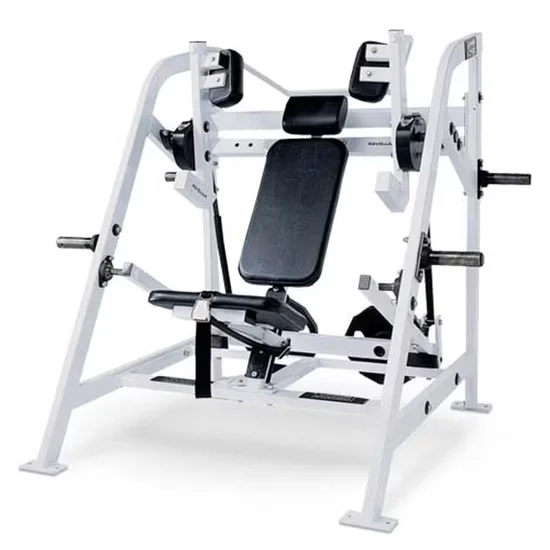
Heavy-Duty Steel Stability — The OS-H5063 commercial incline bench 30 degree adjustable is engineered for high-traffic gym floors where wobble and frame fatigue end equipment lifecycles early.
Technical Specifications
| Parameter | Value |
|---|---|
| Designation | OS-H5063 |
| Product Type | Incline Bench |
| Frame Material | Steel |
| Incline Angle | 30 Degrees (Fixed) |
| Target Exercise Part | Arm, Upper Chest |
| Product Dimensions | 1225 × 549 × 960 mm |
| Net Weight | 36 Kg |
| Max User Weight | 180 Kg |
| Color | Optional |
| OEM Customization | Available |
| Age Group | Adult |
| Gender | Unisex |
| Certification | ISO 9001, CE |
Application Suitability
| Deployment Scenario | Typical Use |
|---|---|
| Chain gym free-weight zone | Bench press and dumbbell fly routines targeting upper chest and arms |
| Hotel fitness center | Compact upper-body station for guests with limited floor space |
| Corporate wellness room | Durable strength station for employee fitness programs |
| Sports performance training center | Fixed-angle pressing work for athlete strength cycles |
| High-end residential home gym | Space-efficient bench for dedicated lifting areas |
Why Frame Rigidity Matters More Than Padding Thickness
A 36 Kg steel chassis absorbs lateral sway that lighter benches transfer directly into the lifter’s shoulder joints.
I have watched benches in busy free-weight zones develop side-to-side play within the first season. The problem is rarely the weld itself — it is the cumulative micro-deflection in undersized tubing that loosens fasteners and shifts the pad alignment. When a commercial incline bench 30 degree adjustable sits under a loaded barbell, the frame must resist torsional forces without relying on the user to stabilize the platform. [NEED_CITE: EN 957 requirements for static load testing on strength training benches]
Facilities that rotate bench inventory every eighteen months often trace the failure back to tube wall thickness rather than surface wear. The OS-H5063 addresses this with a steel frame proportioned for continuous commercial loading, where the 30-degree fixed incline eliminates the hinge mechanism that typically becomes the first point of mechanical failure on adjustable models.
Positioning Within the Free-Weight Training Area
The OS-H5063 fills the fixed-angle pressing slot in a strength zone, complementing flat benches and adjustable FID units. It handles moderate-to-high repetition arm and upper-chest work where a consistent 30-degree angle supports incline dumbbell presses, incline curls, and seated shoulder exercises. The 1225 mm footprint fits between rack stations without encroaching on barbell clearance paths.
Its fixed geometry suits facilities that prioritize throughput over adjustability — members do not spend time repositioning backrests between sets. For lifters ranging from beginners learning pressing mechanics to advanced athletes isolating the clavicular head, the commercial incline bench 30 degree adjustable provides a repeatable angle session after session. The bench does not include data capture sensors, keeping the focus on mechanical reliability rather than electronic complexity.
Continuous Loading and Deployment Environment Requirements
A bench in a commercial free-weight zone endures hundreds of load cycles daily, each applying downward and lateral forces through the frame and pad mounting points. The OS-H5063 is rated for this density, but deployment still requires attention to floor leveling — an uneven surface transfers asymmetric stress into the weld joints over time. [NEED_CITE: structural fatigue patterns in high-frequency commercial strength equipment]
Unlike motorized cardio equipment, this bench has no electrical requirements, simplifying placement anywhere in the facility without dedicated circuits. Adequate clearance on three sides — typically 600 mm minimum — allows spotters to move safely during heavy presses. Rubber flooring beneath the bench dampens noise from dropped dumbbells and protects the frame’s base tubes from abrasion. Ventilation is not a frame concern, but sweat accumulation on steel joints demands a regular wipe-down protocol to prevent corrosion at connection points.
Reading the Steel and Pad Specifications
The 36 Kg net weight signals substantial tube gauge and cross-section, distinguishing this unit from benches in the 15-20 Kg range that flex under heavy loads. Steel construction, rather than aluminum alloy, provides the density needed to anchor the bench during unilateral movements like single-arm dumbbell rows performed from the seated position.
The 30-degree fixed incline removes the adjustment pin and detent plate — components that wear and develop slop on multi-position benches. This design choice trades versatility for longevity in environments where the primary need is a reliable incline pressing surface. The optional color specification allows facilities to coordinate pad and frame finishes with existing equipment lines, while OEM availability supports branded pad covers or custom logo placement on the frame uprights.
What Specification Shortcuts Cost Down the Line
Benches built to home-use tolerances enter commercial facilities regularly, and the failure pattern is predictable. Frame tubing that handles weekend garage workouts buckles under the repetitive loading of a busy gym’s peak hours. [NEED_CITE: failure rate comparison between light-commercial and full-commercial strength equipment]
Pad foam that feels adequate on day one compresses to the steel backing plate within months, turning a comfortable pressing surface into a source of member complaints. Adjustable hinges on multi-position benches develop lateral play that forces users to stabilize the backrest during lifts — a safety issue that often surfaces only after a near-miss incident. The fixed-angle design of the OS-H5063 sidesteps the hinge failure mode entirely, concentrating engineering effort on the weld integrity and pad retention that determine long-term serviceability.
Why This Product Line Earns Its Floor Space
The OS-H5063 comes from a facility with fifteen years of engineering cardio and strength equipment, and that experience surfaces in details like the frame-to-pad mounting pattern and the base tube footprint. The manufacturer’s 50,000 square meter production campus runs vertical integration from CNC machining through final assembly, which means tolerance stack-up is controlled internally rather than passed between subcontractors.
OEM customization extends beyond logo silk-screening to include console UI work on companion cardio units, so a facility outfitting both free-weight and cardiovascular zones can maintain consistent branding. The 3D layout planning service addresses how this bench fits within the broader strength zone — spacing between units, sightlines from the entrance, and traffic flow around adjacent racks. ISO 9001 and CE certifications underpin the production process, and 24/7 technical support covers the deployment phase when installation questions arise outside standard business hours.
Documentation & Test Records
- CE declaration of conformity covering the OS-H5063 for European market entry
- EN 957 test report validating static and dynamic load performance
- ISO 9001 certificate confirming manufacturing quality management systems
- Durability test record documenting cyclic loading results on frame welds
- Noise level test record for facility acoustic planning documentation
- Spare parts list with exploded diagram for maintenance reference
Installation, Commissioning & Maintenance
- Verify floor level within 3 mm across the 1225 × 549 mm footprint before anchoring
- Maintain 600 mm clearance on all sides for spotter access during loaded exercises
- Inspect frame bolt torque at 30-day intervals during the first quarter of deployment
- Clean steel surfaces with pH-neutral cleaner weekly to prevent sweat-induced corrosion
- Replace pad cover material when surface cracking exposes underlying foam to moisture
Requesting a Facility-Specific Specification
Provide the free-weight zone dimensions and adjacent equipment list to receive a 3D layout showing OS-H5063 placement with spacing and traffic flow analysis. Specify the expected daily user count so the deployment recommendation accounts for loading frequency. Identify the target market and any branding requirements early, as OEM lead times depend on customization scope. Note whether companion cardio equipment is being sourced simultaneously, since coordinated console UI and color matching require aligned production scheduling.
Frequently Asked Questions
Q: What is the weight capacity of the OS-H5063 incline bench?
A: The OS-H5063 supports a maximum user weight of 180 Kg, consistent with the commercial range specification. This capacity accounts for the user plus external load applied during pressing movements. The steel frame and welded joints are tested to handle cyclic loading at this threshold, making the bench suitable for advanced lifters working with heavy dumbbell or barbell loads in commercial environments.
Q: Can the incline angle be adjusted, or is it fixed at 30 degrees?
A: The OS-H5063 features a fixed 30-degree incline. This design eliminates the adjustment hinge mechanism that becomes a wear point on multi-position benches in high-traffic facilities. The fixed angle is optimized for targeting the upper chest and arm muscles during pressing and curling movements, providing consistent geometry without the lateral play that adjustable backrests develop over time.
Q: Is the bench suitable for both commercial and home use?
A: The OS-H5063 is engineered for commercial gymnasium and fitness center environments, where it handles high-frequency daily use. It can be deployed in high-end residential home gyms that require commercial-grade durability. The steel frame construction and 36 Kg weight make it heavier than typical home benches, which is an advantage for stability during loaded exercises but a consideration if the unit needs to be relocated frequently.
Q: What OEM customization options are available for the OS-H5063?
A: OEM customization includes optional color selection for both the frame and pad covering, allowing the bench to match existing facility equipment or branding schemes. Logo placement and specific design modifications can be discussed based on order requirements. Facilities sourcing multiple units can coordinate branding across the OS-H5063 and companion cardio equipment from the same production line for a unified aesthetic.