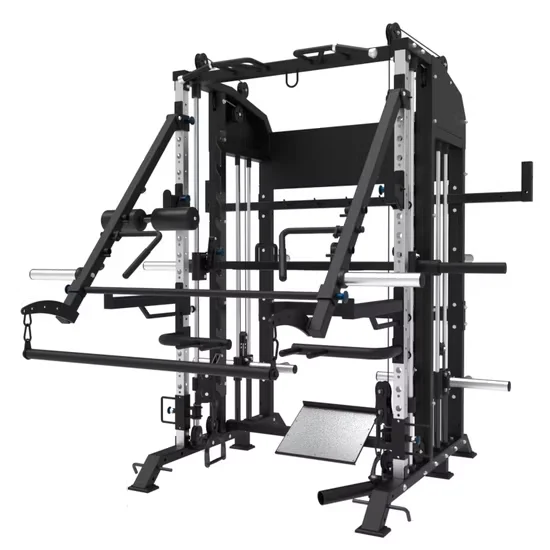
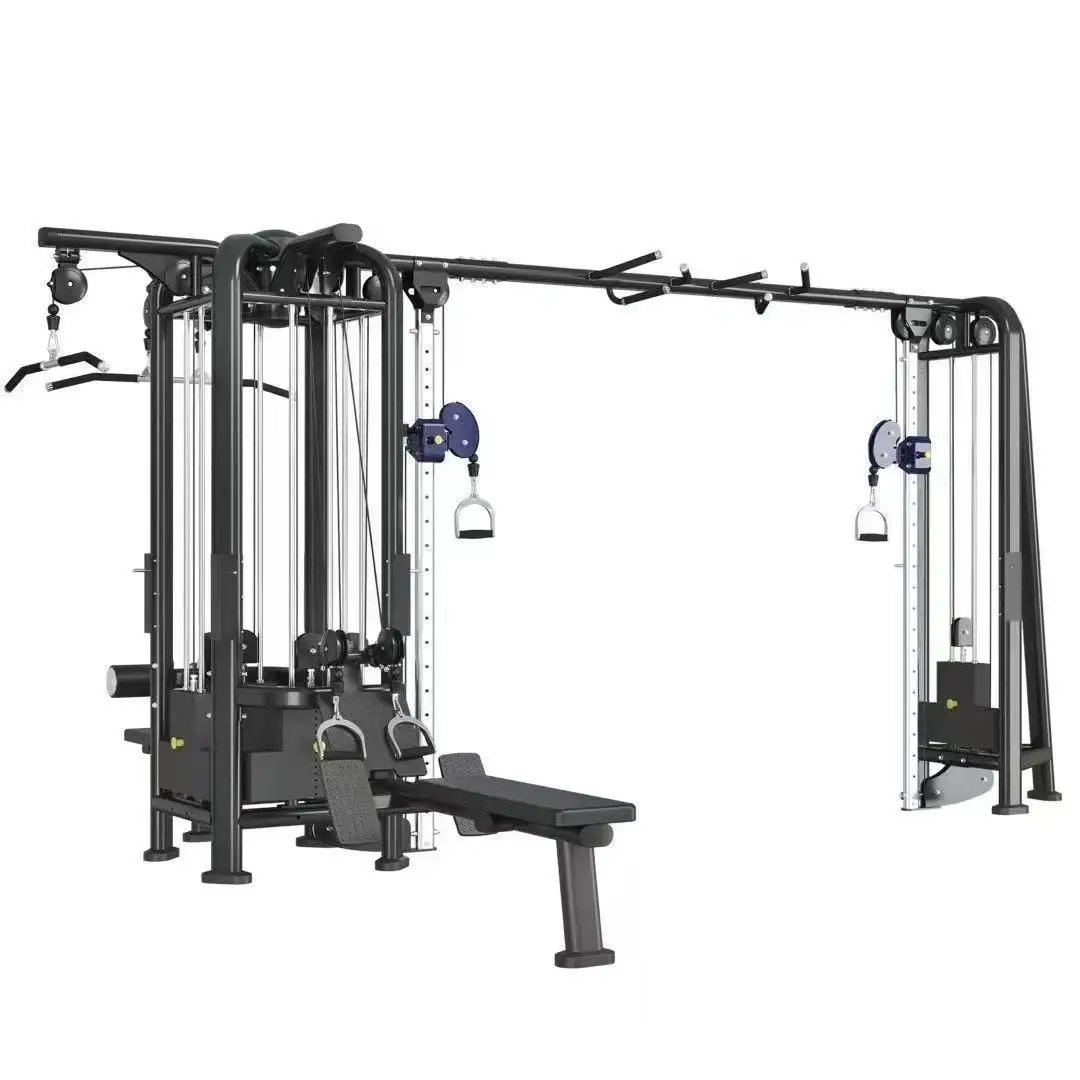
Structural Rigidity — 3mm commercial steel frame engineered for high-frequency strength training zones.
Technical Specifications
| Parameter | Value |
|---|---|
| Product Type | Commercial 3-in-1 Smith Machine Power Rack with Dual Cable Crossover |
| Model NO. | PX1071B |
| Tube Thickness | 3mm |
| Material | Steel |
| Frame Color | Customized (Yellow, Black, Orange, Pink, etc.) |
| Cushion Color | Customized (Yellow, Black, Orange, Pink, etc.) |
| Exercise Part | Leg / Arm / Shoulder |
| Appliance | Gymnasium, Home |
| Specification | 2130 × 2150 × 2200mm |
| Net Weight | 250kg |
| OEM/ODM | Available |
| Delivery Time | 20-25 Days |
| Certification | CE |
| Max User Weight | Heavy-duty commercial standard |
Application Suitability
| Deployment Scenario | Typical Use |
|---|---|
| Chain gym strength training zone | High-frequency multi-user circuit training, integrating Smith machine presses and cable crossover isolation work. |
| Hotel fitness center | Space-efficient full-body resistance training for guests requiring diverse exercise options in a single footprint. |
| Corporate wellness room | Compact deployment for employee fitness programs combining power rack lifts with functional cable movements. |
| High-end residential home gym | Customizable aesthetics matching interior design, delivering commercial-grade training in private environments. |
| Sports performance training center | Athlete conditioning with adjustable cable resistance and guided barbell paths for progressive overload. |
Why Frame Deformation Becomes a Liability Before the Warranty Expires
A 3mm steel tube frame resists torsional drift under continuous asymmetric loading.
Commercial strength equipment absorbs punishing lateral forces during cable crossovers and off-axis Smith machine work. When wall thickness drops below commercial thresholds, uprights begin to deflect, pulley alignment degrades, and users feel the wobble before maintenance logs it [NEED_CITE: structural fatigue thresholds for commercial strength frames]. I have seen power racks in high-traffic facilities require realignment within months because the frame could not hold geometry under daily repetition cycles. This commercial 3-in-1 Smith machine power rack with dual cable crossover maintains structural integrity precisely because its 3mm tubing is specified for facility-grade duty cycles rather than light residential use.
Positioning Within the Strength Training Floor Plan
This unit serves as a centralized anchor in strength zones, covering guided barbell movements, free-weight rack work, and cable isolation exercises within a single 2130 × 2150mm footprint. It complements standalone plate-loaded machines and dumbbell stations by consolidating three training modalities, reducing member wait times during peak hours. The dual cable crossover system enables unilateral and bilateral resistance patterns across upper and lower body groups. Suitable for facilities managing high member density where floor space commands a premium, and adaptable to users of varying anthropometry thanks to adjustable pulley heights and Smith machine bar catches.
Continuous Deployment and Floor Loading Considerations
A 250kg unit of this footprint generates concentrated static and dynamic loads that demand level, reinforced flooring. Facilities deploying on upper floors must verify slab capacity for both the resting weight and the added live load of users plus loaded barbell sleeves [NEED_CITE: structural load calculations for commercial gym equipment on elevated floors]. Lateral cable crossover forces transmit into the floor anchoring points, making bolt-down installation non-optional in multi-user environments. Adequate clearance on all sides — particularly the cable extension paths — ensures safe member flow. Temperature and humidity control in the deployment space prevents corrosion on exposed steel surfaces and bearing housings over extended service life.
Decoding the Steel Gauge and Pulley Architecture
The 3mm tube thickness places this frame squarely in the commercial bracket, where wall thickness directly determines resistance to bending moments during heavy eccentric loading. Thinner residential-grade tubing typically flexes under the same repetition schemes, accelerating joint wear in pulley carriages and introducing cable tracking errors. The dual cable crossover system uses independent weight stacks or plate-loaded horns, allowing asymmetric resistance for functional training patterns. Smith machine guide rods are machined for linear bearing travel, reducing the lateral play that causes bar path deviation. Integrated power rack catch systems provide spotter-arm functionality without requiring additional floor space for standalone squat stands. The 250kg net weight contributes to inherent stability, reducing reliance on extensive floor anchoring compared to lighter multi-function units.
The Hidden Cost of Underspecified Multi-Function Equipment
Facilities that procure multi-station equipment rated for light commercial duty frequently face premature pulley bearing failures, cable fraying, and frame joint separation within the first year of intensive use. When a single integrated unit goes offline, three exercise modalities disappear from the floor simultaneously, creating member frustration and training program disruption [NEED_CITE: failure rate comparison between commercial and light-commercial strength equipment]. I have walked through gym floors where underspecified Smith machine guides developed enough play to render the bar path unpredictable, forcing operators to pull the entire unit from service while members migrated to free-weight racks that were never designed for the same exercise volume.
Why This Product Line Holds Up Under Facility Conditions
The 3mm frame specification is validated through load-cycle testing that simulates years of continuous member use across all three integrated exercise systems. CE certification confirms compliance with European safety standards for commercial strength equipment. The 2130 × 2150 × 2200mm envelope is mapped in 3D layout planning to optimize sightlines, member flow, and cable extension clearance within the strength zone. OEM customization extends to frame and cushion color selection, allowing facility branding consistency without compromising structural specification. Full OEM/ODM capability covers logo application, color matching, and minor dimensional adjustments to fit specific floor plans. Deployment documentation includes assembly sequencing that accounts for the 250kg unit weight and multi-component integration.
Documentation & Test Records
- CE declaration of conformity for commercial strength equipment
- EN 957 test report covering structural integrity and safety requirements
- ISO 9001 quality management certificate
- Steel tube material specification and thickness verification report
- Pulley system durability and cable load test records
- Assembly instruction manual with complete spare parts list
Installation, Commissioning & Maintenance
- Maintain minimum 1000mm clearance on all sides for safe cable crossover extension paths and member movement.
- Install on level concrete substrate using specified floor anchors to resist lateral crossover forces during high-load exercises.
- Verify Smith machine guide rod alignment and linear bearing smoothness during initial commissioning before member use.
- Inspect cable tension and pulley bearing condition at scheduled intervals based on daily usage volume.
- Apply protective coating to exposed steel surfaces in high-humidity environments to prevent surface corrosion.
- Check all structural fastener torque values after the first 30 days of operation and at regular maintenance intervals thereafter.
Planning Your Strength Zone Deployment
Provide your strength training area dimensions and target equipment count to receive a 3D layout plan that accounts for cable extension clearance, member flow, and equipment sightlines. Specify daily usage volume and member throughput expectations to confirm this unit’s duty-cycle alignment with your facility demands. Indicate deployment floor level and adjacent occupied spaces so anchoring and vibration transfer requirements can be assessed. Confirm whether frame and cushion color customization is required to match existing facility branding or interior design specifications.
Frequently Asked Questions
Q: What spatial advantage does the 3-in-1 design offer over separate single-function machines?
A: Integrating a Smith machine, power rack, and dual cable crossover into one 2130 × 2150mm footprint eliminates the floor space that three standalone units would consume, including their individual safety clearances. This consolidation is particularly valuable in hotel and corporate fitness centers where square meterage is limited but training variety remains a member expectation.
Q: How does 3mm commercial tube thickness differ from typical residential specifications?
A: Residential multi-station equipment commonly uses tubing in the 1.5mm to 2mm range, which is adequate for one or two daily users but deflects under the repetition volume of a commercial floor. The 3mm wall thickness specified here maintains frame geometry under continuous multi-user loading, preventing the pulley misalignment and joint play that signal premature structural fatigue.
Q: What training diversity does the dual cable crossover system provide?
A: Dual independent cable paths enable simultaneous or alternating unilateral movements, rotational resistance patterns, and bilateral exercises across upper body, lower body, and core muscle groups. Adjustable pulley heights accommodate standing, kneeling, and supine positions, supporting functional training protocols alongside traditional isolation work without requiring additional dedicated machines.
Q: What customization options are available and what are the minimum order requirements?
A: Frame color and cushion color are selectable from a range including yellow, black, orange, and pink, with additional custom colors available for OEM projects. Logo application and minor dimensional modifications can be scoped during the ordering process. Contact us with your project specifications to confirm minimum order quantities and customization lead times.
Q: How does disassembled shipping affect on-site installation?
A: The unit ships in component form within plywood and carton packaging, reducing freight volume and enabling access through standard doorways and elevator cars. On-site assembly follows a sequenced instruction manual, and the 250kg total weight is distributed across manageable sub-assemblies during installation, though professional fitting with appropriate lifting equipment is recommended.