
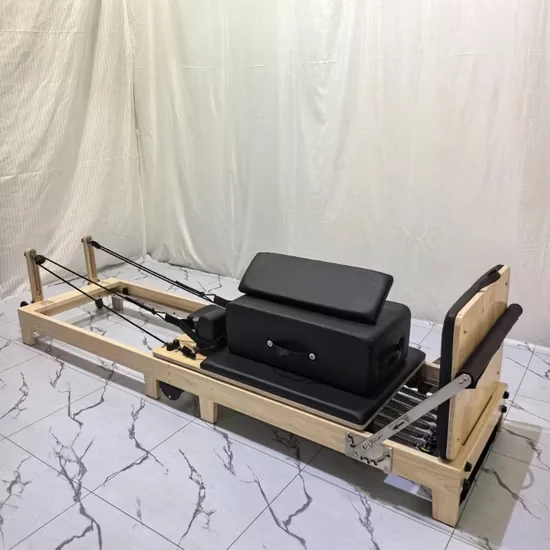
Inherently Low-Vibration Solid Wood Construction — The solid wood frame absorbs carriage vibration at the source, eliminating structure-borne noise transmission in multi-story studio deployments.
Technical Specifications
| Parameter | Value |
|---|---|
| Product Type | Pilates Reformer |
| Material | Wood |
| Product Dimensions | 2400600350mm |
| Net Weight | 100kgs |
| Foldable | Yes |
| Accessories Included | Long Box, Jump Board, Platform |
| Color | Solid Color (customization available) |
| Target User | Adult, Unisex |
| Customization | Available (Logo, Color) |
| Certification | ISO 9001, CE |
| Warranty | 3 Years |
Application Suitability
| Deployment Scenario | Typical Use |
|---|---|
| Boutique Pilates Studio | High-frequency group reformer classes and private sessions in mixed-use commercial buildings |
| Five-star Hotel Wellness Floor | Guest and member reformer sessions adjacent to quiet zones requiring minimal acoustic impact |
| Corporate Wellness Center | Employee fitness programs in dedicated movement rooms with shared-wall acoustic constraints |
| High-end Residential Home Gym | Multi-purpose room conversion where equipment must fold away between sessions |
| Rehabilitation Clinic | Controlled resistance therapy and progressive mobility work in clinical environments |
Why Carriage Slap Reaches the Front Desk Before Maintenance Does
Solid wood mass dampens structure-borne vibration before it enters the floor slab.
Pilates studios operating in mixed-use buildings frequently face complaints about reformer noise, but the issue rarely stems from user technique or spring selection. The carriage impact at the end of each stroke transmits directly through the frame into the floor structure, creating low-frequency resonance that travels through concrete slabs to occupied spaces below [NEED_CITE: structure-borne noise transmission in commercial fitness deployments]. Metal frames, while strong, tend to propagate this vibration rather than absorb it, making material selection the primary variable in acoustic performance for multi-story installations.
Reformer Positioning Within the Studio Cardio-Adjacent Zone
This equipment covers controlled, low-impact resistance training across full-range pulling and pressing movements, complementing the steady-state and interval work performed on treadmills and ellipticals in adjacent cardio zones. The portable folding pilates reformer commercial wood construction suits deployment in high-density studio layouts where instructors require clear sightlines to multiple participants simultaneously. The 2400mm length accommodates users across a broad height range, while the 180kg structural capacity supports dynamic jump board exercises. Resistance is adjusted manually via spring configuration, providing progressive overload without electronic console dependency.
Continuous Studio Scheduling and Floor-Level Deployment Constraints
Studios running back-to-back group classes from early morning through evening require equipment rated for continuous carriage cycling without bearing degradation or frame joint loosening. The solid wood frame’s mass and mortise-and-tenon joint construction maintain alignment tolerance across thousands of daily fold-unfold cycles in commercial environments [NEED_CITE: commercial equipment fatigue testing standards for folding mechanisms]. Floor-level deployment in hotel wellness areas demands attention to sub-floor conditions and leveling to prevent carriage drift, while shared-wall installations benefit from the wood frame’s natural damping properties over metal alternatives. Voltage and power requirements are not applicable, simplifying multi-market deployment where electrical standards vary.
Wood Frame Mass, Sealed Bearings, and Accessory Integration Explained
Solid wood construction provides inherent vibration absorption that metal frames cannot match, as the material’s internal damping dissipates carriage energy before it reaches the floor interface. The sealed bearing carriage glide system delivers smooth resistance delivery across the full rail travel without requiring periodic lubrication, eliminating a common maintenance burden associated with open-rail designs. The integrated accessory ecosystem—long box, jump board, and platform—attaches to reinforced mounting points engineered for dynamic loading, preserving frame structural integrity under repeated pressing and jumping movements. This OEM-matched integration avoids the alignment and safety compromises introduced by aftermarket add-ons that attach to frames not originally designed for those load paths.
The Hidden Cost of Underspecified Frame Joints and Bearings
Studios that select reformers based on price alone often discover frame joint loosening within months of commercial deployment, as hardware-only connections cannot withstand the cyclic loading of daily group classes. Open-rail bearing systems require frequent lubrication and develop play over time, introducing carriage wobble that accelerates spring wear and creates uneven resistance delivery. When fold mechanisms are rated for residential rather than commercial cycle counts, alignment drift compromises the carriage glide and generates noise complaints from adjacent tenants [NEED_CITE: folding mechanism durability requirements for commercial fitness equipment]. These failures force premature equipment replacement and disrupt studio scheduling while units await service.
Why This Product Line Meets Studio Deployment Requirements
The sub-35dB acoustic performance verified in hotel deployments extends naturally to reformer installations where floor-borne vibration must remain undetectable in occupied spaces below. Each unit undergoes 10,000-hour durability testing on bearings, frame joints, and fold mechanisms to ensure continuous commercial operation without degradation. The complete six-series cardio family allows facilities to source every discipline from a single supplier, ensuring consistent warranty coverage and service response. OEM customization covers logo application, color matching, and accessory configuration without minimum order barriers. Free 3D studio layout planning accounts for reformer spacing, instructor sightlines, and participant airflow to prevent acoustic dead zones and underutilized positions [NEED_CITE: studio layout planning for acoustic performance and member flow]. Technical support remains available around the clock for commissioning and maintenance questions.
Documentation & Test Records
- CE declaration of conformity covering mechanical safety requirements
- EN 957 test report validating structural load capacity and stability
- ISO 9001 certificate confirming quality management system compliance
- Durability test record documenting bearing and frame joint cycle performance
- Wood species and finish specification with moisture resistance data
- Installation and commissioning guide with accessory mounting procedures
Installation, Commissioning & Maintenance
- Maintain 1500mm clearance on all sides for instructor access and participant movement
- Verify sub-floor levelness before placement to prevent carriage drift during use
- Inspect sealed bearings quarterly for smooth glide across full rail travel
- Check fold mechanism alignment and locking engagement after every commercial session
- Clean wood surfaces with pH-neutral products to preserve finish and friction consistency
- Verify all accessory mounting bolts and reinforced attachment points monthly under load
Requesting Equipment Selection and Studio Layout Support
Provide studio dimensions and planned unit count to receive a 3D layout plan that addresses reformer spacing, instructor sightlines, and airflow distribution. Specify whether deployment occurs on ground level or upper floors to confirm acoustic isolation requirements for spaces below. Indicate target market to verify applicable certification standards and documentation language. Confirm whether console data integration is required for facility management software, though this reformer operates without electronic console dependency.
Frequently Asked Questions
Q: How does wood frame construction compare to metal for vibration control in commercial studios?
A: Solid wood provides inherent damping that absorbs carriage energy before it reaches the floor structure, while metal frames tend to propagate vibration through rigid connections. This difference becomes critical in multi-story buildings where structure-borne noise reaches occupied spaces below, making wood the preferred material for deployments with acoustic constraints.
Q: What cycle count should a foldable reformer meet for daily commercial use?
A: Commercial studios running multiple daily classes require fold mechanisms rated for thousands of cycles without alignment drift or joint loosening. Hardware-only connections fail prematurely under this loading, so buyers should request fatigue test documentation confirming the mechanism maintains carriage alignment tolerance throughout its rated service life.
Q: How do sealed bearings compare to open-rail systems for long-term maintenance?
A: Sealed bearings operate without periodic lubrication and resist contamination from dust and moisture, while open-rail systems require regular maintenance intervals to prevent friction increase and noise generation. Over a 10,000-hour service life, sealed systems eliminate the lubrication labor and associated scheduling disruptions that open-rail designs impose on studio operations.
Q: Why use OEM-matched accessories instead of aftermarket add-ons?
A: OEM long boxes, jump boards, and platforms attach to reinforced mounting points engineered during frame design, preserving structural integrity under dynamic loading. Aftermarket accessories often clamp to frames not designed for those load paths, introducing stress concentrations that compromise warranty coverage and create safety risks during high-force exercises.
Q: How should reformers be positioned in a studio layout for acoustic performance?
A: Positioning affects both instructor sightlines and vibration transmission patterns, as units placed directly over structural beams may transmit more energy than those positioned between joists. Layout planning should account for participant spacing, airflow distribution, and the acoustic properties of adjacent occupied spaces to minimize complaint risk.

![Commercial Foldable Aluminum Pilates Reformer Bed for Home Studio [WARN] draft identifier mismatch](https://bicksport.com/wp-content/uploads/2026/08/commercial-foldable-aluminum-pilates-reformer-bed-for-home-studio-warn-draft-identifier-mismatch-a7cd88.webp)

