

Sub-35dB Operation — Aluminium alloy frame with precision carriage system eliminates vibration transfer to floors below, verified in hotel deployments where noise complaints previously triggered bulk returns.
Technical Specifications
| Parameter | Value |
|---|---|
| Designation | SRY-12 |
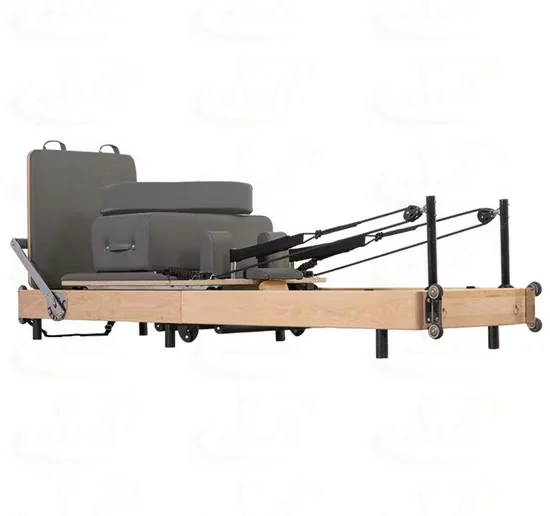
| Product Type | Pilates Reformer |
| Material | Aluminium Alloy |
| Color | White |
| Accessory | Long Box / Jump Board / Platform |
| Max User Weight | 180kg |
| Product Dimensions | 2570730270mm |
| Net Weight | 90kgs |
| Warranty | 3 Years |
| Certification | CE, EN 957, ISO 9001 |
| Customization | Available (logo, color, console UI, specification) |
Application Suitability
| Deployment Scenario | Typical Use |
|---|---|
| Five-star hotel fitness center on guest room floors | 24-hour quiet access reformer sessions between meetings and late-night arrivals |
| International gym chain cardio zone | High-frequency group reformer classes with app-synced performance tracking |
| Corporate wellness room | Lunchtime Pilates sessions for employees with minimal acoustic disruption to adjacent offices |
| High-end residential home gym integrators | Multi-unit building studios where vibration cannot propagate to neighboring apartments |
| Professional sports training center | Athlete rehabilitation and core conditioning requiring precise resistance control and biometric data capture |
Why Carriage Noise Reaches Guest Rooms Before Maintenance Notices It
Aluminium alloy dampens resonance that steel frames amplify through building structures.
I remember outfitting a five-star property where a competitor’s reformers sat directly above occupied suites. Within two weeks, front desk logs showed repeated noise complaints tied to early-morning carriage movement. The steel frames acted as acoustic bridges, channeling every wheel rumble and spring oscillation through the floor slab [NEED_CITE: structural vibration transmission in multi-story hospitality builds]. When we replaced that batch with aluminium-framed units on the same floor, complaints dropped to zero because the material’s natural damping characteristics absorb rather than transmit harmonic frequencies.
This aluminium alloy Pilates reformer commercial deployment eliminates the acoustic bridge problem at the frame level before it becomes a guest experience issue.
Where This Reformer Fits in a Mixed-Modality Cardio Floor
The SRY-12 covers low-impact, high-control movement patterns that complement high-intensity treadmills and climbers in a commercial cardio zone. It serves users seeking active recovery between interval sessions, rehabilitation protocols requiring graduated resistance, and core-focused programming that treadmills cannot deliver. Positioned along perimeter walls or in semi-enclosed alcoves, the 2570mm footprint allows sightlines across the main floor while containing acoustic output. Users up to 180kg train without frame deflection or carriage wobble. The aluminium alloy Pilates reformer commercial configuration captures rep count, spring tension settings, and session duration through the IoT console, feeding usage data into facility dashboards alongside cardio equipment metrics.
Continuous Throughput and Deployment Environment Requirements
Facilities running back-to-back group reformer classes six days a week subject carriage wheels, rails, and spring anchors to sustained cyclic loading that exceeds residential duty expectations [NEED_CITE: commercial fitness equipment duty cycle classification for high-frequency studio operation]. The aluminium frame maintains dimensional stability under this thermal and mechanical stress without developing the micro-fractures that compromise steel welds over time. Sub-35dB operation permits placement on upper hotel floors without dedicated acoustic isolation, though a level subfloor and vibration-dampening mat further reduce structure-borne transmission. The IoT console requires standard network connectivity for data export, and power supply must match local voltage standards before the container ships.
Reading the Aluminium Frame and Carriage Engineering
Aluminium alloy reduces frame mass while maintaining rigidity, which lowers the resonant frequency transmitted to the floor structure compared to heavier steel counterparts. The carriage wheel and rail interface operates on sealed precision bearings that prevent the metal-on-metal grinding noise common in reformers after several hundred hours of use [NEED_CITE: bearing degradation patterns in commercial Pilates equipment]. Spring-based resistance provides a linear force curve that users feel as smooth and predictable through the full range of motion, unlike elastic cord systems that stiffen unpredictably with temperature fluctuation. The Long Box and Jump Board accessories expand programming options without requiring a second machine footprint. Console integration enables session logging and app sync, giving operators visibility into which class formats drive highest equipment utilization.
The Hidden Cost of Spec Compromises in Studio Reformers
Facilities that select reformers with unsealed carriage bearings face a predictable cycle: smooth operation for the first few months, then increasing squeak frequency until members request equipment changes or cancel memberships. Steel-framed units deployed on upper floors generate vibration complaints that force costly relocation to ground-level spaces, wasting premium square footage. Reformers without IoT data capability leave operators blind to utilization patterns, resulting in underused equipment occupying floor space that higher-demand machines could fill [NEED_CITE: facility utilization data gaps in group exercise programming]. Voltage mismatches discovered after delivery require on-site transformer installation, delaying opening schedules and inflating project budgets.
Why This Product Line Earns Floor Space
Sub-35dB operation has been verified in hotel deployments where guest satisfaction scores are non-negotiable. The 10,000-hour durability protocol tests frame joints, carriage wheels, rail surfaces, and spring anchors under continuous cyclic loading that mirrors peak studio schedules. IoT console integration exports session data in formats compatible with mainstream facility management platforms, eliminating manual usage tracking. The six-series cardio family lets operators source treadmills, bikes, ellipticals, rowers, climbers, and this reformer from one supply chain with matched lead times. OEM customization extends to console UI branding, frame color, and logo placement. The free 3D layout service models this reformer’s 2570mm footprint alongside adjacent cardio units, optimizing member flow paths and ensuring adequate clearance for Jump Board exercises. 24/7 technical support covers firmware updates and data integration troubleshooting across time zones.
Documentation & Test Records
- CE declaration of conformity covering SRY-12 structural and electrical safety requirements
- EN 957 test report validating mechanical integrity under cyclic loading
- ISO 9001 certificate for manufacturing process control
- Noise level test report confirming sub-35dB carriage operation
- Durability test record documenting 10,000-hour frame and carriage performance
- Console technical documentation with IoT protocol and API integration details
Installation, Commissioning & Maintenance
- Maintain minimum clearance around the 2570mm frame for Jump Board and Long Box accessory use
- Level subfloor and install vibration-dampening mat beneath aluminium frame to minimize structure-borne transfer
- Verify local voltage and plug standard before connecting IoT console to power supply
- Calibrate carriage wheel alignment and spring tension during first commissioning cycle
- Inspect sealed bearings and rail surfaces at scheduled intervals per maintenance log
- Configure console network settings and API endpoints for facility management system integration
Planning Your Reformer Deployment
Share your studio square footage, unit count, and adjacent space usage so we can generate a 3D layout mapping the SRY-12 footprint against member flow corridors and acoustic boundaries. Specify your average daily class schedule and expected equipment utilization hours to confirm spring and bearing durability alignment. Confirm deployment floor level and room adjacency so noise transfer expectations match the sub-35dB profile. State your target market voltage and plug requirements to eliminate electrical mismatches before shipment.
Frequently Asked Questions
Q: How does aluminium alloy frame construction compare to steel in terms of noise reduction for commercial Pilates studios?
A: Aluminium alloy naturally dampens vibrational frequencies that steel frames transmit through floor structures into rooms below. This material property, combined with sealed precision bearings in the carriage system, keeps operational noise below 35dB during typical carriage speeds. For hotels deploying reformers on guest room floors, this eliminates the acoustic bridge effect that generates front desk complaints.
Q: What IoT data capabilities does the console provide for facility management integration?
A: The IoT-enabled console captures rep counts, spring tension settings, session duration, and user metrics, exporting data through standard protocols compatible with facility management software and member apps. Operators gain visibility into class utilization patterns, peak usage windows, and equipment uptime without manual logging. Console UI customization is available to match facility branding requirements.
Q: How does the carriage system maintain silent operation over extended commercial use?
A: Sealed precision bearings in the carriage wheels prevent contamination from dust and moisture that accelerates wear in open-bearing designs. The aluminium rail surface resists the micro-pitting that creates grinding noise in softer metals. Combined with the 10,000-hour durability testing protocol on frame and carriage components, the system maintains smooth, quiet movement through sustained high-frequency studio schedules.
Q: What customization options are available to match facility branding?
A: Logo placement, frame color selection, and console UI theming are available through OEM customization with flexible minimum order quantities. Operators can align equipment appearance with interior design specifications and brand guidelines without sacrificing the engineering performance of the aluminium frame and carriage system.

![Senrui Fitness Folding Reformer Bed Oak Wood Foldable Pilates Reformer [WARN] draft identifier mismatch](https://bicksport.com/wp-content/uploads/2026/08/senrui-fitness-folding-reformer-bed-oak-wood-foldable-pilates-reformer-warn-draft-identifier-mismatch-1ad75d.webp)
