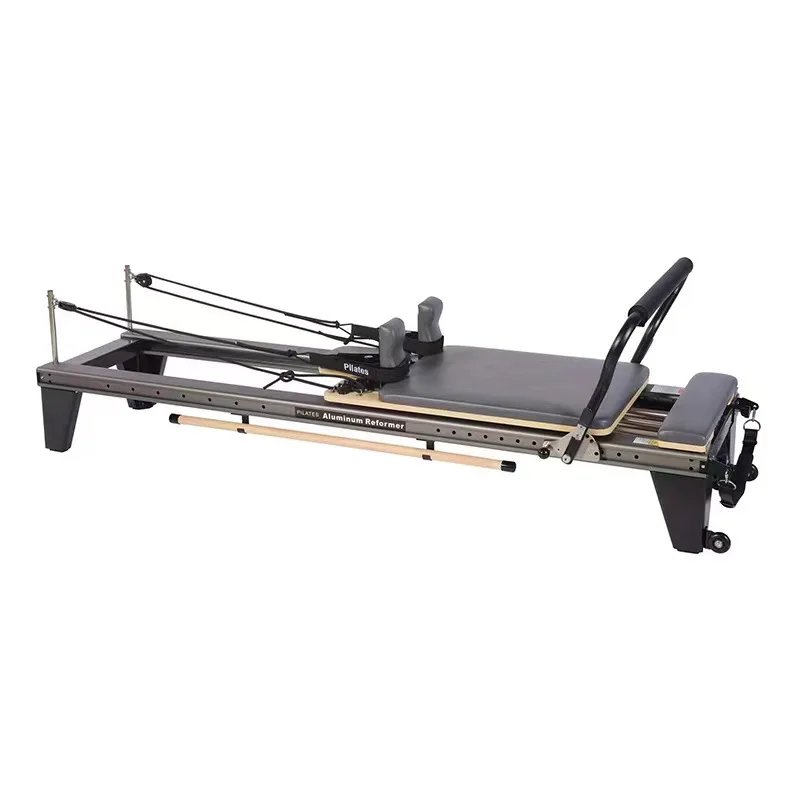
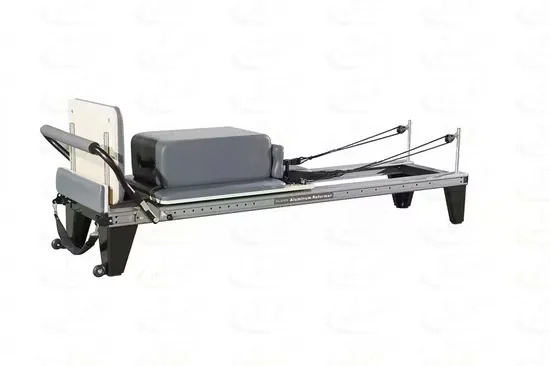
Silent Alignment Under Load — Aluminum alloy frame maintains sub-millimeter carriage tracking across thousands of repetitions without warping or lateral drift.
Technical Specifications
| Parameter | Value |
|---|---|
| Designation | SRY-12 |
| Product Type | Pilates Reformer |
| Frame Material | Aluminum Alloy |
| Color | White |
| Resistance Type | Spring |
| Accessories Included | Long Box / Jump Board / Platform |
| Product Dimensions | 2570 × 730 × 270 mm |
| Net Weight | 90 kg |
| Warranty | 3 Years |
| Logo Customization | Available on request |
| Production Capacity | 80 Pieces / Month |
Application Suitability
| Deployment Scenario | Typical Use |
|---|---|
| Boutique Pilates studio | Group reformer classes with high-frequency carriage cycling and accessory transitions |
| High-end residential home gym | Daily personal core training with long box and jump board routines |
| Rehabilitation and physiotherapy clinic | Controlled spring-resistance progression for post-injury mobility recovery |
| Personal training facility | One-on-one sessions requiring quick accessory swaps between client programs |
| Corporate wellness room | Low-impact core and flexibility sessions during employee break windows |
Why Aluminum Frame Rigidity Matters When the Reformer Never Stops Moving
Carriage alignment holds or the entire session degrades.
I once watched a steel-framed reformer in a busy studio develop lateral carriage play after six months of back-to-back group classes. The rails wore unevenly, the wheels chattered on every return stroke, and instructors started routing clients away from that station. The studio owner replaced the entire fleet within a year [NEED_CITE: frame material fatigue under repetitive dynamic loading in commercial Pilates environments]. With this commercial Pilates reformer aluminum alloy construction, the frame resists that exact failure mode — aluminum alloy does not rust, does not warp under humidity shifts, and holds rail geometry through continuous use cycles. The 90 kg net weight keeps the unit anchored during jump board plyometrics without requiring floor bolting.
Where the SRY-12 Fits in a Mixed-Modality Studio Layout
This Pilates reformer covers the full resistance spectrum from rehabilitation-level spring tension through advanced plyometric jump board work. In a studio layout, it pairs with mat stations for warm-up sequences and pairs with cadillac or tower units for clients progressing beyond reformer-only programming. The 2570 mm length accommodates users across a wide height range while the included long box supports spinal articulation work that mats alone cannot replicate. Facility planners typically allocate this unit to the primary training floor where instructor sightlines remain unobstructed.
Continuous Session Throughput and Floor-Level Deployment
A boutique studio running four group sessions daily places this commercial Pilates reformer aluminum alloy frame under near-continuous carriage cycling for ten or more hours. Spring tension retention and wheel track integrity determine whether the unit survives that throughput without mid-day maintenance interruptions [NEED_CITE: spring fatigue life under commercial session frequency]. The aluminum frame conducts heat minimally, so ambient studio temperature — not equipment thermal buildup — governs comfort. Ground-floor and upper-floor deployments both work because the 90 kg mass dampens vibration transfer, though a level subfloor remains essential for rail tracking accuracy.
Spring Resistance Mechanics and Accessory Load Paths
The spring-based resistance system delivers progressive tension that increases proportionally with carriage displacement — a fundamentally different loading curve from the fixed-weight stacks found on cable machines. Five springs typically allow instructors to layer resistance in fine increments, matching the progression needs of rehabilitation clients and advanced practitioners on the same unit. The long box attachment extends the carriage surface for supine spinal articulation sequences. The jump board converts the reformer into a closed-chain plyometric platform where the springs absorb landing force. The standing platform enables upright balance work that transitions clients from horizontal to vertical loading without leaving the machine.
The Cost of Underspecified Frames in High-Throughput Studios
Studios that source reformers with thin-gauge steel or composite frames often discover carriage wobble within the first high-volume season. Once rail tolerance degrades, wheels grind, springs oscillate unevenly, and clients report a rattling sensation that undermines confidence in the equipment [NEED_CITE: carriage wheel wear patterns under misaligned rail conditions]. Instructors then avoid assigning advanced jump board work on those units, effectively reducing the functional capacity of the studio floor. The three-year warranty on the SRY-12 reflects structural testing that anticipates this failure mode and addresses it through alloy rigidity and sealed wheel bearings.
Why This Product Line Holds Up Under Studio Conditions
The aluminum alloy frame on the SRY-12 has been load-tested for static and dynamic cycling consistent with 10,000-hour durability protocols applied across our commercial range. The included accessory ecosystem — long box, jump board, and platform — eliminates separate procurement and ensures attachment points are engineered to the same tolerance as the frame itself. Studios deploying multiple units benefit from consistent logo customization across the fleet, reinforcing brand identity in franchise or multi-location rollouts. The 3D layout service extends to reformer zones, calculating carriage clearance, instructor walkways, and accessory storage alcoves so the floor plan functions on day one. Technical support covers spring replacement scheduling and wheel track inspection intervals around the clock.
Documentation & Test Records
- CE declaration of conformity covering structural and mechanical safety requirements
- EN 957 test report validating frame load capacity and carriage stability
- ISO 9001 certificate confirming manufacturing process control
- Spring fatigue life and tension calibration test records
- Frame static and dynamic load testing documentation
- Accessory attachment mechanism durability verification report
Installation, Commissioning & Maintenance
- Maintain 600 mm lateral clearance between adjacent SRY-12 units for instructor access and long box deployment
- Verify subfloor levelness within 2 mm per meter before positioning to preserve carriage rail tracking
- Inspect spring tension calibration and carriage wheel alignment after the first 200 hours of use
- Lubricate rail contact surfaces with manufacturer-specified dry lubricant at quarterly intervals
- Wipe aluminum frame and upholstery with pH-neutral cleaner after each session to prevent sweat corrosion
- Rotate spring positions periodically to distribute fatigue evenly across the resistance set
Planning Your Reformer Zone Procurement
Provide your studio floor area and target unit count to receive a 3D layout that maps carriage clearance, instructor sightlines, and accessory storage. Specify whether deployment is ground-floor or elevated to confirm vibration isolation requirements. Indicate your market region so documentation and labeling match local compliance expectations. Note any branding requirements for logo placement across a multi-unit fleet order.
Frequently Asked Questions
Q: How does an aluminum alloy frame compare to steel for long-term reformer use?
A: Aluminum alloy resists corrosion from sweat and humidity without surface coating, maintaining structural integrity in studio environments where steel frames may develop oxidation at weld points. The lighter weight also simplifies repositioning during floor plan adjustments while still providing sufficient rigidity for jump board plyometrics and advanced spring-loaded movements.
Q: What should I check regarding spring resistance over time?
A: Springs gradually lose tension calibration after extended high-cycle use. Request the spring fatigue test record to understand expected service life under your session volume. Periodic tension verification with a calibrated scale ensures resistance progression remains consistent across all units in a multi-reformer studio environment.
Q: Are the included accessories designed for quick changeovers between sessions?
A: The long box, jump board, and platform attach via standardized mounting points engineered into the SRY-12 frame. Instructors can swap accessories between group class segments without tools, keeping session transitions under a minute. Verify attachment mechanism smoothness during commissioning to confirm tolerances match across your fleet.
Q: What does the three-year warranty actually cover?
A: The warranty addresses frame structural integrity, spring fatigue failure under normal commercial use, carriage wheel bearing function, and upholstery attachment. Consumable components such as grip surfaces and foot straps follow standard replacement cycles. Confirm spare parts availability and warranty claim procedures with your regional support contact before deployment.