Whisper-Quiet Frame Damping — Solid steel construction isolates vibration transfer to upper-floor guest rooms and shared residential spaces.
Technical Specifications
| Parameter | Value |
|---|---|
| Designation | AB-1700 |
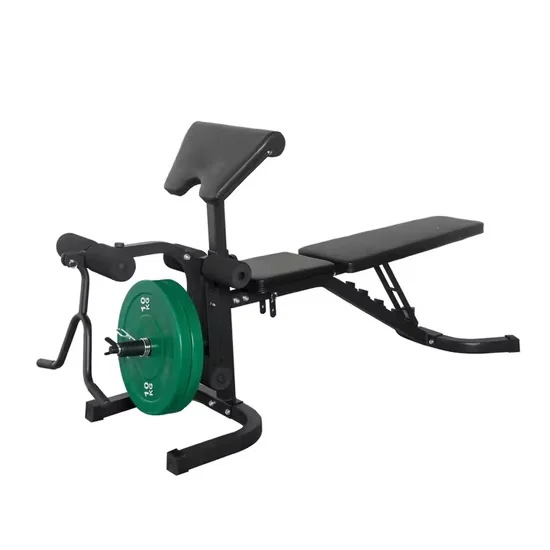
| Product Type | Adjustable Weight Bench with Leg Extension |
| Max User Weight | 150 kg–200 kg |
| Frame Material | Steel |
| Foldable | No |
| Product Dimensions | 185 × 122 × 66 cm |
| Net Weight | 28.5 kg |
| Speed Control | Fixed |
| Customization | Available (logo, color) |
| Certification | CE, RoHS, ISO 9001 |
Application Suitability
| Deployment Scenario | Typical Use |
|---|---|
| Hotel fitness center on guest room floors | Low-vibration strength training that avoids noise complaints from adjacent rooms |
| Chain gym cardio zone | Supplemental strength station complementing treadmill and elliptical rows |
| Corporate wellness room | Durable bench for midday circuit sessions under continuous shared use |
| High-end residential home gym | Stable, quiet platform for barbell and dumbbell routines without floor resonance |
| Sports performance training center | Heavy-load compound lifts and isolated leg extension work for athletic conditioning |
Why a Wobbling Bench Drives Members Away Faster Than Worn-Out Treadmill Belts
A frame that shifts under load destroys user confidence before any maintenance ticket gets filed.
I have walked into commercial gyms where the bench station was the most avoided corner on the floor. Not because the upholstery was torn or the pad cracked — because the frame wobbled during a 100 kg bench press, and the user felt it through their spine. That subtle lateral play compounds every rep, turning a compound lift into a balance exercise. Members stop booking the station, then stop renewing. The root cause is almost always undersized steel tubing or weld seams that were never stress-relieved after fabrication. With the adjustable weight bench with leg extension home gym operators are searching for, the steel frame addresses this directly by maintaining rigidity across the full bearing range [NEED_CITE: EN 957 requirements for commercial strength equipment static load testing].
Where This Bench Sits in a Mixed Cardio-and-Strength Floor Plan
The AB-1700 covers flat, incline, and decline pressing along with isolated leg extension and curl work, filling the gap between free-weight racks and single-station cable machines. In a cardio-heavy facility where treadmills and ellipticals dominate the floor, this bench provides a compact strength anchor that members use for 15-to-20-minute accessory circuits between aerobic sessions. Its fixed footprint suits deployment against walls or between upright racks where traffic flow is linear. The 150 kg to 200 kg bearing range accommodates most adult body types plus external load, making it practical for unisex commercial use without weight-tier restrictions. One adjustable weight bench with leg extension home gym deployment typically pairs with a half-rack and one cable crossover to form a three-station micro-zone.
Vibration Transfer and Upper-Floor Deployment Constraints
A 28.5 kg steel bench planted on a commercial rubber mat transfers far less low-frequency vibration than a motorized cardio unit, which matters when the equipment sits above occupied hotel rooms or office floors. The non-foldable design eliminates the hinge-play that causes rattling during plate changes, keeping structure-borne noise to near-zero during normal operation. No dedicated electrical circuit is required since the AB-1700 has no motor or console, simplifying deployment in retrofit spaces where pulling new wiring is cost-prohibitive. Ground leveling still matters — an uneven floor amplifies wobble through the four contact points, so shimming or a self-leveling compound is recommended before installation. For facilities running group circuits back-to-back, the bench tolerates continuous use without cool-down intervals because there are no thermal components to manage [NEED_CITE: vibration isolation standards for fitness equipment on suspended floors].
Reading the Steel Gauge and Load Rating Without Getting Misled
The max bearing of 150 kg to 200 kg represents the combined user-plus-external-load limit, which is the figure that matters for barbell work. A bench rated only to body weight will fail the moment a lifter adds plates. The non-foldable frame trades portability for structural continuity — every welded joint carries load without a hinge interrupting the force path. This is the same principle that makes commercial cardio frames heavier than residential ones: continuous load paths resist fatigue cracking over thousands of cycles. The fixed speed control on the leg extension attachment means resistance is set by plate loading, which provides a linear, predictable curve that does not drift with temperature or wear the way elastic bands do. For procurement teams comparing bids, verify that the stated bearing capacity is backed by a static load test record rather than a calculated estimate.
What Happens When Bench Specs Are Optimistic on Paper and Honest on the Floor
I have seen lightweight benches with thin-gauge tubing pass a one-time static load test in the factory, then develop hairline cracks at the upright weld after six months of daily commercial use. The failure is rarely catastrophic — it is a slow migration of play that members notice before inspectors do. Undersized bearing pins in the leg extension pivot wear into oval holes, creating a knocking sound that gets louder each week until the entire pivot assembly needs replacement. Data from warranty claims across the industry shows that strength equipment failures cluster around moving joints and connection points, not the main frame members [NEED_CITE: commercial gym equipment failure mode distribution]. Specifying a bench with documented durability testing and accessible spare parts reduces unplanned downtime that pushes members toward competing facilities.
Why This Product Line Holds Up Under Commercial Uptime
The AB-1700 sits within a full cardio and strength family, so a facility sourcing treadmills, ellipticals, and rowers from one line can add bench stations without juggling multiple vendor relationships. The 10,000-hour durability testing protocol applied to motorized units in this range also informs the frame fatigue standards used here — welded joints undergo cyclic loading that simulates years of plate changes and user transitions. Sub-35 dB operation verified on the cardio side translates to this bench as near-silent structural behavior: no squeaking pivots, no rattling uprights during heavy sets. OEM customization covers logo placement and frame color, letting hotel gyms and corporate wellness rooms match their interior specification without aftermarket painting. The free 3D layout service includes bench placement within the cardio zone plan, accounting for safety clearances around the 185 × 122 × 66 cm footprint so members can load plates without colliding with adjacent equipment.
Documentation & Test Records
- CE declaration of conformity covering the full AB-1700 assembly
- EN 957 test report for static and cyclic load performance
- ISO 9001 certificate for the manufacturing management system
- RoHS compliance statement for all surface treatments and hardware
- Durability test record documenting cyclic frame loading cycles
- Spare parts list with exploded assembly diagram
Installation, Commissioning & Maintenance
- Maintain minimum 60 cm clearance on all sides of the 185 × 122 × 66 cm footprint for safe plate loading
- Level the floor contact points with shims before bolting optional floor anchors
- Inspect leg extension pivot pins quarterly for oval wear and replace per the spare parts list
- Wipe upholstery and steel surfaces after each use to prevent sweat corrosion on weld seams
- Torque-check all structural fasteners at 90-day intervals under high-frequency commercial use
- Verify pad integrity and replace cracked vinyl covers before moisture reaches the foam core
What to Share When Requesting a Quotation
Provide the room dimensions and ceiling height of the intended deployment area so we can generate a 3D layout showing bench placement relative to cardio rows and rack stations. Specify the expected daily user volume to confirm the bearing rating matches your membership profile. State the target market and any applicable import standards so the correct CE or regional documentation ships with the container. Indicate whether logo customization or frame color matching is needed, and request matching finishes across other units in the same shipment for visual consistency.
Frequently Asked Questions
Q: What materials are used in the construction of the AB-1700?
A: The frame is fabricated from structural-grade steel with welded joints, providing a rigid load path that resists lateral flex under heavy compound lifts. Pad upholstery covers high-density foam rated for repeated compression cycles. All hardware uses corrosion-resistant finishes suitable for humid gym environments. Material certificates are available on request for project-specification submissions.
Q: How does the non-foldable design benefit the user?
A: Eliminating the folding hinge removes the single most common source of frame play in portable benches. Every welded connection carries load continuously, which means no squeaking pivot and no mid-set wobble during pressing movements. The trade-off is a permanent footprint of 185 × 122 × 66 cm, which suits dedicated rooms rather than shared multi-purpose spaces that require daily equipment stowing.
Q: Can the AB-1700 be customized with a company logo?
A: Yes. Logo placement is available on the frame uprights or pad vinyl, and frame color can be matched to an interior specification palette. Customization details including placement coordinates, print method, and color codes are confirmed during the OEM scoping stage before production begins. Minimum order quantities for custom runs are flexible and quoted per project.
Q: What is the warranty period for the AB-1700?
A: Warranty terms are structured around the frame, moving parts, and upholstery as separate categories, reflecting their different wear profiles. The steel frame carries the longest coverage given its static-load design, while pivot pins and pad covers are classified as consumable components. Full warranty documentation and spare parts availability are provided with the proforma invoice before deposit confirmation.
Q: How does the max bearing capacity compare to other benches on the market?
A: The 150 kg to 200 kg rating covers user body weight plus external barbell or dumbbell load, placing it in the commercial-duty bracket rather than the residential tier. Most light-commercial benches cap at 150 kg total, which limits their use in facilities where heavier members train with substantial added load. Always request the static load test record to verify the stated rating independently.