
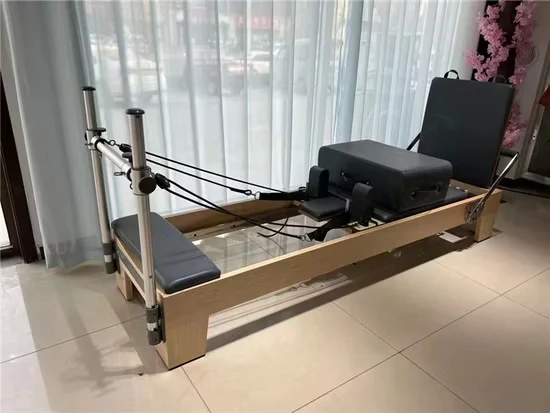
Solid Wood Frame Rigidity — Reinforced carriage rail and sealed bearing system maintain alignment and smooth glide under continuous studio deployment.
Technical Specifications
| Parameter | Value |
|---|---|
| Designation | SRY-02 |
| Product Type | Pilates Reformer |
| Frame Material | Solid Wood |
| Accessory | Long Box / Jump Board / Platform |
| Product Dimensions | 2460730680mm |
| Net Weight | 100kgs |
| Color | Solid Color (customizable) |
| Logo | Customized Is Allowed |
| Gender | Unisex |
| Age Group | Adult |
| Certification | CE |
| Warranty | 3 Years |
Application Suitability
| Deployment Scenario | Typical Use |
|---|---|
| Boutique Pilates studio | Group reformer classes with high-frequency daily scheduling |
| Hotel wellness floor | Guest-accessible Pilates sessions in noise-sensitive environments |
| Corporate wellness center | Employee fitness programming with supervised reformer circuits |
| High-end residential home gym | Private Pilates practice with full accessory versatility |
| Rehabilitation and physiotherapy clinic | Controlled movement therapy with predictable spring resistance |
Why Rail Wear Reaches the Studio Owner Before the Warranty Does
Carriage glide consistency depends on frame stability and bearing integrity under repeated load cycles.
Boutique studios running back-to-back group classes place sustained lateral and longitudinal forces on reformer carriages. Consumer-grade frames built from laminated particle board begin to warp within months, throwing rail alignment off and producing uneven glide that clients feel immediately [NEED_CITE: frame material fatigue under continuous commercial reformer use]. I have seen hotel wellness floors replace entire reformer fleets because the carriage started catching mid-slide during peak sessions. A solid wood frame with reinforced internal structure resists this deformation pattern and keeps the rail plane true through years of daily scheduling.
Reformer Positioning Within a Mixed-Modality Studio Layout
The SRY-02 commercial Pilates reformer wood frame supports the full spectrum of classical and contemporary reformer programming, from supine footwork sequences to standing platform work with the jump board. In a studio layout, it pairs naturally with mat zones and tower units, creating a circuit that moves practitioners through prone, seated, and standing movement patterns without equipment changes. Its footprint accommodates high-density class configurations while leaving sufficient clearance for instructor circulation. The progressive spring resistance system suits practitioners across a wide range of body types and training histories, and the solid color finish integrates into varied interior design schemes.
Continuous Scheduling and the Noise-Sensitive Environments That Demand It
Studios operating six or more group classes per day need equipment that performs without audible friction buildup across consecutive sessions. The sealed bearing carriage system on this reformer minimizes maintenance intervals that would otherwise pull units off the floor during business hours [NEED_CITE: bearing maintenance frequency in high-traffic Pilates studios]. For hotel wellness floors and shared residential facilities, the solid wood construction dampens vibration transfer to adjacent rooms, avoiding the low-frequency resonance complaints that plague metal-frame alternatives. Ground-level deployment requires standard floor leveling; upper-floor installations benefit from anti-vibration pads beneath the frame feet.
What the Rail, Spring, and Bearing Specs Actually Tell You
Solid wood frames outperform laminated alternatives in rail alignment retention because the grain structure distributes carriage load along continuous fibers rather than across bonded layers prone to delamination. The sealed bearing carriage system eliminates the need for periodic lubrication that open-bearing designs require, reducing scheduled downtime. Progressive-tension springs deliver a resistance curve that increases linearly with extension, giving practitioners predictable load feedback during slow eccentric phases — unlike rope-based systems where friction at the pulley introduces hysteresis. The included long box, jump board, and platform expand the exercise library without requiring separate equipment purchases, and each accessory locks into standardized mounting points on the carriage and frame.
The Hidden Cost of Specifying Below Commercial Grade
Studios that purchase consumer-grade reformers for commercial scheduling typically encounter carriage rail wear and spring fatigue within the first year, leading to client complaints about uneven resistance and audible grinding during transitions [NEED_CITE: consumer-grade equipment failure timeline in commercial studio environments]. Warped frames cannot be corrected through adjustment and require full unit replacement. In hotel deployments, noise transmission through metal frames triggers guest complaints that force management to remove equipment from upper floors entirely. Data from high-frequency studios shows that member retention drops when practitioners encounter inconsistent carriage glide, as the unpredictability undermines confidence during advanced repertoire.
Why This Product Line Fits Studio Procurement
Biketon Sport engineers every cardio and wellness unit around verified acoustic performance, and this reformer continues that discipline with a wood frame and sealed bearing system that produce minimal operational noise. Components undergo durability testing protocols aligned with continuous studio scheduling demands. The OEM program covers logo placement, color selection, and branding integration so the reformer matches studio identity without aftermarket modification. Free 3D floor planning addresses reformer spacing, instructor sightlines, and ventilation flow across the entire wellness zone. Documentation packages ship with every unit, and technical support responds around the clock for commissioning questions or field adjustments.
Documentation & Test Records
- CE declaration of conformity for commercial Pilates reformer classification
- Frame load-bearing test report verifying solid wood structural capacity
- Carriage rail glide smoothness and sealed bearing durability record
- Spring tension range and progressive fatigue resistance data sheet
- OEM customization scope document covering logo, color, and branding
- Installation and commissioning guide with accessory mounting instructions
Installation, Commissioning & Maintenance
- Maintain minimum 900mm clearance on all sides of the 2460mm frame for instructor access
- Level the solid wood frame on anti-vibration pads for upper-floor hotel wellness deployments
- Verify spring anchor points and carriage alignment during initial commissioning before client use
- Inspect sealed bearing glide and rail surface quarterly under high-frequency studio scheduling
- Wipe down solid color wood surfaces with non-corrosive cleaner after each session to prevent sweat damage
- Confirm long box, jump board, and platform mounting hardware tightness during weekly maintenance rounds
Specifying the Right Configuration for Your Facility
Provide your wellness zone square footage and planned reformer count to receive a 3D layout covering unit spacing, instructor sightlines, and airflow planning. Specify whether deployment targets a dedicated Pilates studio, hotel wellness floor, or mixed-use corporate fitness room so the floor plan accounts for adjacent noise-sensitive spaces. Confirm target market voltage standards if any powered accessories are planned. Indicate whether OEM branding customization — logo placement, frame color, or accessory finish — is required for your studio identity.
Frequently Asked Questions
Q: How does solid wood compare to engineered wood for reformer frame longevity?
A: Solid wood maintains rail alignment under continuous daily loading because its continuous grain structure distributes force without delamination risk. Engineered wood frames rely on bonded layers that can separate under sustained lateral carriage forces, leading to uneven glide. For studios running multiple group classes per day, solid wood frames retain structural integrity across a significantly longer service life, reducing replacement frequency and associated floor downtime.
Q: What role does carriage rail design play in glide smoothness and maintenance?
A: Sealed bearing carriage systems eliminate the need for periodic lubrication that open-bearing designs require, keeping units available for scheduling without maintenance interruptions. Precision-machined rails paired with sealed bearings deliver consistent glide across the full carriage travel range. In high-traffic studios, this combination reduces both scheduled maintenance windows and unscheduled service calls caused by bearing contamination or lubrication degradation.
Q: Should a commercial studio choose spring resistance or rope resistance?
A: Spring resistance delivers a progressive tension curve that increases predictably with extension, giving practitioners reliable load feedback during controlled eccentric phases common in reformer repertoire. Rope-based systems introduce pulley friction that creates hysteresis and uneven resistance sensation. For commercial studios teaching classical and contemporary programming across varied skill levels, spring systems provide the consistent, linear resistance profile that instructors depend on for class cueing.
Q: Which accessories are included and do they fit other reformer models?
A: The SRY-02 ships with a long box, jump board, and platform, each engineered for standardized mounting points on this frame. Accessory compatibility across different reformer models depends on carriage width, rail height, and mounting geometry, which vary between manufacturers. Confirming accessory fit before ordering additional units ensures consistent class programming without adapter modifications or mounting hardware substitutions.
Q: What customization options are available for studio branding?
A: OEM customization covers logo placement on the frame, solid color selection for wood finish, and branding integration on visible surfaces. Studios can align the reformer aesthetic with interior design schemes or corporate identity guidelines without aftermarket painting or decal application. Customization scope is confirmed during the specification phase, with samples provided for color and finish approval before production begins.


