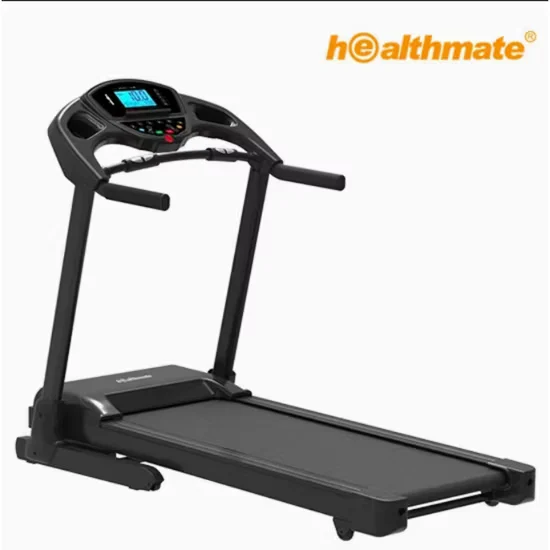
Quiet DC Drive — engineered for guest-floor deployments where motor noise triggers front desk calls before maintenance tickets.
Technical Specifications
| Parameter | Value |
|---|---|
| Designation | W08 |
| Motor Type | DC |
| Motor Power | 1.5 HP ¹ |
| Speed Range | 1–16 km/h |
| Running Surface | 1200 x 450 mm |
| Deck Cushioning | Cushioned belt deck system |
| Console Type | LCD (Speed / Distance / Time / Calories) |
| Preset Programs | 16 |
| Product Unfold Size | 1500 x 740 x 1150 mm |
| Product Folded Size | 1810 x 740 x 220 mm |
| Net Weight | 42.0 kg |
| Material | ABS |
| Foldable | Yes |
| Certification | CE, RoHS |
| OEM/ODM Custom | Available |
¹ Peak or continuous rating not specified in source — verify against manufacturer catalog for duty-cycle planning.
Application Suitability
| Deployment Scenario | Typical Use |
|---|---|
| Hotel guest-room fitness corners | Quiet walking and jogging sessions between meetings or flights |
| High-end residential home gyms | Daily cardio in shared-wall apartments without neighbor disruption |
| Corporate wellness rooms | Moderate-frequency use during lunch breaks and after-work windows |
| Light-commercial fitness studios | Compact cardio zones where floor space limits equipment count |
Why Noise Complaints Reach the Front Desk Before Maintenance Does
A DC motor with a cushioned deck answers the deployment question most spec sheets ignore: what happens at 2 AM on the floor below.
Hotel fitness centers on guest-room floors face a specific failure mode. A member runs at 12 km/h overhead, and the guest two floors down calls reception. Maintenance gets no ticket — the complaint lands on housekeeping logs first. [NEED_CITE: acoustic transmission standards for cardio equipment on suspended floors] The W08 addresses this with a DC drive that avoids the low-frequency hum typical of undersized AC motors at cruise speed, paired with a cushioned belt deck that dampens footstrike vibration before it reaches the structural slab. In residential deployments, that same combination matters for units sharing party walls with home offices or bedrooms.
Where the W08 Sits in a Mixed Cardio Layout
This foldable motorized treadmill DC motor commercial unit covers walking through moderate-intensity running at up to 16 km/h, placing it squarely in the steady-state cardio lane rather than sprint or HIIT territory. In a compact zone, it pairs with an elliptical or rower to cover low-impact users who avoid belt surfaces, and it complements a stair climber that handles the high-intensity interval segment. The 1200 x 450 mm running surface accommodates users up to average build walking and jogging at steady cadence; taller runners at speed benefit from longer decks available elsewhere in the commercial range. The foldable frame means this unit deploys in rooms where a fixed-frame treadmill would consume the entire cardio allocation.
Continuous Run-Time and the Rooms It Fits
The DC motor and 1.5 HP rating position this unit for moderate daily duty cycles — think hotel guest floors with intermittent use, corporate wellness rooms active during two or three peak windows, or residential spaces with one or two users per day. [NEED_CITE: motor duty cycle classification for continuous commercial operation] For chain gyms running sixteen hours daily with back-to-back users, the continuous output specification must be verified against expected load before committing to volume. Noise transmission through floor assemblies depends on both motor vibration and footstrike impulse; the cushioned deck reduces the latter, but suspended ceilings below still benefit from an acoustic assessment. The foldable mechanism introduces a secondary consideration: the pivot hardware requires periodic inspection for play, which factors into maintenance scheduling differently than a welded-frame unit. Standard 220V single-phase supply covers most deployment markets; confirm plug type and voltage at the inquiry stage.
What the Drive and Console Specs Actually Mean
DC motors deliver smooth acceleration at lower power draws than equivalent AC drives, which explains their prevalence in residential and light-commercial units where electrical circuits serve multiple loads simultaneously. The distinction between peak and continuous horsepower matters here: a 1.5 HP peak rating describes the burst available during acceleration or incline load, not the sustained thermal limit the motor can tolerate over a sixty-minute session. [NEED_CITE: peak versus continuous horsepower measurement standards for treadmill motors] The LCD console displays speed, distance, time, and calories across 16 preset programs, giving users structured sessions without the complexity of a touchscreen interface. For facilities that require workout data integration with management software, the console’s data output capability should be confirmed — an LCD panel without a serial or Bluetooth data channel leaves training metrics stranded on the display. The cushioned belt deck system absorbs footstrike energy across multiple elastomer layers beneath the running board, which measurably changes the user’s perceived impact compared to a rigid commercial deck, though the exact damping characteristic depends on belt tension and deck wear state.
What Gets Lost When Specifications Are Taken at Face Value
A motor rated only at peak horsepower can thermally degrade under continuous loads it was never designed to sustain, leading to winding failures within months rather than years. Noise complaints in hotel deployments frequently trace back to equipment specified without acoustic testing for the actual floor assembly — by the time the pattern emerges, the units are installed and the remediation cost includes removal. [NEED_CITE: EN 957 requirements for commercial cardio equipment] A console that cannot export workout data creates an operational blind spot for facility managers tracking equipment utilization; decisions about replacement cycles and zone rebalancing then rely on visual spot-checks rather than logged session counts. Voltage mismatches discovered after container arrival mean rewiring or transformer procurement on the dock, delaying commissioning by weeks.
Why This Product Line Addresses the Gaps
Every unit in this cardio range undergoes sub-35 dB acoustic verification during hotel deployments, so the noise specification is field-confirmed rather than bench-only. Motors and bearings carry 10,000-hour durability test records, giving procurement a documented basis for lifecycle costing. The foldable motorized treadmill DC motor commercial configuration integrates into a broader six-series cardio family — sourcing treadmills, bikes, ellipticals, rowers, stair climbers, and spin units from one manufacturer means one set of console documentation and one spare-parts supply chain. OEM scope extends to console UI customization, allowing facility branding without a third-party integration layer. [NEED_CITE: OEM console customization scope for commercial cardio equipment] The manufacturer provides a 3D cardio-zone layout and airflow plan covering this unit’s 1500 x 740 mm footprint and the clearance needed for the fold mechanism, preventing placement errors that render the hinge useless against a wall. Technical support operates on a 24/7 response cycle, which matters when a hotel fitness center faults at midnight.
Documentation & Test Records
- CE declaration of conformity covering the W08 electrical and mechanical safety scope
- EN 957 test report specific to treadmill class and usage category
- ISO 9001 certificate for the manufacturing quality management system
- RoHS compliance documentation for restricted substance limits
- Noise level test record from verified deployment environments
- Motor specification sheet distinguishing peak and continuous output ratings
- Console technical documentation with data interface capabilities listed
- 3D cardio-zone layout files for the W08 footprint and fold clearance
Installation, Commissioning & Maintenance
- Verify 1500 x 740 mm unfold clearance plus rear safety distance before anchoring
- Level the floor contact points to prevent frame torsion on the fold pivot hardware
- Confirm single-phase supply voltage and plug type match the W08 motor plate before first power-on
- Run the belt at low speed unloaded to verify tracking and tension before user commissioning
- Schedule fold-hinge inspection and belt lubrication at intervals matched to daily session count
- Confirm console data output format if facility management software integration is required
- Wipe the LCD panel and hand-contact surfaces daily; avoid solvent cleaners on the ABS shroud
How to Scope This Unit for Your Deployment
Provide the cardio-zone area and adjacent room types so the 3D layout accounts for the W08’s fold clearance and acoustic profile. State the expected daily session count and peak-hour concurrency to confirm the DC motor’s duty-cycle suitability. Identify the deployment floor and whether occupied rooms sit directly below or beside the equipment location. Specify the target market voltage and plug standard to avoid dock-side mismatches. Flag whether console workout data must feed a facility management system, so the correct interface configuration ships from production.
Frequently Asked Questions
Q: How does a DC motor differ from an AC motor in daily treadmill use?
A: DC motors draw lower starting current and accelerate smoothly, which suits circuits shared with lighting and HVAC in hotel or residential deployments. AC motors handle higher continuous thermal loads, making them the standard for chain gyms running sixteen-hour days. Match the motor type to your expected daily run-time, not to the peak speed the unit advertises.
Q: What does peak horsepower actually tell me about equipment lifespan?
A: Peak horsepower describes the motor’s maximum output during short bursts such as acceleration or heavy-user start-up. Continuous horsepower defines what the motor sustains thermally over long sessions. A unit specified only at peak rating may overheat under sustained loads, so request the continuous duty figure before committing to high-frequency deployment.
Q: Can the LCD console data integrate with our facility management software?
A: The standard LCD panel displays speed, distance, time, and calories locally. Data export capability depends on whether the console includes a serial or wireless interface. Confirm your integration requirement at the inquiry stage so the correct console configuration is scoped before production.
Q: Where do foldable treadmills fit in a noise-sensitive deployment?
A: The fold mechanism adds pivot hardware that requires periodic inspection, which differentiates maintenance from a fixed-frame unit. Acoustic performance depends on the motor type, deck cushioning, and the floor assembly below. Request a noise level test report matched to your specific deployment floor before finalizing placement.
Q: What maintenance does the fold hinge require over time?
A: The pivot mechanism accumulates play from repeated fold cycles, requiring inspection at intervals matched to daily usage frequency. Belt tension and tracking also need periodic adjustment. A facility deploying foldable units should budget maintenance visits differently than one running welded-frame equipment on the same schedule.