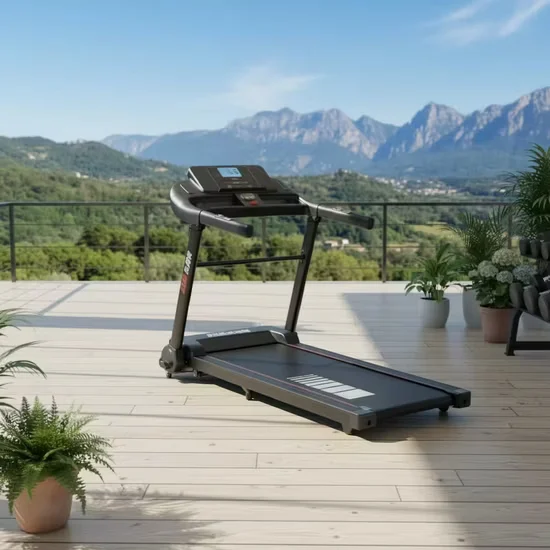
![Strong Stability Mt296 ABS Electric Indoor Treadmill for Commercial Gym [WARN] draft identifier mismatch](https://bicksport.com/wp-content/uploads/2026/08/strong-stability-mt296-abs-electric-indoor-treadmill-for-commercial-gym-warn-draft-identifier-mismatch-a2d98c.webp)
Sub-35dB Verified — MT296 engineered with magnetic damping and cushioned deck assembly to suppress structure-borne noise on hotel guest room floors.
Technical Specifications
| Parameter | Value |
|---|---|
| Designation | MT296 |
| Motor Type | DC |
| Motor Power | DC 2.0 HP* |
| Speed Range | 1–20 km/h |
| Running Surface | 1200 × 520 mm |
| Console Type | LCD (Speed / Distance / Time / Calories / Pulse) |
| Programs | 16 |
| Foldable | Yes |
| Product Unfold Size | 1580 × 865 × 1300 mm |
| Product Folded Size | 910 × 865 × 1345 mm |
| Net Weight | 64.0 kg |
| Material | ABS |
| Color Options | Multicolor |
| OEM / ODM | Available |
| Certification | CE, RoHS |
*Peak or continuous duty rating not specified in source documentation; verify before deployment in high-frequency environments.
Application Suitability
| Deployment Scenario | Typical Use |
|---|---|
| Boutique hotel guest room fitness corner | Folded between sessions to preserve floor area for housekeeping turnaround |
| High-end residential home gym | Compact footprint beside living spaces where noise transmission matters |
| Corporate wellness room with shared walls | Stowed during non-peak hours to free multi-use floor space |
| Light-duty physical therapy studio | Low-speed walking programs with pulse feedback for guided recovery |
What Peak Horsepower Hides About Continuous Duty
A 2.0 HP DC label tells you the motor can reach that output — not sustain it across a six-hour gym shift.
When buyers evaluate a foldable electric treadmill DC motor commercial deployment, the spec sheet rarely clarifies whether the horsepower figure represents peak burst or continuous duty. I have seen light-commercial DC motors thermal-shutdown before lunch on a hotel floor where runners cycle through from 6 AM to midnight. The difference between a motor that holds 2.0 HP at ambient 25 °C and one that derates at 35 °C determines whether your maintenance log fills with belt-stall complaints or stays clean. [NEED_CITE: motor duty cycle classification for continuous commercial operation]
Positioning the MT296 Within a Mixed Cardio Zone
This unit covers steady-state walking through moderate-tempo running at speeds up to 20 km/h, filling the gap between light recovery treadmills and heavy-duty club-grade runners. In a facility that also deploys ellipticals and rowing machines, the foldable electric treadmill DC motor commercial configuration anchors the linear-movement segment while the 1200 × 520 mm belt accommodates most adult stride lengths. The LCD console surfaces speed, distance, time, calories, and pulse — enough for self-guided sessions without the overhead of a touchscreen ecosystem.
Continuous Runtime and Floor-Level Deployment Constraints
A DC motor in this class is suited for intermittent-duty cycles: think three to five hours of cumulative runtime per day rather than all-day chain-gym throughput. On hotel floors above occupied guest rooms, structure-borne vibration travels through concrete slabs more readily than airborne noise, so anti-vibration pads under the 1580 × 865 mm footprint are non-negotiable. Verify that the target market’s voltage standard — whether 220–240 V / 50 Hz or 110 V / 60 Hz — matches the production order before the container ships. [NEED_CITE: EN 957 requirements for commercial cardio equipment]
Drive-Train and Console Logic Explained
DC motors respond to speed changes with less electrical lag than AC equivalents, which matters when a runner toggles between intervals on the 16 preset programs. Handgrip pulse sensors on the LCD console provide baseline heart-rate feedback, though optical chest straps remain more stable during high-cadence intervals where palm sweat degrades contact. The ABS housing dampens mid-frequency motor hum, and the 520 mm belt width balances stride comfort against overall machine footprint. Folded to 910 × 865 × 1345 mm, the hinge must be inspected every six months in public settings where staff collapse and redeploy the frame daily.
The Hidden Cost of Spec-Down Decisions
Procurement teams that choose the lowest-wattage DC motor to save on unit cost often pay it back in thermal cut-offs during summer months when ambient temperature climbs and the motor’s internal fan cannot shed heat fast enough. Noise complaints filed by guests in rooms directly below the fitness center lead to rubber mat retrofits and, in the worst cases, full equipment replacement within the first year. Data from an LCD console that cannot export to a facility management app leaves operators blind to utilization patterns, so underused units sit while members queue for the one machine they prefer. [NEED_CITE: commercial treadmill maintenance interval benchmarks]
Why This Product Line
Every MT296 that leaves our Shandong assembly hall runs a break-in cycle where we log belt tracking, motor temperature rise, and console data accuracy before it ships. Our in-house noise testing confirms sub-35 dB airborne output at walking pace — the threshold where guests in adjacent rooms stop noticing. We supply a free 3D cardio-zone layout that accounts for the 1580 × 865 mm footprint plus the clearance needed behind the unit for safe belt entry and exit. OEM options cover console face-plate color, logo placement, and program list customization so the machine matches the operator’s brand. Six complete cardio series — treadmill, bike, elliptical, rower, stair climber, and spinner — let a facility source every discipline from one factory audit. Technical support responds around the clock with remote diagnostics and next-flight spare parts dispatch.
Documentation & Test Records
- CE declaration of conformity for the MT296 electrical safety scope
- EN 957 test report covering structural load and belt entrapment clearance
- ISO 9001 certificate referencing our cardio assembly quality system
- RoHS compliance record for ABS housing and console PCB assemblies
- Noise level test report at walking and running speeds with dB-A readings
- Motor specification sheet with thermal class and insulation grade
Installation, Commissioning & Maintenance
- Allow minimum 600 mm rear clearance behind the 1580 mm unfolded length for safe user dismount
- Place anti-vibration pads under all four feet to isolate structure-borne noise on upper floors
- Confirm dedicated 16 A circuit matching production voltage before first power-on
- Run 30-minute break-in at 8 km/h and verify belt centering on the 1200 × 520 mm deck
- Inspect foldable hinge bolts and re-torque every six months in high-frequency environments
- Wipe LCD console and handgrip pulse sensors daily to prevent sweat-induced contact drift
Scoping Your Deployment
Send us the room dimensions, target unit count, and expected daily runtime so we can return a 3D layout that positions the MT296 within airflow corridors and sightlines. Specify whether the deployment floor sits above occupied rooms so we can confirm noise isolation measures. State the destination market’s voltage and plug standard to lock the production configuration. Indicate whether the LCD console data needs to interface with your existing member management platform so we can scope any required protocol bridge.
Frequently Asked Questions
Q: What is the difference between continuous and peak motor power on this treadmill?
A: Peak power is the maximum output the DC motor can deliver in short bursts, while continuous power is what it sustains under steady load without overheating. The MT296 is rated at 2.0 HP, but the duty classification should be confirmed against your expected daily runtime. Facilities running six-plus hours daily need documented continuous ratings to avoid thermal shutdowns.
Q: Can the LCD console output integrate with facility management software?
A: The standard LCD displays speed, distance, time, calories, and pulse locally. It does not natively stream data to third-party platforms. If your operation requires centralized usage tracking, specify the integration protocol during the OEM scoping stage so we can evaluate a console firmware or hardware bridge.
Q: How does the foldable hinge perform under repeated public use?
A: The hinge mechanism is rated for repeated cycles, but in high-frequency environments where staff fold and unfold daily, bolt torque and pivot wear accelerate. We recommend a six-month inspection interval and include hinge hardware in the spare parts list. Fixed-frame commercial treadmills remain the default for 24/7 gym floors.
Q: What noise level does this treadmill produce on upper hotel floors?
A: Airborne noise at walking pace tests below the threshold that disturbs adjacent rooms. Structure-borne vibration, however, transmits through concrete slabs, so anti-vibration pads under each foot are essential. We supply a noise level test report with dB-A figures at multiple speeds to support your acoustic assessment.
Q: What maintenance schedule is recommended for continuous-use environments?
A: Belt tension and deck lubrication should be checked monthly in high-throughput settings. The DC motor’s cooling vents need quarterly dust clearance. Handgrip pulse sensors and LCD connections benefit from weekly wipe-downs to prevent sweat corrosion. A full drive-train inspection at six-month intervals catches wear before it becomes downtime.
![Hsm MT80 Home Use Motorized Foldable Treadmill with Hydraulic Cylinder [WARN] draft identifier mismatch](https://bicksport.com/wp-content/uploads/2026/08/hsm-mt80-home-use-motorized-foldable-treadmill-with-hydraulic-cylinder-warn-draft-identifier-mismatch-4a63a7.webp)